 Add to Chrome
 Add to Firefox
 Add to Edge
Generation as Auxiliary Supervision: Enhancing Visual Understanding at Zero Inference Overhead via Decoupled Embedding Prediction
Aug 12, 2026
While Multimodal Large Language Models (MLLMs) have achieved remarkable progress, visual understanding and generation are typically treated as divergent objectives. Existing unified frameworks often rely on discrete visual tokenization or diffusion objectives whose generative targets differ from the continuous representations consumed by visual understanding models, making direct transfer to enhance existing pretrained MLLMs non-trivial. In this work, we present GAS, a generation-guided training framework that reinterprets visual generation as auxiliary supervision for representation learning. Concretely, GAS adapts Next Embedding Prediction (NEP) as a cross-modal generation paradigm within a decoupled Mixture-of-Transformers (MoT) architecture. By maintaining a shared lower trunk and parallel upper layers, GAS lets generation losses enrich the shared visual pathway with finer spatial precision and stronger visual retention while shielding the upper understanding layers from direct generation gradients. To maximize this synergy, we further construct highly correlated generation tasks that demand deep cognitive grounding rather than generic synthesis alone. Across model scales and training stages, GAS improves aggregate multimodal understanding, with its most reliable gains on perception and spatial comprehension. Crucially, because the auxiliary generation branch is discarded after training, these gains incur zero inference overhead. Extensive controlled comparisons and representation-level analyses further clarify when and why generation-guided training benefits understanding, and demonstrate the feasibility of generation-guided training as a practical route to stronger multimodal understanding.

PRISM: Priority-aware Rubric Internalization via Structured Multimodal Data Synthesis
Aug 07, 2026Real-world multimodal instructions often bundle multiple requirements with unequal importance, yet most multimodal training data still reduce instruction following to answering one self-contained question. We study this gap through rubric comprehension, which casts the model not as a generator measured against rubrics but as an executor that follows them: given an image and a typed, prioritized rubric, the model must verify each rule before producing an overall judgment. To support this setting, we propose PRISM, a four-stage data synthesis framework that produces persona--task pairs, prefix-guided rule sets, quality-filtered rubrics, and structured verification traces. We further introduce PRISM-Eval, whose Loose and Strict metrics use deterministic matching against fixed labels and therefore require no inference-time judge model. With only 10K synthesized samples, PRISM lifts Qwen3-VL-4B from 9.5% to 30.1% Strict accuracy on PRISM-Eval while preserving average performance on general benchmarks, and the gains transfer to four additional open-source MLLMs across dense and MoE architectures, suggesting that structured rubric supervision is a scalable path toward multi-rule, priority-aware multimodal instruction following.
DecoupleMix: Decoupled Ratio Search and Convex Allocation for Scalable VLM Data Recipes
Jul 27, 2026While data curation for Vision Language Models (VLMs) is increasingly active, public practice for constructing pretraining mixtures remains largely heuristic: practitioners stack datasets that pass quality filters, set cross-domain ratios by intuition, and lack a principled, attributable criterion for admitting new data, while frontier recipes remain undisclosed. We formulate data construction as a systematic mixture-optimization problem and turn it into a reproducible engineering discipline by decoupling the mixture into two orthogonal sub-problems: inter-class ratios across capabilities and intra-class ratios within a category. For inter-class allocation, we use a single-variable iterative search; for intra-class composition, we apply a multidimensional, dataset-level assessment scoring Quality and Difficulty, and formulate selection as a constrained convex optimization with a diversity objective. The DecoupleMix framework delivers two critical capabilities: guiding what data to collect next and rendering dataset validation a controlled, attributable experiment. Experiments show our approach consistently surpasses heuristic baselines. Moreover, optimal ratios discovered on small-scale proxies transfer seamlessly to larger scales without retuning. Using 80B additional multimodal continue-pretraining tokens, our VLM is competitive with strong open-source models trained with substantially larger multimodal budgets.
How Do LLMs and VLMs Understand Viewpoint Rotation Without Vision? An Interpretability Study
Apr 16, 2026Over the past year, spatial intelligence has drawn increasing attention. Many prior works study it from the perspective of visual-spatial intelligence, where models have access to visuospatial information from visual inputs. However, in the absence of visual information, whether linguistic intelligence alone is sufficient to endow models with spatial intelligence, and how models perform relevant tasks with text-only inputs still remain unexplored. Therefore, in this paper, we focus on a fundamental and critical capability in spatial intelligence from a linguistic perspective: viewpoint rotation understanding (VRU). Specifically, LLMs and VLMs are asked to infer their final viewpoint and predict the corresponding observation in an environment given textual description of viewpoint rotation and observation over multiple steps. We find that both LLMs and VLMs perform poorly on our proposed dataset while human can easily achieve 100% accuracy, indicating a substantial gap between current model capabilities and the requirements of spatial intelligence. To uncover the underlying mechanisms, we conduct a layer-wise probing analysis and head-wise causal intervention. Our findings reveal that although models encode viewpoint information in the hidden states, they appear to struggle to bind the viewpoint position with corresponding observation, resulting in a hallucination in final layers. Finally, we selectively fine-tune the key attention heads identified by causal intervention to improve VRU performance. Experimental results demonstrate that such selective fine-tuning achieves improved VRU performance while avoiding catastrophic forgetting of generic abilities. Our dataset and code will be released at https://github.com/Young-Zhen/VRU_Interpret .
The Struggle Between Continuation and Refusal: A Mechanistic Analysis of the Continuation-Triggered Jailbreak in LLMs
Mar 09, 2026With the rapid advancement of large language models (LLMs), the safety of LLMs has become a critical concern. Despite significant efforts in safety alignment, current LLMs remain vulnerable to jailbreaking attacks. However, the root causes of such vulnerabilities are still poorly understood, necessitating a rigorous investigation into jailbreak mechanisms across both academic and industrial communities. In this work, we focus on a continuation-triggered jailbreak phenomenon, whereby simply relocating a continuation-triggered instruction suffix can substantially increase jailbreak success rates. To uncover the intrinsic mechanisms of this phenomenon, we conduct a comprehensive mechanistic interpretability analysis at the level of attention heads. Through causal interventions and activation scaling, we show that this jailbreak behavior primarily arises from an inherent competition between the model's intrinsic continuation drive and the safety defenses acquired through alignment training. Furthermore, we perform a detailed behavioral analysis of the identified safety-critical attention heads, revealing notable differences in the functions and behaviors of safety heads across different model architectures. These findings provide a novel mechanistic perspective for understanding and interpreting jailbreak behaviors in LLMs, offering both theoretical insights and practical implications for improving model safety.
Patch the Distribution Mismatch: RL Rewriting Agent for Stable Off-Policy SFT
Feb 11, 2026Large language models (LLMs) have made rapid progress, yet adapting them to downstream scenarios still commonly relies on supervised fine-tuning (SFT). When downstream data exhibit a substantial distribution shift from the model's prior training distribution, SFT can induce catastrophic forgetting. To narrow this gap, data rewriting has been proposed as a data-centric approach that rewrites downstream training data prior to SFT. However, existing methods typically sample rewrites from a prompt-induced conditional distribution, so the resulting targets are not necessarily aligned with the model's natural QA-style generation distribution. Moreover, reliance on fixed templates can lead to diversity collapse. To address these issues, we cast data rewriting as a policy learning problem and learn a rewriting policy that better matches the backbone's QA-style generation distribution while preserving diversity. Since distributional alignment, diversity and task consistency are automatically evaluable but difficult to optimize end-to-end with differentiable objectives, we leverage reinforcement learning to optimize the rewrite distribution under reward feedback and propose an RL-based data-rewriting agent. The agent jointly optimizes QA-style distributional alignment and diversity under a hard task-consistency gate, thereby constructing a higher-quality rewritten dataset for downstream SFT. Extensive experiments show that our method achieves downstream gains comparable to standard SFT while reducing forgetting on non-downstream benchmarks by 12.34% on average. Our code is available at https://anonymous.4open.science/r/Patch-the-Prompt-Gap-4112 .
Can LLMs See Without Pixels? Benchmarking Spatial Intelligence from Textual Descriptions
Jan 07, 2026Recent advancements in Spatial Intelligence (SI) have predominantly relied on Vision-Language Models (VLMs), yet a critical question remains: does spatial understanding originate from visual encoders or the fundamental reasoning backbone? Inspired by this question, we introduce SiT-Bench, a novel benchmark designed to evaluate the SI performance of Large Language Models (LLMs) without pixel-level input, comprises over 3,800 expert-annotated items across five primary categories and 17 subtasks, ranging from egocentric navigation and perspective transformation to fine-grained robotic manipulation. By converting single/multi-view scenes into high-fidelity, coordinate-aware textual descriptions, we challenge LLMs to perform symbolic textual reasoning rather than visual pattern matching. Evaluation results of state-of-the-art (SOTA) LLMs reveals that while models achieve proficiency in localized semantic tasks, a significant "spatial gap" remains in global consistency. Notably, we find that explicit spatial reasoning significantly boosts performance, suggesting that LLMs possess latent world-modeling potential. Our proposed dataset SiT-Bench serves as a foundational resource to foster the development of spatially-grounded LLM backbones for future VLMs and embodied agents. Our code and benchmark will be released at https://github.com/binisalegend/SiT-Bench .
Beyond Flatlands: Unlocking Spatial Intelligence by Decoupling 3D Reasoning from Numerical Regression
Nov 18, 2025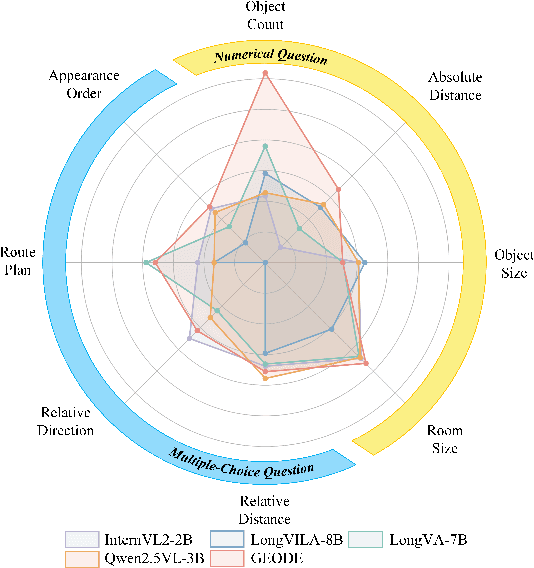
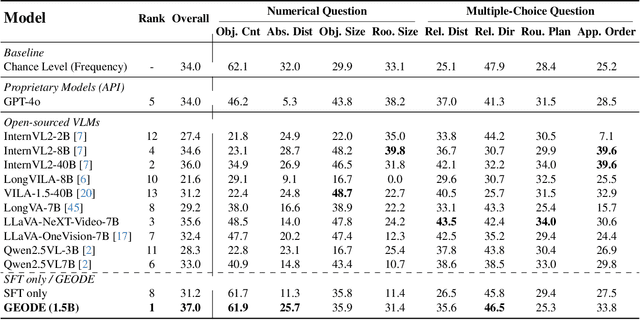
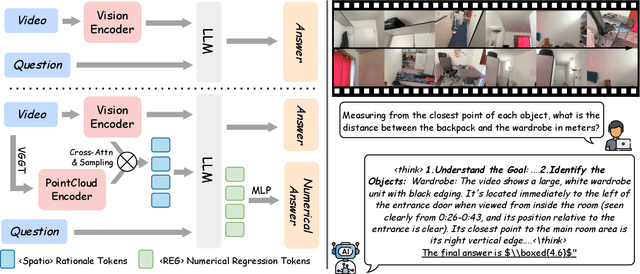
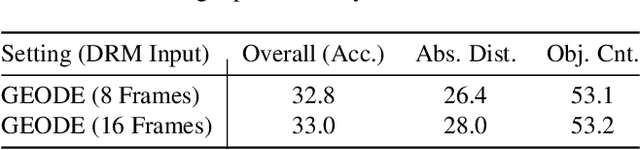
Existing Vision Language Models (VLMs) architecturally rooted in "flatland" perception, fundamentally struggle to comprehend real-world 3D spatial intelligence. This failure stems from a dual-bottleneck: input-stage conflict between computationally exorbitant geometric-aware encoders and superficial 2D-only features, and output-stage misalignment where discrete tokenizers are structurally incapable of producing precise, continuous numerical values. To break this impasse, we introduce GEODE (Geometric-Output and Decoupled-Input Engine), a novel architecture that resolves this dual-bottleneck by decoupling 3D reasoning from numerical generation. GEODE augments main VLM with two specialized, plug-and-play modules: Decoupled Rationale Module (DRM) that acts as spatial co-processor, aligning explicit 3D data with 2D visual features via cross-attention and distilling spatial Chain-of-Thought (CoT) logic into injectable Rationale Tokens; and Direct Regression Head (DRH), an "Embedding-as-Value" paradigm which routes specialized control tokens to a lightweight MLP for precise, continuous regression of scalars and 3D bounding boxes. The synergy of these modules allows our 1.5B parameter model to function as a high-level semantic dispatcher, achieving state-of-the-art spatial reasoning performance that rivals 7B+ models.
TAMMs: Temporal-Aware Multimodal Model for Satellite Image Change Understanding and Forecasting
Jun 23, 2025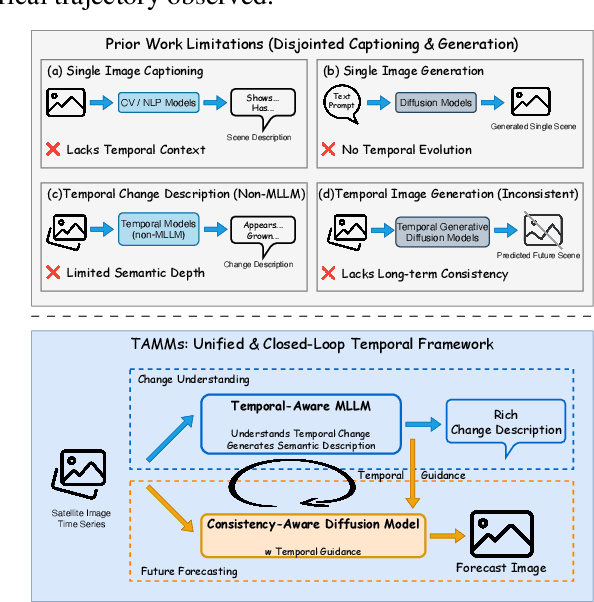
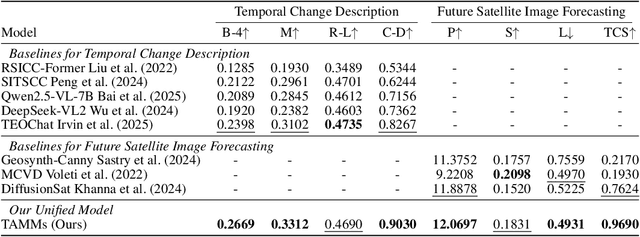
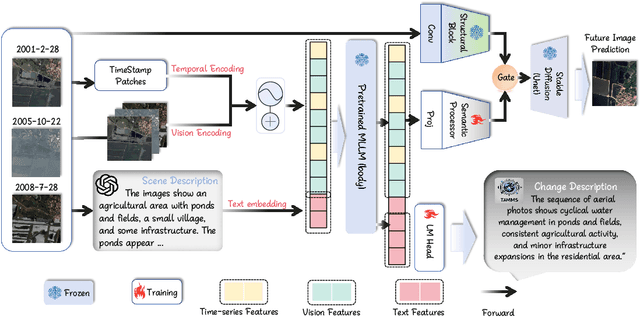
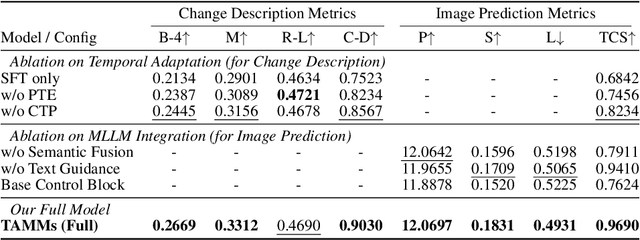
Satellite image time-series analysis demands fine-grained spatial-temporal reasoning, which remains a challenge for existing multimodal large language models (MLLMs). In this work, we study the capabilities of MLLMs on a novel task that jointly targets temporal change understanding and future scene generation, aiming to assess their potential for modeling complex multimodal dynamics over time. We propose TAMMs, a Temporal-Aware Multimodal Model for satellite image change understanding and forecasting, which enhances frozen MLLMs with lightweight temporal modules for structured sequence encoding and contextual prompting. To guide future image generation, TAMMs introduces a Semantic-Fused Control Injection (SFCI) mechanism that adaptively combines high-level semantic reasoning and structural priors within an enhanced ControlNet. This dual-path conditioning enables temporally consistent and semantically grounded image synthesis. Experiments demonstrate that TAMMs outperforms strong MLLM baselines in both temporal change understanding and future image forecasting tasks, highlighting how carefully designed temporal reasoning and semantic fusion can unlock the full potential of MLLMs for spatio-temporal understanding.