 Add to Chrome
 Add to Firefox
 Add to Edge
CIGTSurv: Clinical Information Guided Tri-modal Survival Prediction with Local Prototype Association and Global Feature Alignment
Aug 04, 2026
Multimodal learning has significantly advanced survival prediction by integrating pathology images with genomic data. However, clinical information, despite its critical role in reflecting a patient' s overall health, remains underutilized due to its discrete, sparse, and low-dimensional nature. Furthermore, the inherent heterogeneity across these modalities pose significant challenges in modeling cross-modal interactions. In this paper, we propose CIGTSurv, a Clinical Information Guided Tri-modal framework for Survival prediction. Specifically, we first design a holistic text template and use pretrained foundation models to transform clinical tabular data into high-dimensional tokenized embeddings. Using clinical information as an anchor, we then introduce a dual-level interaction mechanism: 1) a local prototype association (LPA) module based on cross-attention to explicitly learn token-level correspondences between different modalities, and 2) a global feature alignment (GFA) loss based on Maximum Mean Discrepancy (MMD) to implicitly enhance cross-modal distribution consistency. Extensive experiments on five TCGA cancer cohorts demonstrate that CIGTSurv achieves state-of-the-art (SOTA) survival prediction performance. Our source code is publicly available at https://github.com/Daijing-ai/CIGT-Surv.git.

Video2Code: Generating Interactive Webpages from UI Videos via Action-Aware Revisit
Jun 16, 2026UI videos provide a natural input for generating interactive webpages, as they capture both webpage appearance and action-triggered state transitions. However, directly applying video-capable vision-language models to this task remains insufficient. Existing models typically rely on sparse sampling or compressed temporal representations, which may miss short action boundaries and break the state-action-state transitions needed to implement webpage behavior. We formulate UI video-to-code generation as executable state-transition recovery from interaction videos, and identify this failure mode as state-transition misalignment. We introduce Video2Code, an action-aware video-to-code approach for recovering executable UI state transitions. Rather than allocating the visual budget uniformly across the video, Video2Code first performs coarse video understanding to locate action-critical regions, then invokes a temporal clipping tool to revisit these regions at higher temporal resolution before generating HTML/CSS/JavaScript code. We instantiate Video2Code with action-aligned video-code supervision and evaluate it under both visual and functional criteria. Experiments show that Video2Code substantially strengthens the underlying open-source model for UI video-to-code generation, improving functional correctness over direct video observation, especially on dense multi-step interactions.
LongWebBench: Evaluating Structural and Functional Webpage Generation in Long-Horizon Settings
Jun 16, 2026Recent vision-language models (VLMs) have shown promising progress in generating webpages from visual inputs, yet existing evaluations mainly focus on short, single-screen, and largely static webpages. We introduce LongWebBench, a benchmark for evaluating long-horizon webpage generation from both structural and functional perspectives. LongWebBench contains 490 real-world long webpages for structural fidelity evaluation and 507 goal-oriented interaction tasks over 129 webpages for functional evaluation. It employs two complementary protocols: a multi-dimensional VLM-based metric for assessing long-range structural coherence, and a DOM-augmented agent-based pipeline for end-to-end functional verification. We further examine the automatic evaluation protocols through human agreement analysis. Experiments with state-of-the-art open-source and proprietary VLMs under single-image and multi-image settings reveal that structural fidelity degrades as webpage length increases, while visually plausible generations often fail to support executable multi-step interactions. These results highlight the need to evaluate long webpage generation beyond visual similarity, with executable interaction as a core criterion. Our code and data are available at https://github.com/zheny2751-dotcom/LongWebBench.
UI2Code^N: A Visual Language Model for Test-Time Scalable Interactive UI-to-Code Generation
Nov 14, 2025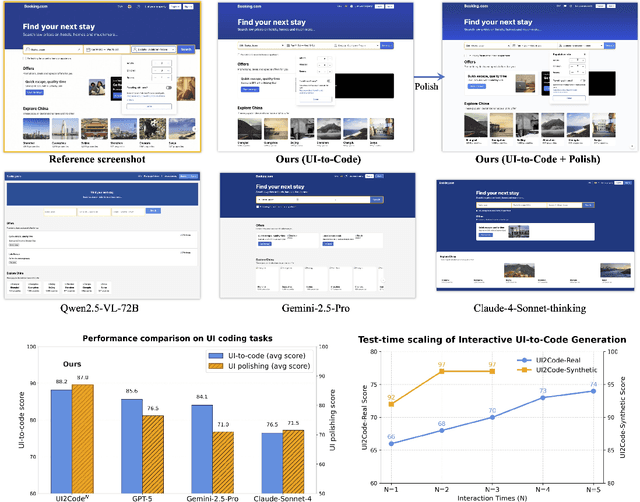
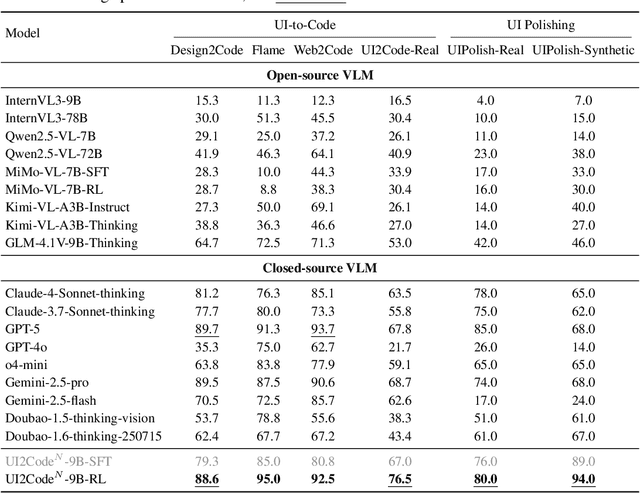
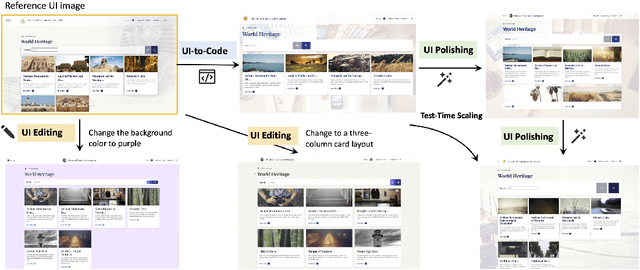

User interface (UI) programming is a core yet highly complex part of modern software development. Recent advances in visual language models (VLMs) highlight the potential of automatic UI coding, but current approaches face two key limitations: multimodal coding capabilities remain underdeveloped, and single-turn paradigms make little use of iterative visual feedback. We address these challenges with an interactive UI-to-code paradigm that better reflects real-world workflows and raises the upper bound of achievable performance. Under this paradigm, we present UI2Code$^\text{N}$, a visual language model trained through staged pretraining, fine-tuning, and reinforcement learning to achieve foundational improvements in multimodal coding. The model unifies three key capabilities: UI-to-code generation, UI editing, and UI polishing. We further explore test-time scaling for interactive generation, enabling systematic use of multi-turn feedback. Experiments on UI-to-code and UI polishing benchmarks show that UI2Code$^\text{N}$ establishes a new state of the art among open-source models and achieves performance comparable to leading closed-source models such as Claude-4-Sonnet and GPT-5. Our code and models are available at https://github.com/zai-org/UI2Code_N.
WebVIA: A Web-based Vision-Language Agentic Framework for Interactive and Verifiable UI-to-Code Generation
Nov 09, 2025User interface (UI) development requires translating design mockups into functional code, a process that remains repetitive and labor-intensive. While recent Vision-Language Models (VLMs) automate UI-to-Code generation, they generate only static HTML/CSS/JavaScript layouts lacking interactivity. To address this, we propose WebVIA, the first agentic framework for interactive UI-to-Code generation and validation. The framework comprises three components: 1) an exploration agent to capture multi-state UI screenshots; 2) a UI2Code model that generates executable interactive code; 3) a validation module that verifies the interactivity. Experiments demonstrate that WebVIA-Agent achieves more stable and accurate UI exploration than general-purpose agents (e.g., Gemini-2.5-Pro). In addition, our fine-tuned WebVIA-UI2Code models exhibit substantial improvements in generating executable and interactive HTML/CSS/JavaScript code, outperforming their base counterparts across both interactive and static UI2Code benchmarks. Our code and models are available at \href{https://zheny2751-dotcom.github.io/webvia.github.io/}{\texttt{https://webvia.github.io}}.