 Add to Chrome
 Add to Firefox
 Add to Edge
Video2Code: Generating Interactive Webpages from UI Videos via Action-Aware Revisit
Jun 16, 2026
UI videos provide a natural input for generating interactive webpages, as they capture both webpage appearance and action-triggered state transitions. However, directly applying video-capable vision-language models to this task remains insufficient. Existing models typically rely on sparse sampling or compressed temporal representations, which may miss short action boundaries and break the state-action-state transitions needed to implement webpage behavior. We formulate UI video-to-code generation as executable state-transition recovery from interaction videos, and identify this failure mode as state-transition misalignment. We introduce Video2Code, an action-aware video-to-code approach for recovering executable UI state transitions. Rather than allocating the visual budget uniformly across the video, Video2Code first performs coarse video understanding to locate action-critical regions, then invokes a temporal clipping tool to revisit these regions at higher temporal resolution before generating HTML/CSS/JavaScript code. We instantiate Video2Code with action-aligned video-code supervision and evaluate it under both visual and functional criteria. Experiments show that Video2Code substantially strengthens the underlying open-source model for UI video-to-code generation, improving functional correctness over direct video observation, especially on dense multi-step interactions.

Vision2Web: A Hierarchical Benchmark for Visual Website Development with Agent Verification
Mar 27, 2026Recent advances in large language models have improved the capabilities of coding agents, yet systematic evaluation of complex, end-to-end website development remains limited. To address this gap, we introduce Vision2Web, a hierarchical benchmark for visual website development, spanning from static UI-to-code generation, interactive multi-page frontend reproduction, to long-horizon full-stack website development. The benchmark is constructed from real-world websites and comprises a total of 193 tasks across 16 categories, with 918 prototype images and 1,255 test cases. To support flexible, thorough and reliable evaluation, we propose workflow-based agent verification paradigm based on two complementary components: a GUI agent verifier and a VLM-based judge. We evaluate multiple visual language models instantiated under different coding-agent frameworks, revealing substantial performance gaps at all task levels, with state-of-the-art models still struggling on full-stack development.
GLM-OCR Technical Report
Mar 11, 2026GLM-OCR is an efficient 0.9B-parameter compact multimodal model designed for real-world document understanding. It combines a 0.4B-parameter CogViT visual encoder with a 0.5B-parameter GLM language decoder, achieving a strong balance between computational efficiency and recognition performance. To address the inefficiency of standard autoregressive decoding in deterministic OCR tasks, GLM-OCR introduces a Multi-Token Prediction (MTP) mechanism that predicts multiple tokens per step, significantly improving decoding throughput while keeping memory overhead low through shared parameters. At the system level, a two-stage pipeline is adopted: PP-DocLayout-V3 first performs layout analysis, followed by parallel region-level recognition. Extensive evaluations on public benchmarks and industrial scenarios show that GLM-OCR achieves competitive or state-of-the-art performance in document parsing, text and formula transcription, table structure recovery, and key information extraction. Its compact architecture and structured generation make it suitable for both resource-constrained edge deployment and large-scale production systems.
UI2Code^N: A Visual Language Model for Test-Time Scalable Interactive UI-to-Code Generation
Nov 14, 2025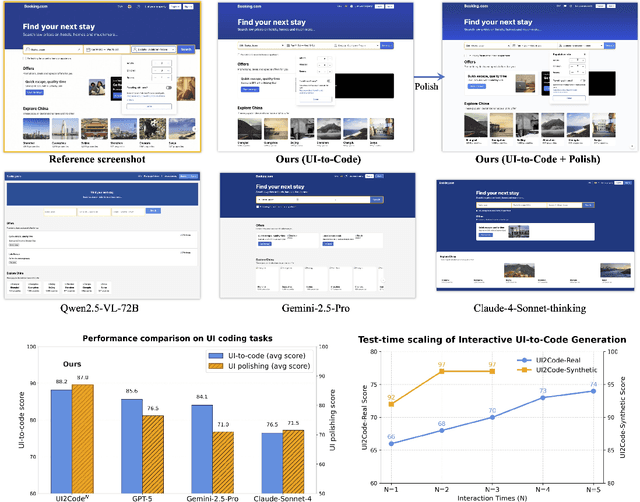
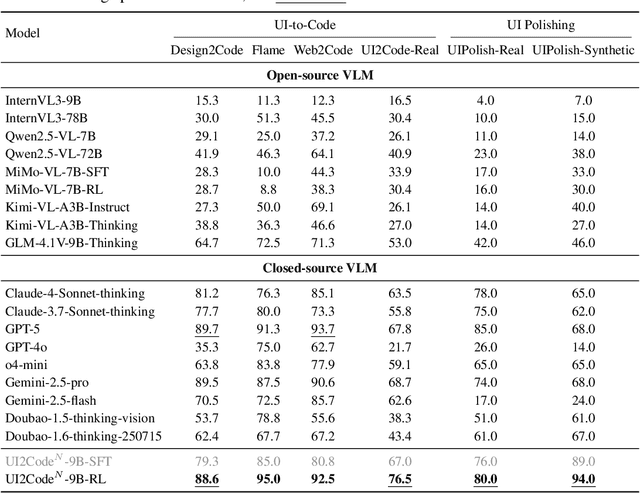
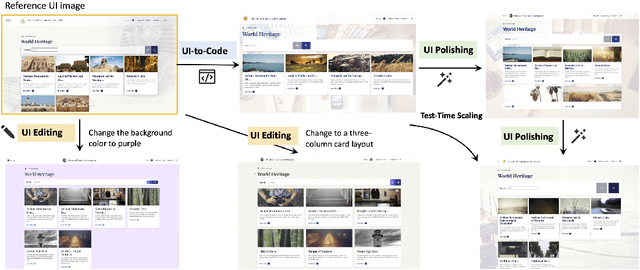

User interface (UI) programming is a core yet highly complex part of modern software development. Recent advances in visual language models (VLMs) highlight the potential of automatic UI coding, but current approaches face two key limitations: multimodal coding capabilities remain underdeveloped, and single-turn paradigms make little use of iterative visual feedback. We address these challenges with an interactive UI-to-code paradigm that better reflects real-world workflows and raises the upper bound of achievable performance. Under this paradigm, we present UI2Code$^\text{N}$, a visual language model trained through staged pretraining, fine-tuning, and reinforcement learning to achieve foundational improvements in multimodal coding. The model unifies three key capabilities: UI-to-code generation, UI editing, and UI polishing. We further explore test-time scaling for interactive generation, enabling systematic use of multi-turn feedback. Experiments on UI-to-code and UI polishing benchmarks show that UI2Code$^\text{N}$ establishes a new state of the art among open-source models and achieves performance comparable to leading closed-source models such as Claude-4-Sonnet and GPT-5. Our code and models are available at https://github.com/zai-org/UI2Code_N.
WebVIA: A Web-based Vision-Language Agentic Framework for Interactive and Verifiable UI-to-Code Generation
Nov 09, 2025User interface (UI) development requires translating design mockups into functional code, a process that remains repetitive and labor-intensive. While recent Vision-Language Models (VLMs) automate UI-to-Code generation, they generate only static HTML/CSS/JavaScript layouts lacking interactivity. To address this, we propose WebVIA, the first agentic framework for interactive UI-to-Code generation and validation. The framework comprises three components: 1) an exploration agent to capture multi-state UI screenshots; 2) a UI2Code model that generates executable interactive code; 3) a validation module that verifies the interactivity. Experiments demonstrate that WebVIA-Agent achieves more stable and accurate UI exploration than general-purpose agents (e.g., Gemini-2.5-Pro). In addition, our fine-tuned WebVIA-UI2Code models exhibit substantial improvements in generating executable and interactive HTML/CSS/JavaScript code, outperforming their base counterparts across both interactive and static UI2Code benchmarks. Our code and models are available at \href{https://zheny2751-dotcom.github.io/webvia.github.io/}{\texttt{https://webvia.github.io}}.
GLM-4.1V-Thinking: Towards Versatile Multimodal Reasoning with Scalable Reinforcement Learning
Jul 02, 2025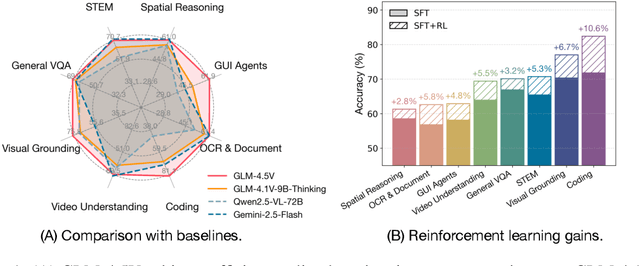
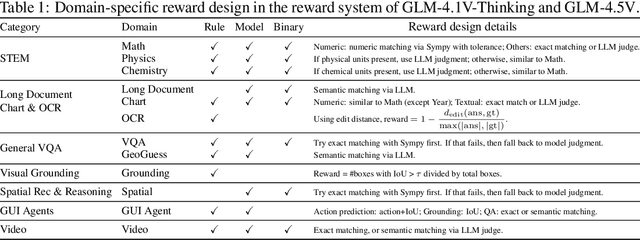
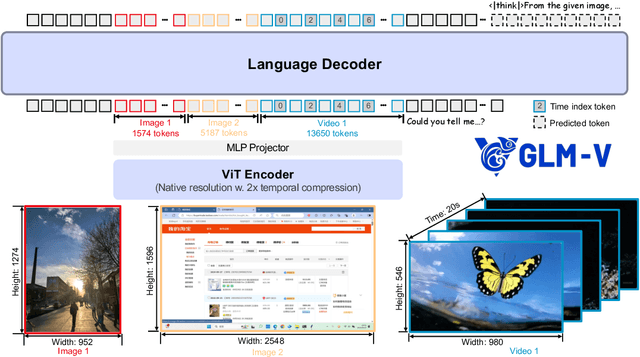
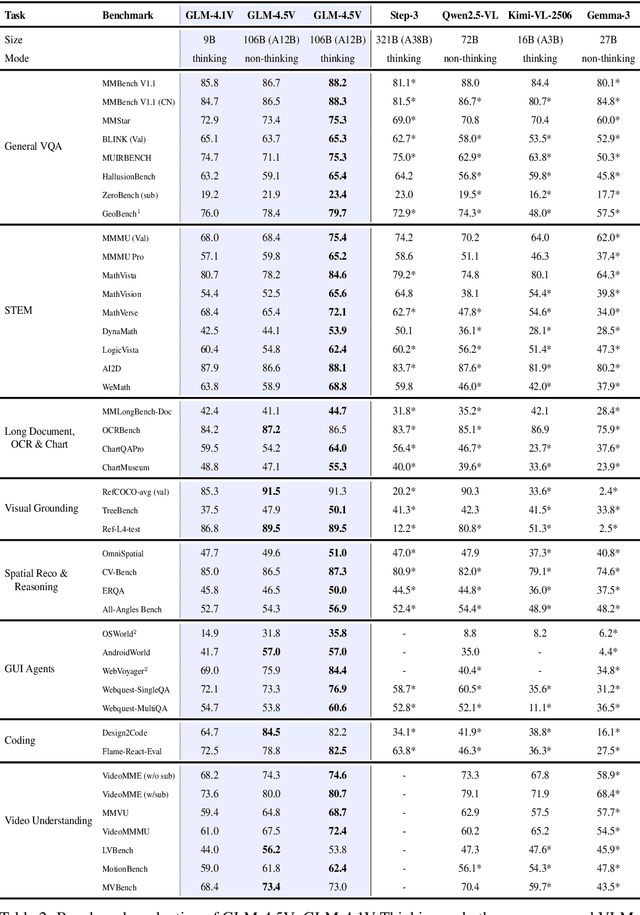
We present GLM-4.1V-Thinking, a vision-language model (VLM) designed to advance general-purpose multimodal understanding and reasoning. In this report, we share our key findings in the development of the reasoning-centric training framework. We first develop a capable vision foundation model with significant potential through large-scale pre-training, which arguably sets the upper bound for the final performance. We then propose Reinforcement Learning with Curriculum Sampling (RLCS) to unlock the full potential of the model, leading to comprehensive capability enhancement across a diverse range of tasks, including STEM problem solving, video understanding, content recognition, coding, grounding, GUI-based agents, and long document understanding. We open-source GLM-4.1V-9B-Thinking, which achieves state-of-the-art performance among models of comparable size. In a comprehensive evaluation across 28 public benchmarks, our model outperforms Qwen2.5-VL-7B on nearly all tasks and achieves comparable or even superior performance on 18 benchmarks relative to the significantly larger Qwen2.5-VL-72B. Notably, GLM-4.1V-9B-Thinking also demonstrates competitive or superior performance compared to closed-source models such as GPT-4o on challenging tasks including long document understanding and STEM reasoning, further underscoring its strong capabilities. Code, models and more information are released at https://github.com/THUDM/GLM-4.1V-Thinking.
MotionBench: Benchmarking and Improving Fine-grained Video Motion Understanding for Vision Language Models
Jan 06, 2025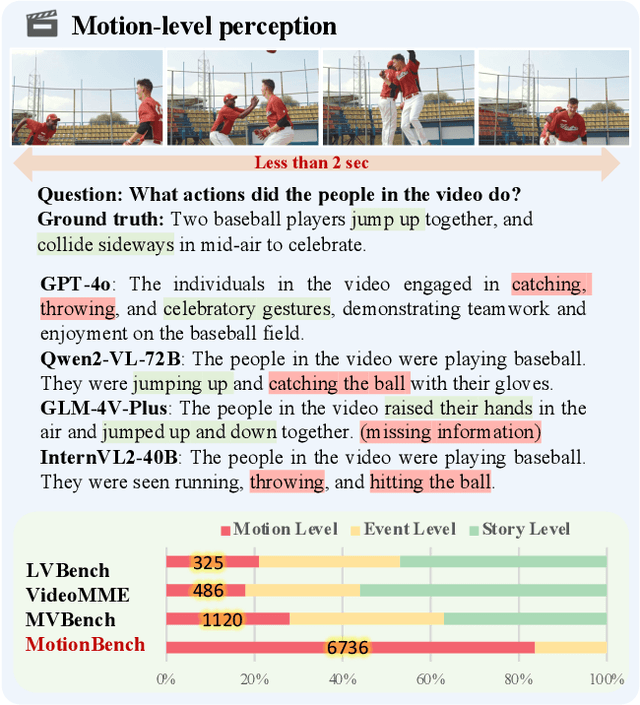
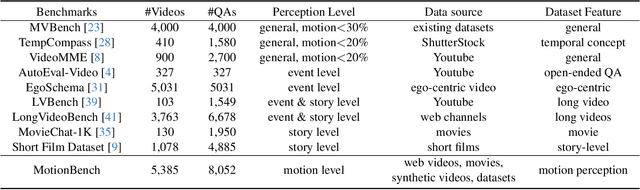
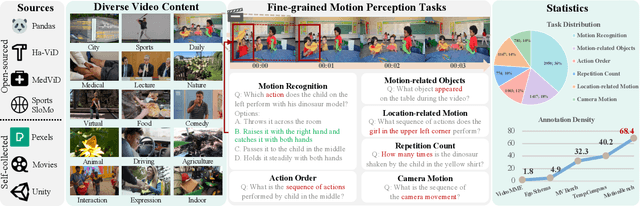
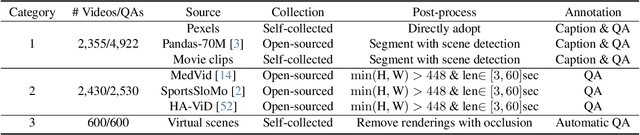
In recent years, vision language models (VLMs) have made significant advancements in video understanding. However, a crucial capability - fine-grained motion comprehension - remains under-explored in current benchmarks. To address this gap, we propose MotionBench, a comprehensive evaluation benchmark designed to assess the fine-grained motion comprehension of video understanding models. MotionBench evaluates models' motion-level perception through six primary categories of motion-oriented question types and includes data collected from diverse sources, ensuring a broad representation of real-world video content. Experimental results reveal that existing VLMs perform poorly in understanding fine-grained motions. To enhance VLM's ability to perceive fine-grained motion within a limited sequence length of LLM, we conduct extensive experiments reviewing VLM architectures optimized for video feature compression and propose a novel and efficient Through-Encoder (TE) Fusion method. Experiments show that higher frame rate inputs and TE Fusion yield improvements in motion understanding, yet there is still substantial room for enhancement. Our benchmark aims to guide and motivate the development of more capable video understanding models, emphasizing the importance of fine-grained motion comprehension. Project page: https://motion-bench.github.io .
CogVLM2: Visual Language Models for Image and Video Understanding
Aug 29, 2024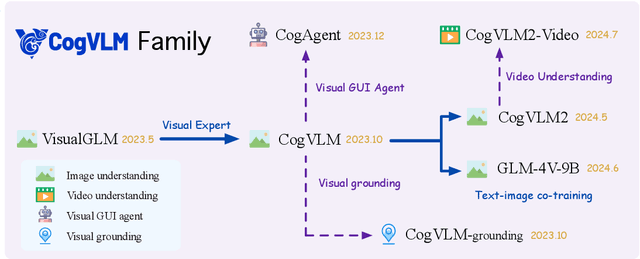


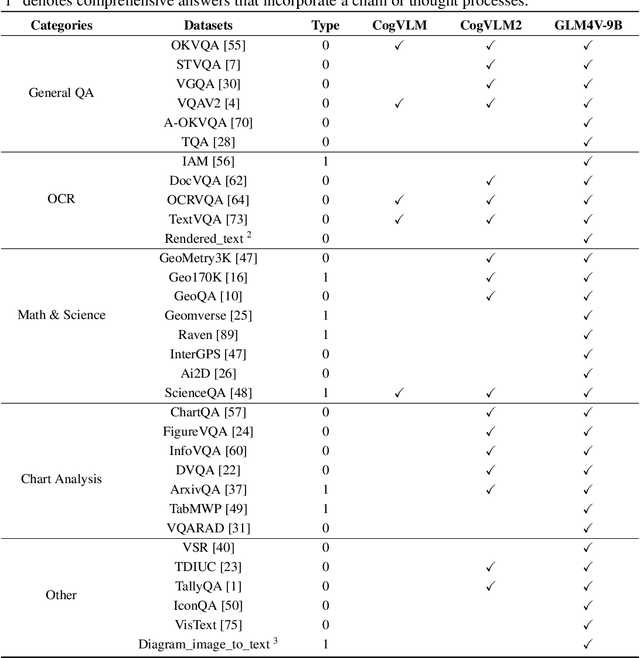
Beginning with VisualGLM and CogVLM, we are continuously exploring VLMs in pursuit of enhanced vision-language fusion, efficient higher-resolution architecture, and broader modalities and applications. Here we propose the CogVLM2 family, a new generation of visual language models for image and video understanding including CogVLM2, CogVLM2-Video and GLM-4V. As an image understanding model, CogVLM2 inherits the visual expert architecture with improved training recipes in both pre-training and post-training stages, supporting input resolution up to $1344 \times 1344$ pixels. As a video understanding model, CogVLM2-Video integrates multi-frame input with timestamps and proposes automated temporal grounding data construction. Notably, CogVLM2 family has achieved state-of-the-art results on benchmarks like MMBench, MM-Vet, TextVQA, MVBench and VCGBench. All models are open-sourced in https://github.com/THUDM/CogVLM2 and https://github.com/THUDM/GLM-4, contributing to the advancement of the field.
CogVideoX: Text-to-Video Diffusion Models with An Expert Transformer
Aug 12, 2024We introduce CogVideoX, a large-scale diffusion transformer model designed for generating videos based on text prompts. To efficently model video data, we propose to levearge a 3D Variational Autoencoder (VAE) to compress videos along both spatial and temporal dimensions. To improve the text-video alignment, we propose an expert transformer with the expert adaptive LayerNorm to facilitate the deep fusion between the two modalities. By employing a progressive training technique, CogVideoX is adept at producing coherent, long-duration videos characterized by significant motions. In addition, we develop an effective text-video data processing pipeline that includes various data preprocessing strategies and a video captioning method. It significantly helps enhance the performance of CogVideoX, improving both generation quality and semantic alignment. Results show that CogVideoX demonstrates state-of-the-art performance across both multiple machine metrics and human evaluations. The model weights of both the 3D Causal VAE and CogVideoX are publicly available at https://github.com/THUDM/CogVideo.
VisualAgentBench: Towards Large Multimodal Models as Visual Foundation Agents
Aug 12, 2024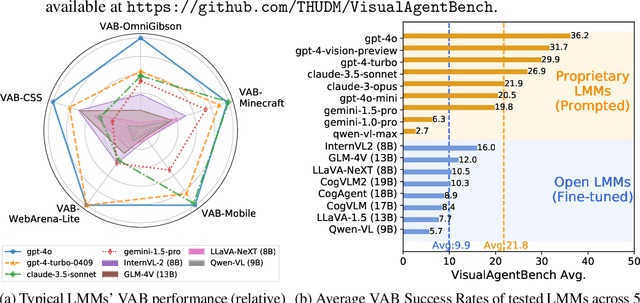
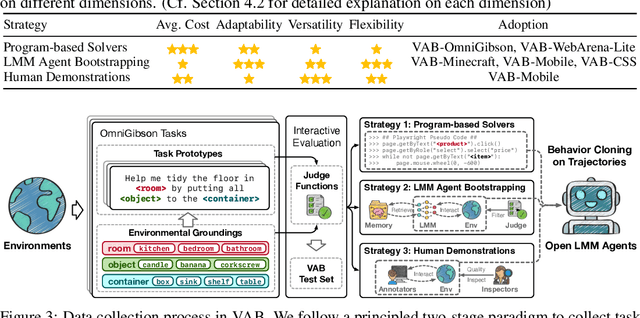
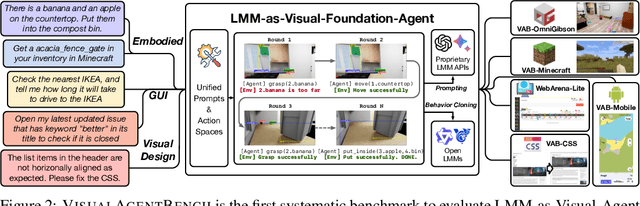
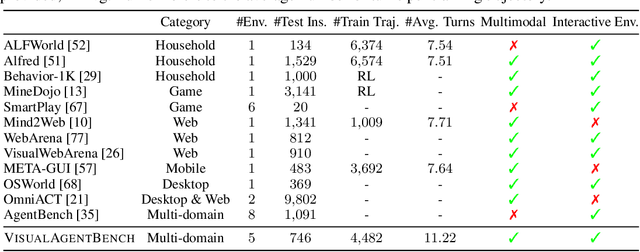
Large Multimodal Models (LMMs) have ushered in a new era in artificial intelligence, merging capabilities in both language and vision to form highly capable Visual Foundation Agents. These agents are postulated to excel across a myriad of tasks, potentially approaching general artificial intelligence. However, existing benchmarks fail to sufficiently challenge or showcase the full potential of LMMs in complex, real-world environments. To address this gap, we introduce VisualAgentBench (VAB), a comprehensive and pioneering benchmark specifically designed to train and evaluate LMMs as visual foundation agents across diverse scenarios, including Embodied, Graphical User Interface, and Visual Design, with tasks formulated to probe the depth of LMMs' understanding and interaction capabilities. Through rigorous testing across nine proprietary LMM APIs and eight open models, we demonstrate the considerable yet still developing agent capabilities of these models. Additionally, VAB constructs a trajectory training set constructed through hybrid methods including Program-based Solvers, LMM Agent Bootstrapping, and Human Demonstrations, promoting substantial performance improvements in LMMs through behavior cloning. Our work not only aims to benchmark existing models but also provides a solid foundation for future development into visual foundation agents. Code, train \& test data, and part of fine-tuned open LMMs are available at \url{https://github.com/THUDM/VisualAgentBench}.