 Add to Chrome
 Add to Firefox
 Add to Edge
LoRA-GA$^2$: Low Rank Adaptation with Multi-step Gradient Adaptive Alignment
Aug 20, 2026
Low-Rank Adaptation (LoRA) is a prominent fine-tuning method for large models, achieving competitive performance with reduced memory overhead. However, a persistent performance gap remains between LoRA and full fine-tuning. Recent studies have sought to narrow this gap by employing one-step gradient approximations of pretrained weights to align LoRA updates with the principal directions or intrinsic dimensionalities of full fine-tuning updates. Nevertheless, these approaches fail to capture the full dynamics of the gradients. In this paper, we propose LoRA-GA$^2$, an effective fine-tuning algorithm that fully leverages multi-step gradient information. Specifically, we introduce a lightweight probe for multi-step gradients of pretrained weights that incurs no additional GPU memory cost and only marginal time overhead. We further employ a spectrum-aware, importance-based rank allocation and optimal initialization derived from multi-step gradients. Extensive experimental results demonstrate that LoRA-GA$^2$ consistently outperforms existing LoRA variants while preserving the efficiency advantages of vanilla LoRA. For instance, LoRA-GA$^2$ surpasses the leading baseline by an average of 0.66 points on the GLUE benchmark, and outperforms the strongest baseline by 1.03 points on GSM8K and 0.87 points on HumanEval, respectively.

Beyond Reconstruction: Full-Context Generative DiT for Music Generation
Aug 11, 2026Hybrid music generators combine the long-range planning of an autoregressive language model with the fidelity of a diffusion- or flow-based acoustic renderer. Yet renderers are trained with clean, target-derived codec tokens but deployed with imperfect language-model predictions, creating codecinterface exposure bias. Rather than treating rendering as a simple reconstruction task,we formulate it as full-context generation from an imperfect discrete plan. We introduce FullDiT, a conditional DiT that fuses eight frame-aligned RVQ streams with independently encoded captions and lyrics and uses non-causal self-attention over the complete acoustic latent sequence. During training, Error-Matched Distractor Conditioning (EMDC) matches per-codebook replacement rates to teacher-forced top-1 error rates and samples near-miss tokens from cosine-KNN neighborhoods without changing the acoustic target. At inference, four-way classifier-free guidance (4-CFG) independently scales codec, lyric, and caption guidance increments. Matched ablations show that EMDC improves ViSQOL by 0.77 under synthetic corruption and is clearly preferred in non-tied comparisons with fixed languagemodel tokens. Further ablations show gains from full-song context and renderer-side text conditioning. The complete system outperforms five commercial systems on 15 of 18 automatic metrics and ranks among the top three on the Artificial Analysis Music with Vocals Leaderboard. The demo page is available at https://selinacloudl.github.io/fulldit-demo/.
Qwen-Audio-3.0-Gen-Preview Technical Report
Jul 29, 2026Existing single-domain and multi-task audio systems remain limited in directly organizing speech, music, sound effects, ambience, and multiple roles into long-form temporal scenes. We present Qwen-Audio-3.0-Gen-Preview, a unified non-autoregressive framework that uses a Diffusion Transformer (DiT) and a shared variational autoencoder (VAE) to generate the complete mixed waveform. Prompt enhancement converts free-form requests into structured temporal records that are rendered as textual conditions, while a two-stage data curriculum and semantic conditional views train the proposed model to use these conditions across domains. A shared continuous VAE compresses 48kHz stereo waveforms into 25Hz latent sequences and incorporates semantic supervision, providing one representation for speech, music, sound effects, and their mixtures. On Seed-TTS-Eval, speaker similarity is the proposed model's clearest strength across all three subsets, and on the multi-speaker benchmark, the proposed model shows higher cross-turn consistency than Seed-Audio-1.0 in both languages. On AudioCaps, its advantages are concentrated in evaluations using large audio-language models and AudioBox. Relative to Seed-Audio-1.0, it achieves stronger temporal localization. Using approximately 10% music data of a dedicated in-house model, the proposed model remains close across all seven SongBench components and leads in three while retaining speech and general-audio capabilities. These results demonstrate the potential of unified generation for temporally structured, multi-domain audio.
Pushing the Frontier of Full-Song Generation: Hierarchical Autoregressive Planning Meets Flow-Matching Rendering
Jul 23, 2026In this report, we present a unified song generation framework capable of producing high-quality full-length music from lyrics, text descriptions, and musical attributes. The proposed framework supports three tasks: Lyrics-to-Song Generation, which generates complete songs from text descriptions, lyrics, and musical attributes; Instrumental Music Generation, which creates music without vocals; and Cover Song Generation, which reinterprets existing songs with different styles while preserving their melodic content. Architecturally, our system consists of four main components: a semantic-aware tokenizer, hybird-LM, FullDiT, and a two-level melody module. The tokenizer encodes audio into 8-codebook RVQ tokens for efficient discrete music representation. Based on these tokens, hybird-LM performs hierarchical autoregressive audio-token modeling for full-song generation. To improve audio fidelity, FullDiT performs full-song flow matching in a continuous VAE latent space conditioned on codec tokens, lyrics, and text captions. For cover song generation, the melody module extracts and discretizes melody cues from reference audio to guide generation while preserving the original melodic content. Finally, we investigate DPO, GRPO, and OPD as reward-based post-training strategies for hybird-LM and apply flow-based GRPO to FullDiT to improve musicality and rendering quality. Experimental results on a multilingual automatic benchmark, complemented by the Artificial Analysis Music with Vocals leaderboard, show that the proposed framework achieves competitive performance in the evaluated settings.
Fairness-Aware Insurance Pricing: A Multi-Objective Optimization Approach
Dec 31, 2025Machine learning improves predictive accuracy in insurance pricing but exacerbates trade-offs between competing fairness criteria across different discrimination measures, challenging regulators and insurers to reconcile profitability with equitable outcomes. While existing fairness-aware models offer partial solutions under GLM and XGBoost estimation methods, they remain constrained by single-objective optimization, failing to holistically navigate a conflicting landscape of accuracy, group fairness, individual fairness, and counterfactual fairness. To address this, we propose a novel multi-objective optimization framework that jointly optimizes all four criteria via the Non-dominated Sorting Genetic Algorithm II (NSGA-II), generating a diverse Pareto front of trade-off solutions. We use a specific selection mechanism to extract a premium on this front. Our results show that XGBoost outperforms GLM in accuracy but amplifies fairness disparities; the Orthogonal model excels in group fairness, while Synthetic Control leads in individual and counterfactual fairness. Our method consistently achieves a balanced compromise, outperforming single-model approaches.
UI2Code^N: A Visual Language Model for Test-Time Scalable Interactive UI-to-Code Generation
Nov 14, 2025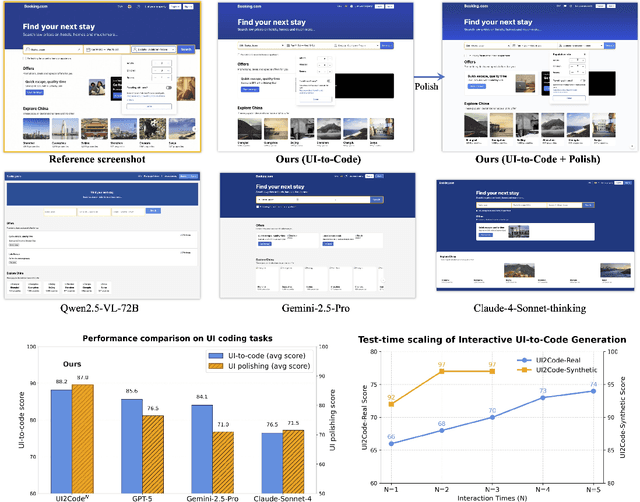
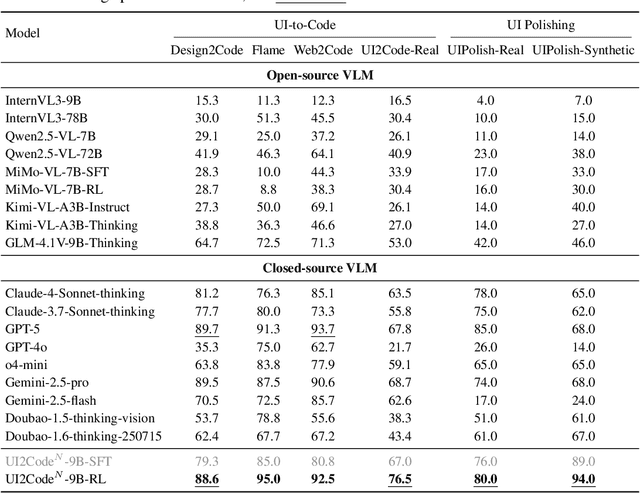
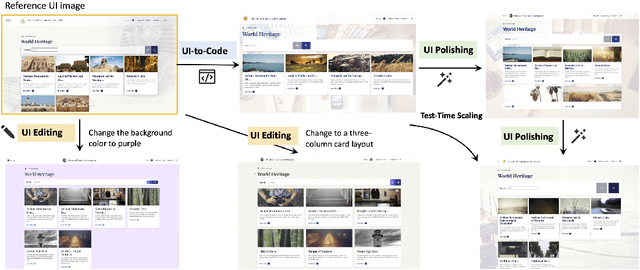

User interface (UI) programming is a core yet highly complex part of modern software development. Recent advances in visual language models (VLMs) highlight the potential of automatic UI coding, but current approaches face two key limitations: multimodal coding capabilities remain underdeveloped, and single-turn paradigms make little use of iterative visual feedback. We address these challenges with an interactive UI-to-code paradigm that better reflects real-world workflows and raises the upper bound of achievable performance. Under this paradigm, we present UI2Code$^\text{N}$, a visual language model trained through staged pretraining, fine-tuning, and reinforcement learning to achieve foundational improvements in multimodal coding. The model unifies three key capabilities: UI-to-code generation, UI editing, and UI polishing. We further explore test-time scaling for interactive generation, enabling systematic use of multi-turn feedback. Experiments on UI-to-code and UI polishing benchmarks show that UI2Code$^\text{N}$ establishes a new state of the art among open-source models and achieves performance comparable to leading closed-source models such as Claude-4-Sonnet and GPT-5. Our code and models are available at https://github.com/zai-org/UI2Code_N.
WebVIA: A Web-based Vision-Language Agentic Framework for Interactive and Verifiable UI-to-Code Generation
Nov 09, 2025User interface (UI) development requires translating design mockups into functional code, a process that remains repetitive and labor-intensive. While recent Vision-Language Models (VLMs) automate UI-to-Code generation, they generate only static HTML/CSS/JavaScript layouts lacking interactivity. To address this, we propose WebVIA, the first agentic framework for interactive UI-to-Code generation and validation. The framework comprises three components: 1) an exploration agent to capture multi-state UI screenshots; 2) a UI2Code model that generates executable interactive code; 3) a validation module that verifies the interactivity. Experiments demonstrate that WebVIA-Agent achieves more stable and accurate UI exploration than general-purpose agents (e.g., Gemini-2.5-Pro). In addition, our fine-tuned WebVIA-UI2Code models exhibit substantial improvements in generating executable and interactive HTML/CSS/JavaScript code, outperforming their base counterparts across both interactive and static UI2Code benchmarks. Our code and models are available at \href{https://zheny2751-dotcom.github.io/webvia.github.io/}{\texttt{https://webvia.github.io}}.
Efficient Cavity Searching for Gene Network of Influenza A Virus
Nov 05, 2022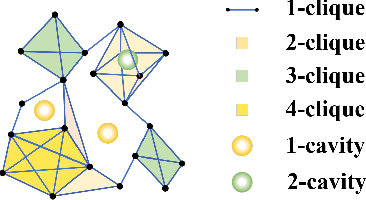

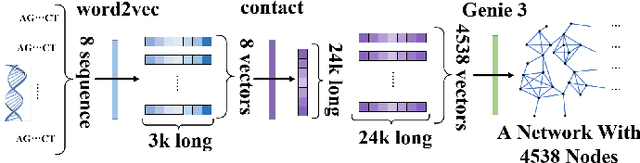

High order structures (cavities and cliques) of the gene network of influenza A virus reveal tight associations among viruses during evolution and are key signals that indicate viral cross-species infection and cause pandemics. As indicators for sensing the dynamic changes of viral genes, these higher order structures have been the focus of attention in the field of virology. However, the size of the viral gene network is usually huge, and searching these structures in the networks introduces unacceptable delay. To mitigate this issue, in this paper, we propose a simple-yet-effective model named HyperSearch based on deep learning to search cavities in a computable complex network for influenza virus genetics. Extensive experiments conducted on a public influenza virus dataset demonstrate the effectiveness of HyperSearch over other advanced deep-learning methods without any elaborated model crafting. Moreover, HyperSearch can finish the search works in minutes while 0-1 programming takes days. Since the proposed method is simple and easy to be transferred to other complex networks, HyperSearch has the potential to facilitate the monitoring of dynamic changes in viral genes and help humans keep up with the pace of virus mutations.