 Add to Chrome
 Add to Firefox
 Add to Edge
MDL: A Unified Multi-Distribution Learner in Large-scale Industrial Recommendation through Tokenization
Feb 07, 2026
Industrial recommender systems increasingly adopt multi-scenario learning (MSL) and multi-task learning (MTL) to handle diverse user interactions and contexts, but existing approaches suffer from two critical drawbacks: (1) underutilization of large-scale model parameters due to limited interaction with complex feature modules, and (2) difficulty in jointly modeling scenario and task information in a unified framework. To address these challenges, we propose a unified \textbf{M}ulti-\textbf{D}istribution \textbf{L}earning (MDL) framework, inspired by the "prompting" paradigm in large language models (LLMs). MDL treats scenario and task information as specialized tokens rather than auxiliary inputs or gating signals. Specifically, we introduce a unified information tokenization module that transforms features, scenarios, and tasks into a unified tokenized format. To facilitate deep interaction, we design three synergistic mechanisms: (1) feature token self-attention for rich feature interactions, (2) domain-feature attention for scenario/task-adaptive feature activation, and (3) domain-fused aggregation for joint distribution prediction. By stacking these interactions, MDL enables scenario and task information to "prompt" and activate the model's vast parameter space in a bottom-up, layer-wise manner. Extensive experiments on real-world industrial datasets demonstrate that MDL significantly outperforms state-of-the-art MSL and MTL baselines. Online A/B testing on Douyin Search platform over one month yields +0.0626\% improvement in LT30 and -0.3267\% reduction in change query rate. MDL has been fully deployed in production, serving hundreds of millions of users daily.

TokenMixer-Large: Scaling Up Large Ranking Models in Industrial Recommenders
Feb 06, 2026In recent years, the study of scaling laws for large recommendation models has gradually gained attention. Works such as Wukong, HiFormer, and DHEN have attempted to increase the complexity of interaction structures in ranking models and validate scaling laws between performance and parameters/FLOPs by stacking multiple layers. However, their experimental scale remains relatively limited. Our previous work introduced the TokenMixer architecture, an efficient variant of the standard Transformer where the self-attention mechanism is replaced by a simple reshape operation, and the feed-forward network is adapted to a pertoken FFN. The effectiveness of this architecture was demonstrated in the ranking stage by the model presented in the RankMixer paper. However, this foundational TokenMixer architecture itself has several design limitations. In this paper, we propose TokenMixer-Large, which systematically addresses these core issues: sub-optimal residual design, insufficient gradient updates in deep models, incomplete MoE sparsification, and limited exploration of scalability. By leveraging a mixing-and-reverting operation, inter-layer residuals, the auxiliary loss and a novel Sparse-Pertoken MoE architecture, TokenMixer-Large successfully scales its parameters to 7-billion and 15-billion on online traffic and offline experiments, respectively. Currently deployed in multiple scenarios at ByteDance, TokenMixer -Large has achieved significant offline and online performance gains.
LAB-Det: Language as a Domain-Invariant Bridge for Training-Free One-Shot Domain Generalization in Object Detection
Feb 06, 2026Foundation object detectors such as GLIP and Grounding DINO excel on general-domain data but often degrade in specialized and data-scarce settings like underwater imagery or industrial defects. Typical cross-domain few-shot approaches rely on fine-tuning scarce target data, incurring cost and overfitting risks. We instead ask: Can a frozen detector adapt with only one exemplar per class without training? To answer this, we introduce training-free one-shot domain generalization for object detection, where detectors must adapt to specialized domains with only one annotated exemplar per class and no weight updates. To tackle this task, we propose LAB-Det, which exploits Language As a domain-invariant Bridge. Instead of adapting visual features, we project each exemplar into a descriptive text that conditions and guides a frozen detector. This linguistic conditioning replaces gradient-based adaptation, enabling robust generalization in data-scarce domains. We evaluate on UODD (underwater) and NEU-DET (industrial defects), two widely adopted benchmarks for data-scarce detection, where object boundaries are often ambiguous, and LAB-Det achieves up to 5.4 mAP improvement over state-of-the-art fine-tuned baselines without updating a single parameter. These results establish linguistic adaptation as an efficient and interpretable alternative to fine-tuning in specialized detection settings.
SIDeR: Semantic Identity Decoupling for Unrestricted Face Privacy
Feb 04, 2026With the deep integration of facial recognition into online banking, identity verification, and other networked services, achieving effective decoupling of identity information from visual representations during image storage and transmission has become a critical challenge for privacy protection. To address this issue, we propose SIDeR, a Semantic decoupling-driven framework for unrestricted face privacy protection. SIDeR decomposes a facial image into a machine-recognizable identity feature vector and a visually perceptible semantic appearance component. By leveraging semantic-guided recomposition in the latent space of a diffusion model, it generates visually anonymous adversarial faces while maintaining machine-level identity consistency. The framework incorporates momentum-driven unrestricted perturbation optimization and a semantic-visual balancing factor to synthesize multiple visually diverse, highly natural adversarial samples. Furthermore, for authorized access, the protected image can be restored to its original form when the correct password is provided. Extensive experiments on the CelebA-HQ and FFHQ datasets demonstrate that SIDeR achieves a 99% attack success rate in black-box scenarios and outperforms baseline methods by 41.28% in PSNR-based restoration quality.
Expert Knowledge-Guided Decision Calibration for Accurate Fine-Grained Tree Species Classification
Jan 23, 2026Accurate fine-grained tree species classification is critical for forest inventory and biodiversity monitoring. Existing methods predominantly focus on designing complex architectures to fit local data distributions. However, they often overlook the long-tailed distributions and high inter-class similarity inherent in limited data, thereby struggling to distinguish between few-shot or confusing categories. In the process of knowledge dissemination in the human world, individuals will actively seek expert assistance to transcend the limitations of local thinking. Inspired by this, we introduce an external "Domain Expert" and propose an Expert Knowledge-Guided Classification Decision Calibration Network (EKDC-Net) to overcome these challenges. Our framework addresses two core issues: expert knowledge extraction and utilization. Specifically, we first develop a Local Prior Guided Knowledge Extraction Module (LPKEM). By leveraging Class Activation Map (CAM) analysis, LPKEM guides the domain expert to focus exclusively on discriminative features essential for classification. Subsequently, to effectively integrate this knowledge, we design an Uncertainty-Guided Decision Calibration Module (UDCM). This module dynamically corrects the local model's decisions by considering both overall category uncertainty and instance-level prediction uncertainty. Furthermore, we present a large-scale classification dataset covering 102 tree species, named CU-Tree102 to address the issue of scarce diversity in current benchmarks. Experiments on three benchmark datasets demonstrate that our approach achieves state-of-the-art performance. Crucially, as a lightweight plug-and-play module, EKDC-Net improves backbone accuracy by 6.42% and precision by 11.46% using only 0.08M additional learnable parameters. The dataset, code, and pre-trained models are available at https://github.com/WHU-USI3DV/TreeCLS.
AgentEHR: Advancing Autonomous Clinical Decision-Making via Retrospective Summarization
Jan 20, 2026Large Language Models have demonstrated profound utility in the medical domain. However, their application to autonomous Electronic Health Records~(EHRs) navigation remains constrained by a reliance on curated inputs and simplified retrieval tasks. To bridge the gap between idealized experimental settings and realistic clinical environments, we present AgentEHR. This benchmark challenges agents to execute complex decision-making tasks, such as diagnosis and treatment planning, requiring long-range interactive reasoning directly within raw and high-noise databases. In tackling these tasks, we identify that existing summarization methods inevitably suffer from critical information loss and fractured reasoning continuity. To address this, we propose RetroSum, a novel framework that unifies a retrospective summarization mechanism with an evolving experience strategy. By dynamically re-evaluating interaction history, the retrospective mechanism prevents long-context information loss and ensures unbroken logical coherence. Additionally, the evolving strategy bridges the domain gap by retrieving accumulated experience from a memory bank. Extensive empirical evaluations demonstrate that RetroSum achieves performance gains of up to 29.16% over competitive baselines, while significantly decreasing total interaction errors by up to 92.3%.
Pix2NPHM: Learning to Regress NPHM Reconstructions From a Single Image
Dec 19, 2025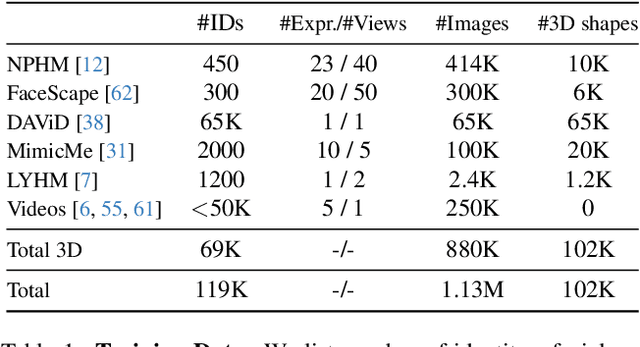
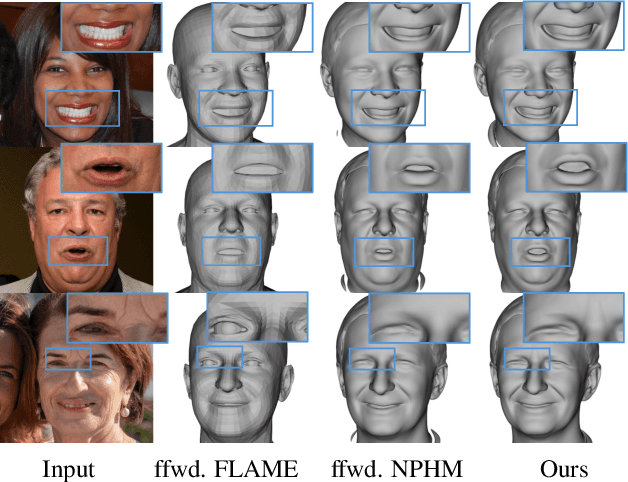
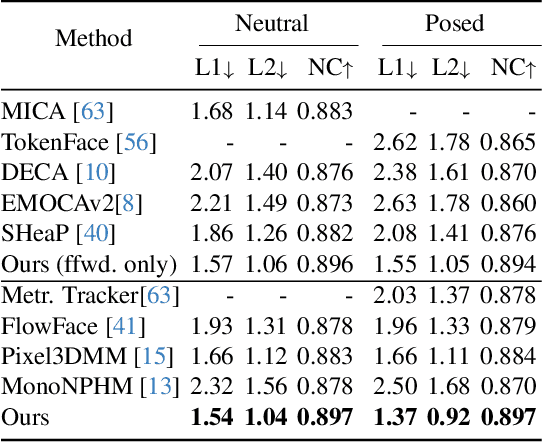
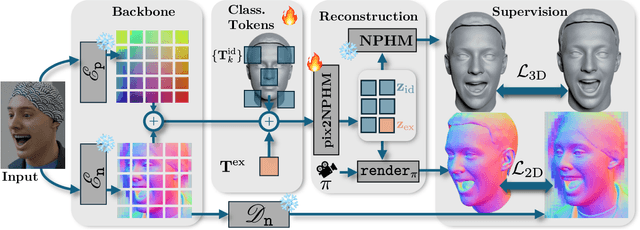
Neural Parametric Head Models (NPHMs) are a recent advancement over mesh-based 3d morphable models (3DMMs) to facilitate high-fidelity geometric detail. However, fitting NPHMs to visual inputs is notoriously challenging due to the expressive nature of their underlying latent space. To this end, we propose Pix2NPHM, a vision transformer (ViT) network that directly regresses NPHM parameters, given a single image as input. Compared to existing approaches, the neural parametric space allows our method to reconstruct more recognizable facial geometry and accurate facial expressions. For broad generalization, we exploit domain-specific ViTs as backbones, which are pretrained on geometric prediction tasks. We train Pix2NPHM on a mixture of 3D data, including a total of over 100K NPHM registrations that enable direct supervision in SDF space, and large-scale 2D video datasets, for which normal estimates serve as pseudo ground truth geometry. Pix2NPHM not only allows for 3D reconstructions at interactive frame rates, it is also possible to improve geometric fidelity by a subsequent inference-time optimization against estimated surface normals and canonical point maps. As a result, we achieve unprecedented face reconstruction quality that can run at scale on in-the-wild data.
Smile on the Face, Sadness in the Eyes: Bridging the Emotion Gap with a Multimodal Dataset of Eye and Facial Behaviors
Dec 18, 2025Emotion Recognition (ER) is the process of analyzing and identifying human emotions from sensing data. Currently, the field heavily relies on facial expression recognition (FER) because visual channel conveys rich emotional cues. However, facial expressions are often used as social tools rather than manifestations of genuine inner emotions. To understand and bridge this gap between FER and ER, we introduce eye behaviors as an important emotional cue and construct an Eye-behavior-aided Multimodal Emotion Recognition (EMER) dataset. To collect data with genuine emotions, spontaneous emotion induction paradigm is exploited with stimulus material, during which non-invasive eye behavior data, like eye movement sequences and eye fixation maps, is captured together with facial expression videos. To better illustrate the gap between ER and FER, multi-view emotion labels for mutimodal ER and FER are separately annotated. Furthermore, based on the new dataset, we design a simple yet effective Eye-behavior-aided MER Transformer (EMERT) that enhances ER by bridging the emotion gap. EMERT leverages modality-adversarial feature decoupling and a multitask Transformer to model eye behaviors as a strong complement to facial expressions. In the experiment, we introduce seven multimodal benchmark protocols for a variety of comprehensive evaluations of the EMER dataset. The results show that the EMERT outperforms other state-of-the-art multimodal methods by a great margin, revealing the importance of modeling eye behaviors for robust ER. To sum up, we provide a comprehensive analysis of the importance of eye behaviors in ER, advancing the study on addressing the gap between FER and ER for more robust ER performance. Our EMER dataset and the trained EMERT models will be publicly available at https://github.com/kejun1/EMER.
Multi-Agent Deep Research: Training Multi-Agent Systems with M-GRPO
Nov 18, 2025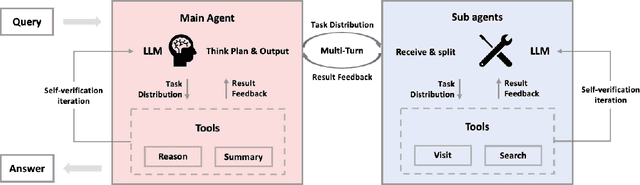
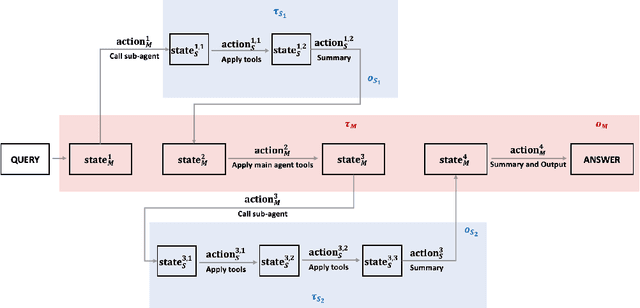
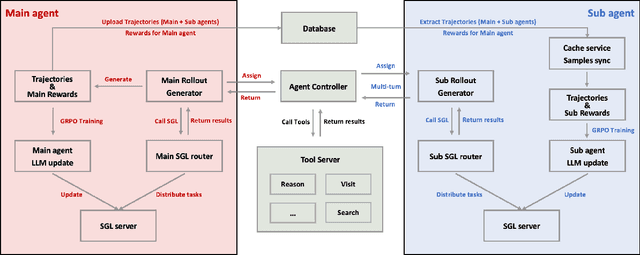
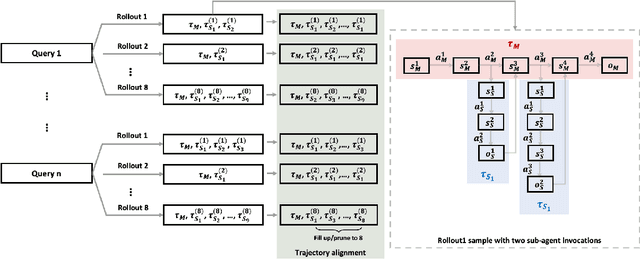
Multi-agent systems perform well on general reasoning tasks. However, the lack of training in specialized areas hinders their accuracy. Current training methods train a unified large language model (LLM) for all agents in the system. This may limit the performances due to different distributions underlying for different agents. Therefore, training multi-agent systems with distinct LLMs should be the next step to solve. However, this approach introduces optimization challenges. For example, agents operate at different frequencies, rollouts involve varying sub-agent invocations, and agents are often deployed across separate servers, disrupting end-to-end gradient flow. To address these issues, we propose M-GRPO, a hierarchical extension of Group Relative Policy Optimization designed for vertical Multi-agent systems with a main agent (planner) and multiple sub-agents (multi-turn tool executors). M-GRPO computes group-relative advantages for both main and sub-agents, maintaining hierarchical credit assignment. It also introduces a trajectory-alignment scheme that generates fixed-size batches despite variable sub-agent invocations. We deploy a decoupled training pipeline in which agents run on separate servers and exchange minimal statistics via a shared store. This enables scalable training without cross-server backpropagation. In experiments on real-world benchmarks (e.g., GAIA, XBench-DeepSearch, and WebWalkerQA), M-GRPO consistently outperforms both single-agent GRPO and multi-agent GRPO with frozen sub-agents, demonstrating improved stability and sample efficiency. These results show that aligning heterogeneous trajectories and decoupling optimization across specialized agents enhances tool-augmented reasoning tasks.
MiroThinker: Pushing the Performance Boundaries of Open-Source Research Agents via Model, Context, and Interactive Scaling
Nov 18, 2025We present MiroThinker v1.0, an open-source research agent designed to advance tool-augmented reasoning and information-seeking capabilities. Unlike previous agents that only scale up model size or context length, MiroThinker explores interaction scaling at the model level, systematically training the model to handle deeper and more frequent agent-environment interactions as a third dimension of performance improvement. Unlike LLM test-time scaling, which operates in isolation and risks degradation with longer reasoning chains, interactive scaling leverages environment feedback and external information acquisition to correct errors and refine trajectories. Through reinforcement learning, the model achieves efficient interaction scaling: with a 256K context window, it can perform up to 600 tool calls per task, enabling sustained multi-turn reasoning and complex real-world research workflows. Across four representative benchmarks-GAIA, HLE, BrowseComp, and BrowseComp-ZH-the 72B variant achieves up to 81.9%, 37.7%, 47.1%, and 55.6% accuracy respectively, surpassing previous open-source agents and approaching commercial counterparts such as GPT-5-high. Our analysis reveals that MiroThinker benefits from interactive scaling consistently: research performance improves predictably as the model engages in deeper and more frequent agent-environment interactions, demonstrating that interaction depth exhibits scaling behaviors analogous to model size and context length. These findings establish interaction scaling as a third critical dimension for building next-generation open research agents, complementing model capacity and context windows.