 Add to Chrome
 Add to Firefox
 Add to Edge
BLADE: Boundary-Expanded and Layer-Adaptive Dynamic Exit for Efficient LLM Reasoning
Jul 31, 2026
Large language models often improve task performance by generating long reasoning traces, but the resulting computation is frequently wasted on redundant verification and revision. Existing probe-based early-exit approaches mainly inspect explicit self-doubt expressions, leaving many earlier termination opportunities undetected. Expanding inspection to ordinary reasoning boundaries improves coverage, but also exposes highly diverse intermediate states whose predictive information may reside in different hidden layers. We present Boundary-Expanded and Layer-Adaptive Dynamic Exit for Efficient LLM Reasoning (BLADE), a lightweight framework that dynamically terminates reasoning by estimating whether the generated prefix is sufficient for correct answering. BLADE constructs multi-granular checkpoints from sentence, self-doubt, and paragraph boundaries, and derives robust training labels through repeated answer completions. It further learns a compact subset of informative probe layers instead of relying on fixed choices or expensive representations from all layers. At inference time, calibrated predictions are combined with checkpoint-specific confirmation rules to balance responsiveness and premature-exit risk. Experiments on five benchmarks and two Qwen3 reasoning models show that BLADE preserves near-baseline accuracy while reducing generated tokens by 24.8% on Qwen3-8B and 15.8% on Qwen3-4B. Ablation studies further confirm the benefits of diverse checkpoints and automatic layer selection, demonstrating an effective approach to more efficient LLM reasoning.

Bridging the Detection-to-Abstention Gap in Reasoning Models under Insufficient Information
May 27, 2026We highlight a failure mode of large reasoning models on questions with insufficient information: models may recognize that a problem is under-specified, yet still continue reasoning and produce unsupported final answers instead of abstaining. We formalize this mismatch as the detection-to-abstention gap, where detected insufficiency fails to translate into final abstention. This gap is especially concerning in high-risk domains such as medical AI, where answers based on incomplete evidence can be more harmful than refusal. To close this gap, we propose Judge-Then-Solve (JTS), a trajectory-level reasoning-control framework that trains models to make an explicit answerability commitment before solution generation. Rather than treating abstention as a final-answer style, JTS casts it as a control decision: the model either proceeds to solve or terminates early based on its answerability judgment. We instantiate this policy through supervised warm-up and missing-premise reinforcement learning with consistency and length-shaping rewards. Experiments on dense and MoE reasoning models show that JTS substantially improves reliable abstention across datasets and pushes Abstention@Detection (A@D) to near-saturation, indicating that models not only detect missing information but also act on that detection. By terminating unanswerable trajectories immediately after the answerability judgment, JTS reduces unnecessary reasoning and improves inference efficiency when continued deliberation would amplify unsupported assumptions. We also observe that missing-premise training can alter reasoning behavior on difficult but answerable problems, reducing unproductive self-reflection. These results suggest that abstention under insufficient information is a key form of reasoning control for deploying reasoning models safely and efficiently.
dWorldEval: Scalable Robotic Policy Evaluation via Discrete Diffusion World Model
Apr 24, 2026Evaluating robotics policies across thousands of environments and thousands of tasks is infeasible with existing approaches. This motivates the need for a new methodology for scalable robotics policy evaluation. In this paper, we propose dWorldEval, which uses a discrete diffusion world model as a scalable evaluation proxy for robotics policies. Specifically, dWorldEval maps all modalities - including vision, language, and robotic actions - into a unified token space, modeling them via a single transformer-based denoising network. In this paper, we propose dWorldEval, using a discrete diffusion world model as a scalable evaluation proxy for robotics policy. Specifically, it maps all modalities, including vision, language, and robotics action into a unified token space, then denoises them with a single transformer network. Building on this architecture, we employ a sparse keyframe memory to maintain spatiotemporal consistency. We also introduce a progress token that indicates the degree of task completion. At inference, the model jointly predicts future observations and progress token, allowing automatically determine success when the progress reaches 1. Extensive experiments demonstrate that dWorldEval significantly outperforms previous approaches, i.e., WorldEval, Ctrl-World, and WorldGym, on LIBERO, RoboTwin, and multiple real-robot tasks. It paves the way for a new architectural paradigm in building world simulators for robotics evaluation at scale.
Hi-WM: Human-in-the-World-Model for Scalable Robot Post-Training
Apr 23, 2026Post-training is essential for turning pretrained generalist robot policies into reliable task-specific controllers, but existing human-in-the-loop pipelines remain tied to physical execution: each correction requires robot time, scene setup, resets, and operator supervision in the real world. Meanwhile, action-conditioned world models have been studied mainly for imagination, synthetic data generation, and policy evaluation. We propose \textbf{Human-in-the-World-Model (Hi-WM)}, a post-training framework that uses a learned world model as a reusable corrective substrate for failure-targeted policy improvement. A policy is first rolled out in closed loop inside the world model; when the rollout becomes incorrect or failure-prone, a human intervenes directly in the model to provide short corrective actions. Hi-WM caches intermediate states and supports rollback and branching, allowing a single failure state to be reused for multiple corrective continuations and yielding dense supervision around behaviors that the base policy handles poorly. The resulting corrective trajectories are then added back to the training set for post-training. We evaluate Hi-WM on three real-world manipulation tasks spanning both rigid and deformable object interaction, and on two policy backbones. Hi-WM improves real-world success by 37.9 points on average over the base policy and by 19.0 points over a world-model closed-loop baseline, while world-model evaluation correlates strongly with real-world performance (r = 0.953). These results suggest that world models can serve not only as generators or evaluators, but also as effective corrective substrates for scalable robot post-training.
SpecForge: A Flexible and Efficient Open-Source Training Framework for Speculative Decoding
Mar 19, 2026Large language models incur high inference latency due to sequential autoregressive decoding. Speculative decoding alleviates this bottleneck by using a lightweight draft model to propose multiple tokens for batched verification. However, its adoption has been limited by the lack of high-quality draft models and scalable training infrastructure. We introduce SpecForge, an open-source, production-oriented framework for training speculative decoding models with full support for EAGLE-3. SpecForge incorporates target-draft decoupling, hybrid parallelism, optimized training kernels, and integration with production-grade inference engines, enabling up to 9.9x faster EAGLE-3 training for Qwen3-235B-A22B. In addition, we release SpecBundle, a suite of production-grade EAGLE-3 draft models trained with SpecForge for mainstream open-source LLMs. Through a systematic study of speculative decoding training recipes, SpecBundle addresses the scarcity of high-quality drafts in the community, and our draft models achieve up to 4.48x end-to-end inference speedup on SGLang, establishing SpecForge as a practical foundation for real-world speculative decoding deployment.
Multi-Agent Deep Research: Training Multi-Agent Systems with M-GRPO
Nov 18, 2025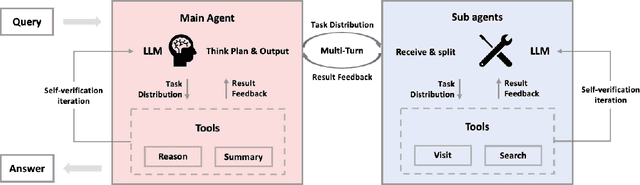
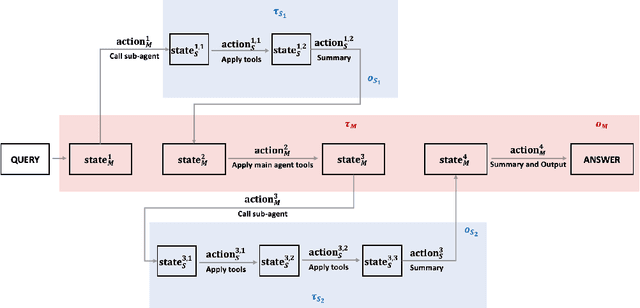
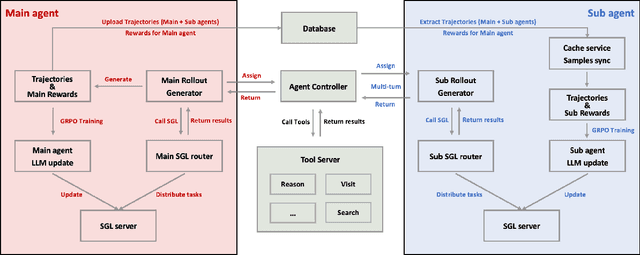
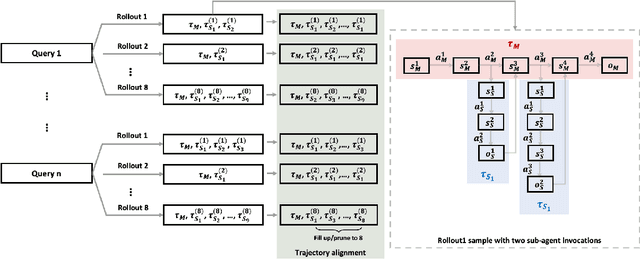
Multi-agent systems perform well on general reasoning tasks. However, the lack of training in specialized areas hinders their accuracy. Current training methods train a unified large language model (LLM) for all agents in the system. This may limit the performances due to different distributions underlying for different agents. Therefore, training multi-agent systems with distinct LLMs should be the next step to solve. However, this approach introduces optimization challenges. For example, agents operate at different frequencies, rollouts involve varying sub-agent invocations, and agents are often deployed across separate servers, disrupting end-to-end gradient flow. To address these issues, we propose M-GRPO, a hierarchical extension of Group Relative Policy Optimization designed for vertical Multi-agent systems with a main agent (planner) and multiple sub-agents (multi-turn tool executors). M-GRPO computes group-relative advantages for both main and sub-agents, maintaining hierarchical credit assignment. It also introduces a trajectory-alignment scheme that generates fixed-size batches despite variable sub-agent invocations. We deploy a decoupled training pipeline in which agents run on separate servers and exchange minimal statistics via a shared store. This enables scalable training without cross-server backpropagation. In experiments on real-world benchmarks (e.g., GAIA, XBench-DeepSearch, and WebWalkerQA), M-GRPO consistently outperforms both single-agent GRPO and multi-agent GRPO with frozen sub-agents, demonstrating improved stability and sample efficiency. These results show that aligning heterogeneous trajectories and decoupling optimization across specialized agents enhances tool-augmented reasoning tasks.
Differentiable Search for Finding Optimal Quantization Strategy
Apr 15, 2024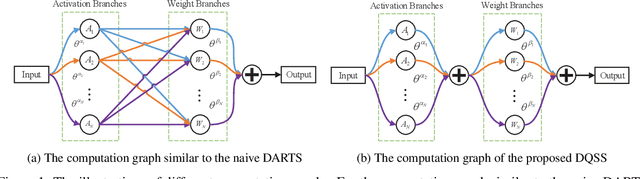
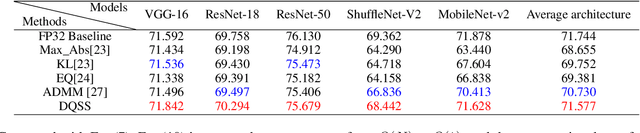
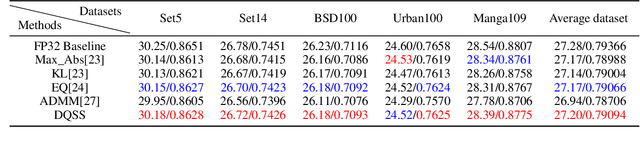
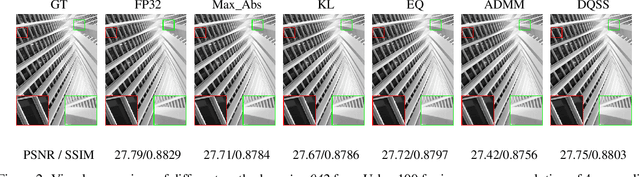
To accelerate and compress deep neural networks (DNNs), many network quantization algorithms have been proposed. Although the quantization strategy of any algorithm from the state-of-the-arts may outperform others in some network architectures, it is hard to prove the strategy is always better than others, and even cannot judge that the strategy is always the best choice for all layers in a network. In other words, existing quantization algorithms are suboptimal as they ignore the different characteristics of different layers and quantize all layers by a uniform quantization strategy. To solve the issue, in this paper, we propose a differentiable quantization strategy search (DQSS) to assign optimal quantization strategy for individual layer by taking advantages of the benefits of different quantization algorithms. Specifically, we formulate DQSS as a differentiable neural architecture search problem and adopt an efficient convolution to efficiently explore the mixed quantization strategies from a global perspective by gradient-based optimization. We conduct DQSS for post-training quantization to enable their performance to be comparable with that in full precision models. We also employ DQSS in quantization-aware training for further validating the effectiveness of DQSS. To circumvent the expensive optimization cost when employing DQSS in quantization-aware training, we update the hyper-parameters and the network parameters in a single forward-backward pass. Besides, we adjust the optimization process to avoid the potential under-fitting problem. Comprehensive experiments on high level computer vision task, i.e., image classification, and low level computer vision task, i.e., image super-resolution, with various network architectures show that DQSS could outperform the state-of-the-arts.