 Add to Chrome
 Add to Firefox
 Add to Edge
ClawMark: A Living-World Benchmark for Multi-Turn, Multi-Day, Multimodal Coworker Agents
Apr 26, 2026
Language-model agents are increasingly used as persistent coworkers that assist users across multiple working days. During such workflows, the surrounding environment may change independently of the agent: new emails arrive, calendar entries shift, knowledge-base records are updated, and evidence appears across images, scanned PDFs, audio, video, and spreadsheets. Existing benchmarks do not adequately evaluate this setting because they typically run within a single static episode and remain largely text-centric. We introduce \bench{}, a benchmark for coworker agents built around multi-turn multi-day tasks, a stateful sandboxed service environment whose state evolves between turns, and rule-based verification. The current release contains 100 tasks across 13 professional scenarios, executed against five stateful sandboxed services (filesystem, email, calendar, knowledge base, spreadsheet) and scored by 1537 deterministic Python checkers over post-execution service state; no LLM-as-judge is invoked during scoring. We benchmark seven frontier agent systems. The strongest model reaches 75.8 weighted score, but the best strict Task Success is only 20.0\%, indicating that partial progress is common while complete end-to-end workflow completion remains rare. Turn-level analysis shows that performance drops after the first exogenous environment update, highlighting adaptation to changing state as a key open challenge. We release the benchmark, evaluation harness, and construction pipeline to support reproducible coworker-agent evaluation.

Agent2World: Learning to Generate Symbolic World Models via Adaptive Multi-Agent Feedback
Dec 26, 2025Symbolic world models (e.g., PDDL domains or executable simulators) are central to model-based planning, but training LLMs to generate such world models is limited by the lack of large-scale verifiable supervision. Current approaches rely primarily on static validation methods that fail to catch behavior-level errors arising from interactive execution. In this paper, we propose Agent2World, a tool-augmented multi-agent framework that achieves strong inference-time world-model generation and also serves as a data engine for supervised fine-tuning, by grounding generation in multi-agent feedback. Agent2World follows a three-stage pipeline: (i) A Deep Researcher agent performs knowledge synthesis by web searching to address specification gaps; (ii) A Model Developer agent implements executable world models; And (iii) a specialized Testing Team conducts adaptive unit testing and simulation-based validation. Agent2World demonstrates superior inference-time performance across three benchmarks spanning both Planning Domain Definition Language (PDDL) and executable code representations, achieving consistent state-of-the-art results. Beyond inference, Testing Team serves as an interactive environment for the Model Developer, providing behavior-aware adaptive feedback that yields multi-turn training trajectories. The model fine-tuned on these trajectories substantially improves world-model generation, yielding an average relative gain of 30.95% over the same model before training. Project page: https://agent2world.github.io.
Multi-Agent Deep Research: Training Multi-Agent Systems with M-GRPO
Nov 18, 2025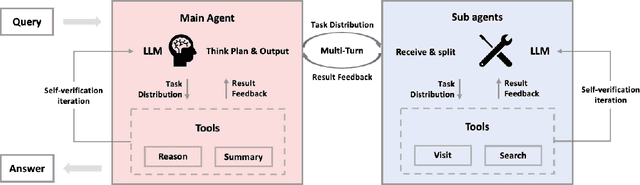
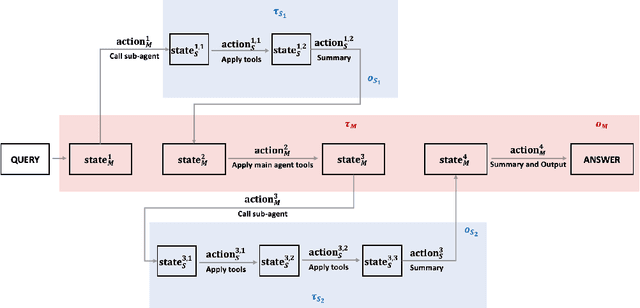
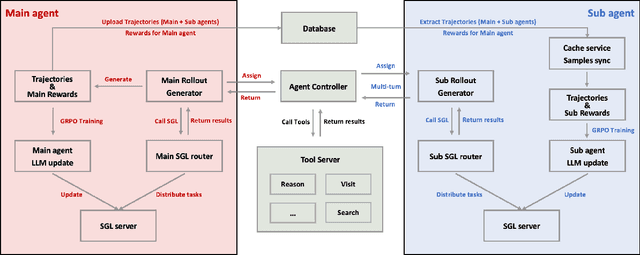
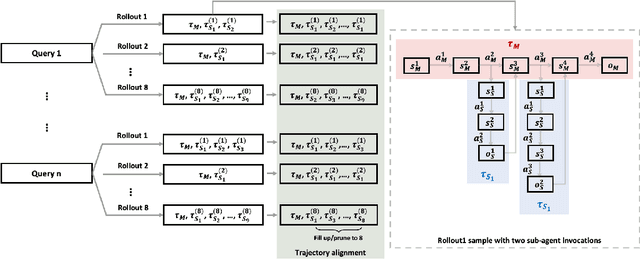
Multi-agent systems perform well on general reasoning tasks. However, the lack of training in specialized areas hinders their accuracy. Current training methods train a unified large language model (LLM) for all agents in the system. This may limit the performances due to different distributions underlying for different agents. Therefore, training multi-agent systems with distinct LLMs should be the next step to solve. However, this approach introduces optimization challenges. For example, agents operate at different frequencies, rollouts involve varying sub-agent invocations, and agents are often deployed across separate servers, disrupting end-to-end gradient flow. To address these issues, we propose M-GRPO, a hierarchical extension of Group Relative Policy Optimization designed for vertical Multi-agent systems with a main agent (planner) and multiple sub-agents (multi-turn tool executors). M-GRPO computes group-relative advantages for both main and sub-agents, maintaining hierarchical credit assignment. It also introduces a trajectory-alignment scheme that generates fixed-size batches despite variable sub-agent invocations. We deploy a decoupled training pipeline in which agents run on separate servers and exchange minimal statistics via a shared store. This enables scalable training without cross-server backpropagation. In experiments on real-world benchmarks (e.g., GAIA, XBench-DeepSearch, and WebWalkerQA), M-GRPO consistently outperforms both single-agent GRPO and multi-agent GRPO with frozen sub-agents, demonstrating improved stability and sample efficiency. These results show that aligning heterogeneous trajectories and decoupling optimization across specialized agents enhances tool-augmented reasoning tasks.
MedReseacher-R1: Expert-Level Medical Deep Researcher via A Knowledge-Informed Trajectory Synthesis Framework
Aug 20, 2025Recent developments in Large Language Model (LLM)-based agents have shown impressive capabilities spanning multiple domains, exemplified by deep research systems that demonstrate superior performance on complex information-seeking and synthesis tasks. While general-purpose deep research agents have shown impressive capabilities, they struggle significantly with medical domain challenges, as evidenced by leading proprietary systems achieving limited accuracy on complex medical benchmarks. The key limitations are: (1) the model lacks sufficient dense medical knowledge for clinical reasoning, and (2) the framework is constrained by the absence of specialized retrieval tools tailored for medical contexts.We present a medical deep research agent that addresses these challenges through two core innovations. First, we develop a novel data synthesis framework using medical knowledge graphs, extracting the longest chains from subgraphs around rare medical entities to generate complex multi-hop question-answer pairs. Second, we integrate a custom-built private medical retrieval engine alongside general-purpose tools, enabling accurate medical information synthesis. Our approach generates 2100+ diverse trajectories across 12 medical specialties, each averaging 4.2 tool interactions.Through a two-stage training paradigm combining supervised fine-tuning and online reinforcement learning with composite rewards, our MedResearcher-R1-32B model demonstrates exceptional performance, establishing new state-of-the-art results on medical benchmarks while maintaining competitive performance on general deep research tasks. Our work demonstrates that strategic domain-specific innovations in architecture, tool design, and training data construction can enable smaller open-source models to outperform much larger proprietary systems in specialized domains.