 Add to Chrome
 Add to Firefox
 Add to Edge
UniFormer: Efficient and Unified Model-Centric Scaling for Industrial Recommendation
Jun 25, 2026
Recently, substantial progress has been made in industrial recommendation through component-centric model scaling, where individual components such as behavior modeling, feature interaction, or task modeling are independently scaled to improve model capacity. Although recent methods such as HyFormer and OneTrans further explore cross-module co-scaling by jointly modeling behavior and interaction, their designs are still confined to the feature space and lack a unified model-centric scaling framework over the overall modeling space. In this paper, we propose UniFormer, an efficient and unified model-centric scaling framework for industrial recommender systems. To improve efficiency, UniFormer decomposes the overall modeling space into feature and task spaces, which are modeled by stacked Feature-space Interaction Modules and Task-space Interaction Modules, respectively. Moreover, UniFormer introduces semantic-based tokenization scheme to enable user-item decoupling, thereby achieving request-level inference acceleration. To prevent preference collapse, UniFormer employs multi-sequence cross-attention to separately capture heterogeneous behavior patterns, followed by the self-attention to enhance interaction modeling. Besides, dedicated multi-view FFNs are introduced to support flexible and scalable parameter scaling across different modeling components. Extensive online A/B testing in two production scenarios, Kuaishou and Kuaishou Lite, shows that UniFormer consistently improves user engagement and interaction metrics, achieving gains of +0.101%/+0.260% in App Stay Time and +0.729%/+1.113% in Watch Time, respectively.

TokenMixer-Large: Scaling Up Large Ranking Models in Industrial Recommenders
Feb 06, 2026In recent years, the study of scaling laws for large recommendation models has gradually gained attention. Works such as Wukong, HiFormer, and DHEN have attempted to increase the complexity of interaction structures in ranking models and validate scaling laws between performance and parameters/FLOPs by stacking multiple layers. However, their experimental scale remains relatively limited. Our previous work introduced the TokenMixer architecture, an efficient variant of the standard Transformer where the self-attention mechanism is replaced by a simple reshape operation, and the feed-forward network is adapted to a pertoken FFN. The effectiveness of this architecture was demonstrated in the ranking stage by the model presented in the RankMixer paper. However, this foundational TokenMixer architecture itself has several design limitations. In this paper, we propose TokenMixer-Large, which systematically addresses these core issues: sub-optimal residual design, insufficient gradient updates in deep models, incomplete MoE sparsification, and limited exploration of scalability. By leveraging a mixing-and-reverting operation, inter-layer residuals, the auxiliary loss and a novel Sparse-Pertoken MoE architecture, TokenMixer-Large successfully scales its parameters to 7-billion and 15-billion on online traffic and offline experiments, respectively. Currently deployed in multiple scenarios at ByteDance, TokenMixer -Large has achieved significant offline and online performance gains.
Towards Exploratory and Focused Manipulation with Bimanual Active Perception: A New Problem, Benchmark and Strategy
Feb 02, 2026Recently, active vision has reemerged as an important concept for manipulation, since visual occlusion occurs more frequently when main cameras are mounted on the robot heads. We reflect on the visual occlusion issue and identify its essence as the absence of information useful for task completion. Inspired by this, we come up with the more fundamental problem of Exploratory and Focused Manipulation (EFM). The proposed problem is about actively collecting information to complete challenging manipulation tasks that require exploration or focus. As an initial attempt to address this problem, we establish the EFM-10 benchmark that consists of 4 categories of tasks that align with our definition (10 tasks in total). We further come up with a Bimanual Active Perception (BAP) strategy, which leverages one arm to provide active vision and another arm to provide force sensing while manipulating. Based on this idea, we collect a dataset named BAPData for the tasks in EFM-10. With the dataset, we successfully verify the effectiveness of the BAP strategy in an imitation learning manner. We hope that the EFM-10 benchmark along with the BAP strategy can become a cornerstone that facilitates future research towards this direction. Project website: EFManipulation.github.io.
Discovering Invariant Neighborhood Patterns for Heterophilic Graphs
Mar 15, 2024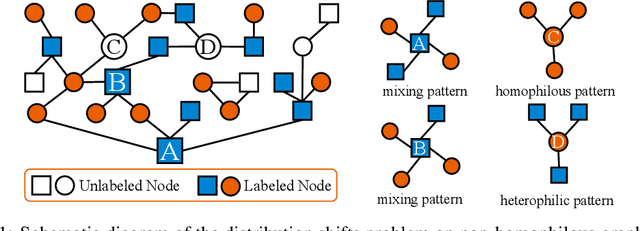
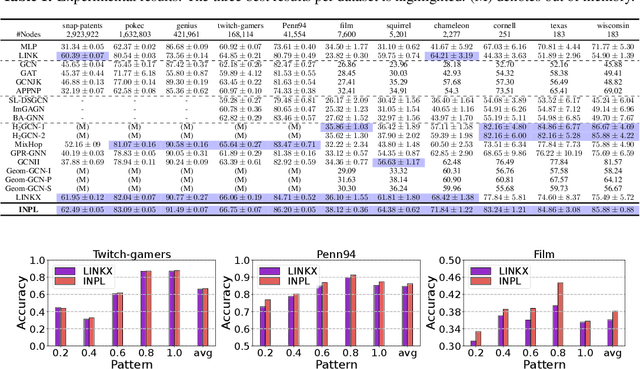
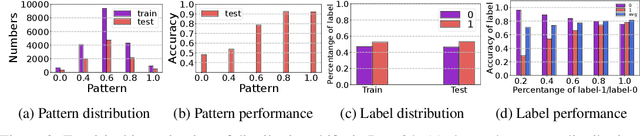
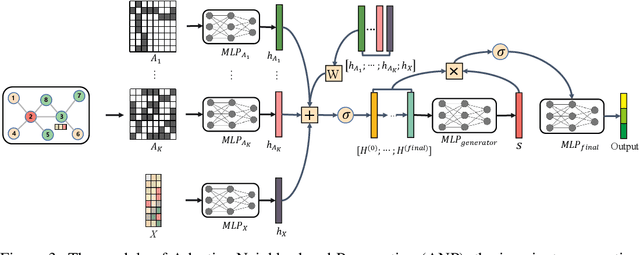
This paper studies the problem of distribution shifts on non-homophilous graphs Mosting existing graph neural network methods rely on the homophilous assumption that nodes from the same class are more likely to be linked. However, such assumptions of homophily do not always hold in real-world graphs, which leads to more complex distribution shifts unaccounted for in previous methods. The distribution shifts of neighborhood patterns are much more diverse on non-homophilous graphs. We propose a novel Invariant Neighborhood Pattern Learning (INPL) to alleviate the distribution shifts problem on non-homophilous graphs. Specifically, we propose the Adaptive Neighborhood Propagation (ANP) module to capture the adaptive neighborhood information, which could alleviate the neighborhood pattern distribution shifts problem on non-homophilous graphs. We propose Invariant Non-Homophilous Graph Learning (INHGL) module to constrain the ANP and learn invariant graph representation on non-homophilous graphs. Extensive experimental results on real-world non-homophilous graphs show that INPL could achieve state-of-the-art performance for learning on large non-homophilous graphs.