 Add to Chrome
 Add to Firefox
 Add to Edge
Online KL-Regularized Reinforcement Learning with Function Approximation under Misspecification
Jun 04, 2026
We study KL-regularized contextual bandits and episodic reinforcement learning (RL) under general function approximation with model misspecification. Existing guarantees rely on realizability and therefore do not extend to misspecified models, where classical regret bounds may fail. This work introduces KL misspecification formulations for contextual bandits and episodic RL and analyzes regression-based algorithms with Gibbs policy updates. High-probability KL-regret guarantees with explicit misspecification terms are established, recovering the standard realizable KL-regularized setting as a special case.

When Can You Poison Rewards? A Tight Characterization of Reward Poisoning in Linear MDPs
Apr 11, 2026We study reward poisoning attacks in reinforcement learning (RL), where an adversary manipulates rewards within constrained budgets to force the target RL agent to adopt a policy that aligns with the attacker's objectives. Prior works on reward poisoning mainly focused on sufficient conditions to design a successful attacker, while only a few studies discussed the infeasibility of targeted attacks. This paper provides the first precise necessity and sufficiency characterization of the attackability of a linear MDP under reward poisoning attacks. Our characterization draws a bright line between the vulnerable RL instances, and the intrinsically robust ones which cannot be attacked without large costs even running vanilla non-robust RL algorithms. Our theory extends beyond linear MDPs -- by approximating deep RL environments as linear MDPs, we show that our theoretical framework effectively distinguishes the attackability and efficiently attacks the vulnerable ones, demonstrating both the theoretical and practical significance of our characterization.
Multi-Agent Deep Research: Training Multi-Agent Systems with M-GRPO
Nov 18, 2025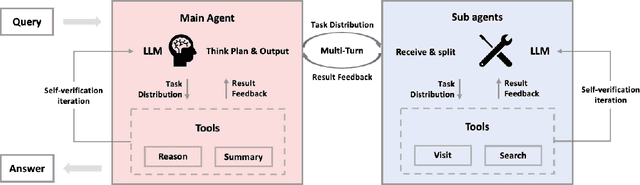
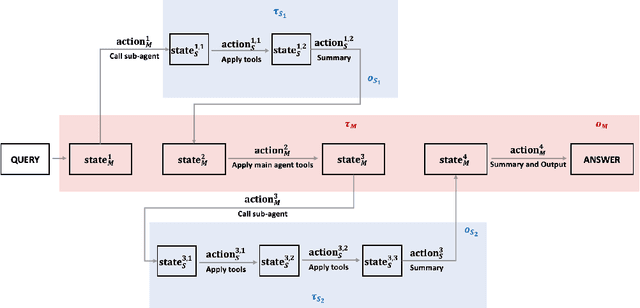
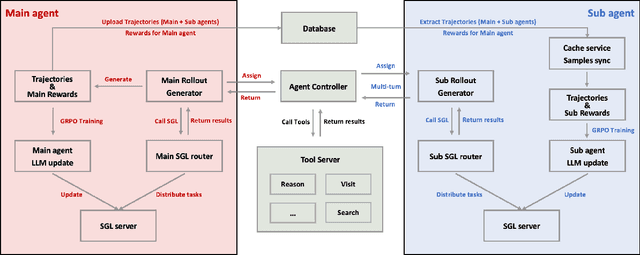
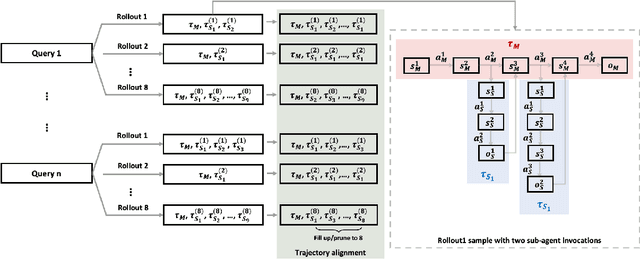
Multi-agent systems perform well on general reasoning tasks. However, the lack of training in specialized areas hinders their accuracy. Current training methods train a unified large language model (LLM) for all agents in the system. This may limit the performances due to different distributions underlying for different agents. Therefore, training multi-agent systems with distinct LLMs should be the next step to solve. However, this approach introduces optimization challenges. For example, agents operate at different frequencies, rollouts involve varying sub-agent invocations, and agents are often deployed across separate servers, disrupting end-to-end gradient flow. To address these issues, we propose M-GRPO, a hierarchical extension of Group Relative Policy Optimization designed for vertical Multi-agent systems with a main agent (planner) and multiple sub-agents (multi-turn tool executors). M-GRPO computes group-relative advantages for both main and sub-agents, maintaining hierarchical credit assignment. It also introduces a trajectory-alignment scheme that generates fixed-size batches despite variable sub-agent invocations. We deploy a decoupled training pipeline in which agents run on separate servers and exchange minimal statistics via a shared store. This enables scalable training without cross-server backpropagation. In experiments on real-world benchmarks (e.g., GAIA, XBench-DeepSearch, and WebWalkerQA), M-GRPO consistently outperforms both single-agent GRPO and multi-agent GRPO with frozen sub-agents, demonstrating improved stability and sample efficiency. These results show that aligning heterogeneous trajectories and decoupling optimization across specialized agents enhances tool-augmented reasoning tasks.