 Add to Chrome
 Add to Firefox
 Add to Edge
Head Avatars with Dynamic Explicit Hair
Jul 26, 2026
We present DynHair, a novel method for tracking and modeling dynamic hair for human head avatars. From video input, we reconstruct a dynamic head avatar with an explicit strand-based hair representation using structured 3D Gaussian Splatting. In contrast to the face region of human head avatars, which can be modeled with 3D Gaussians that are attached or generated with respect to some expressive 3D head model, hair is particularly challenging as it exhibits dynamic motion effects. Therefore, we present a novel method that models the dynamic deformations of the hair strands using a temporal network that is conditioned on angular velocity and acceleration of the head, as well as relative gravity. Specifically, an LSTM encodes the motion history and modulates per-point strand features via FiLM conditioning which further used by MLP to produce physically plausible displacements to canonical hairstyle. We jointly optimize this motion and appearance representation of the hair, with a 3DGS-based representation of the face-region, via differentiable Gaussian splatting with photometric, geometric, and physics-based supervision. As a result of our method, we retrieve hair tracking of the training video data and an animatable head avatar with controllable hair dynamics. In our experiments, we demonstrate state-of-the-art performance in terms of hair dynamics, temporal consistency, and generalization across subjects.

How to Build Digital Humans? From Priors to Photorealistic Avatars
Jul 05, 2026This state-of-the-art report provides an overview of controllable 3D human avatar creation. We describe current 3D avatar systems, which typically consist of three stages: (i) learning priors of human appearance and motion, (ii) creating a personalized avatar, and (iii) animating the avatar. To limit the scope, we focus on the prior learning and avatar creation stages. We define current avatar representations and introduce a taxonomy that categorizes existing work along multiple axes, including body regions and employed priors. We review methods for full-body and head avatars, as well as layered representations that decompose the body into components such as hands, hair, and garments. Finally, we outline common underlying principles, reference key literature for newcomers, and discuss open challenges and future research directions.
Pix2NPHM: Learning to Regress NPHM Reconstructions From a Single Image
Dec 19, 2025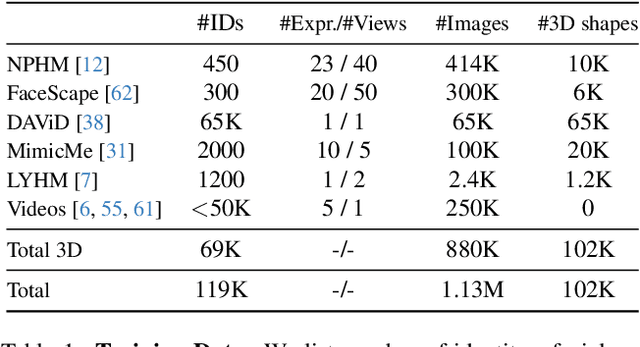
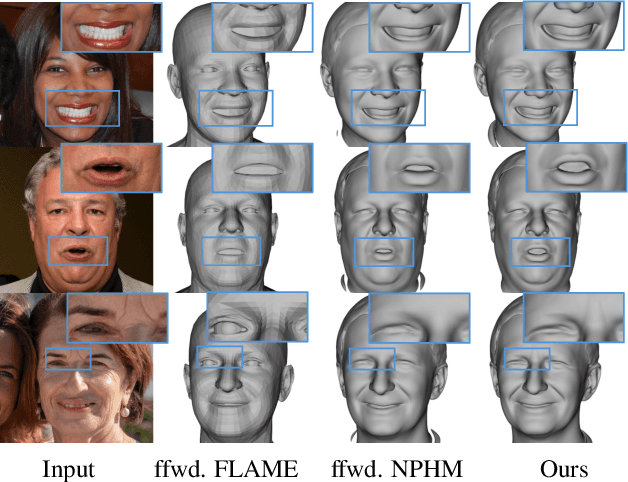
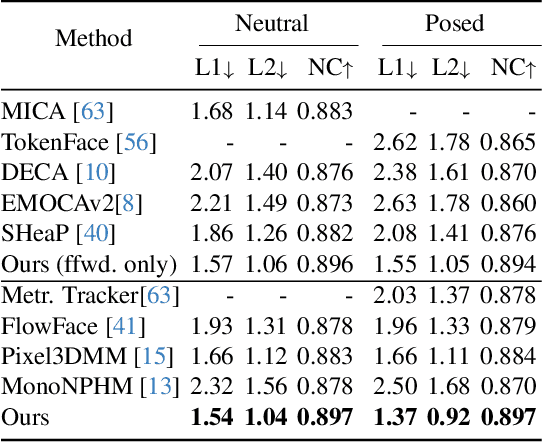
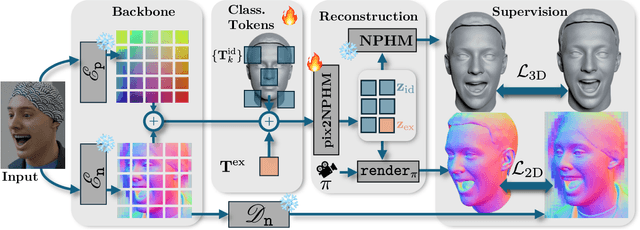
Neural Parametric Head Models (NPHMs) are a recent advancement over mesh-based 3d morphable models (3DMMs) to facilitate high-fidelity geometric detail. However, fitting NPHMs to visual inputs is notoriously challenging due to the expressive nature of their underlying latent space. To this end, we propose Pix2NPHM, a vision transformer (ViT) network that directly regresses NPHM parameters, given a single image as input. Compared to existing approaches, the neural parametric space allows our method to reconstruct more recognizable facial geometry and accurate facial expressions. For broad generalization, we exploit domain-specific ViTs as backbones, which are pretrained on geometric prediction tasks. We train Pix2NPHM on a mixture of 3D data, including a total of over 100K NPHM registrations that enable direct supervision in SDF space, and large-scale 2D video datasets, for which normal estimates serve as pseudo ground truth geometry. Pix2NPHM not only allows for 3D reconstructions at interactive frame rates, it is also possible to improve geometric fidelity by a subsequent inference-time optimization against estimated surface normals and canonical point maps. As a result, we achieve unprecedented face reconstruction quality that can run at scale on in-the-wild data.
FlexAvatar: Learning Complete 3D Head Avatars with Partial Supervision
Dec 17, 2025We introduce FlexAvatar, a method for creating high-quality and complete 3D head avatars from a single image. A core challenge lies in the limited availability of multi-view data and the tendency of monocular training to yield incomplete 3D head reconstructions. We identify the root cause of this issue as the entanglement between driving signal and target viewpoint when learning from monocular videos. To address this, we propose a transformer-based 3D portrait animation model with learnable data source tokens, so-called bias sinks, which enables unified training across monocular and multi-view datasets. This design leverages the strengths of both data sources during inference: strong generalization from monocular data and full 3D completeness from multi-view supervision. Furthermore, our training procedure yields a smooth latent avatar space that facilitates identity interpolation and flexible fitting to an arbitrary number of input observations. In extensive evaluations on single-view, few-shot, and monocular avatar creation tasks, we verify the efficacy of FlexAvatar. Many existing methods struggle with view extrapolation while FlexAvatar generates complete 3D head avatars with realistic facial animations. Website: https://tobias-kirschstein.github.io/flexavatar/
HairGS: Hair Strand Reconstruction based on 3D Gaussian Splatting
Sep 09, 2025Human hair reconstruction is a challenging problem in computer vision, with growing importance for applications in virtual reality and digital human modeling. Recent advances in 3D Gaussians Splatting (3DGS) provide efficient and explicit scene representations that naturally align with the structure of hair strands. In this work, we extend the 3DGS framework to enable strand-level hair geometry reconstruction from multi-view images. Our multi-stage pipeline first reconstructs detailed hair geometry using a differentiable Gaussian rasterizer, then merges individual Gaussian segments into coherent strands through a novel merging scheme, and finally refines and grows the strands under photometric supervision. While existing methods typically evaluate reconstruction quality at the geometric level, they often neglect the connectivity and topology of hair strands. To address this, we propose a new evaluation metric that serves as a proxy for assessing topological accuracy in strand reconstruction. Extensive experiments on both synthetic and real-world datasets demonstrate that our method robustly handles a wide range of hairstyles and achieves efficient reconstruction, typically completing within one hour. The project page can be found at: https://yimin-pan.github.io/hair-gs/
3DGH: 3D Head Generation with Composable Hair and Face
Jun 25, 2025We present 3DGH, an unconditional generative model for 3D human heads with composable hair and face components. Unlike previous work that entangles the modeling of hair and face, we propose to separate them using a novel data representation with template-based 3D Gaussian Splatting, in which deformable hair geometry is introduced to capture the geometric variations across different hairstyles. Based on this data representation, we design a 3D GAN-based architecture with dual generators and employ a cross-attention mechanism to model the inherent correlation between hair and face. The model is trained on synthetic renderings using carefully designed objectives to stabilize training and facilitate hair-face separation. We conduct extensive experiments to validate the design choice of 3DGH, and evaluate it both qualitatively and quantitatively by comparing with several state-of-the-art 3D GAN methods, demonstrating its effectiveness in unconditional full-head image synthesis and composable 3D hairstyle editing. More details will be available on our project page: https://c-he.github.io/projects/3dgh/.
Pixel3DMM: Versatile Screen-Space Priors for Single-Image 3D Face Reconstruction
May 01, 2025We address the 3D reconstruction of human faces from a single RGB image. To this end, we propose Pixel3DMM, a set of highly-generalized vision transformers which predict per-pixel geometric cues in order to constrain the optimization of a 3D morphable face model (3DMM). We exploit the latent features of the DINO foundation model, and introduce a tailored surface normal and uv-coordinate prediction head. We train our model by registering three high-quality 3D face datasets against the FLAME mesh topology, which results in a total of over 1,000 identities and 976K images. For 3D face reconstruction, we propose a FLAME fitting opitmization that solves for the 3DMM parameters from the uv-coordinate and normal estimates. To evaluate our method, we introduce a new benchmark for single-image face reconstruction, which features high diversity facial expressions, viewing angles, and ethnicities. Crucially, our benchmark is the first to evaluate both posed and neutral facial geometry. Ultimately, our method outperforms the most competitive baselines by over 15% in terms of geometric accuracy for posed facial expressions.
Avat3r: Large Animatable Gaussian Reconstruction Model for High-fidelity 3D Head Avatars
Feb 27, 2025Traditionally, creating photo-realistic 3D head avatars requires a studio-level multi-view capture setup and expensive optimization during test-time, limiting the use of digital human doubles to the VFX industry or offline renderings. To address this shortcoming, we present Avat3r, which regresses a high-quality and animatable 3D head avatar from just a few input images, vastly reducing compute requirements during inference. More specifically, we make Large Reconstruction Models animatable and learn a powerful prior over 3D human heads from a large multi-view video dataset. For better 3D head reconstructions, we employ position maps from DUSt3R and generalized feature maps from the human foundation model Sapiens. To animate the 3D head, our key discovery is that simple cross-attention to an expression code is already sufficient. Finally, we increase robustness by feeding input images with different expressions to our model during training, enabling the reconstruction of 3D head avatars from inconsistent inputs, e.g., an imperfect phone capture with accidental movement, or frames from a monocular video. We compare Avat3r with current state-of-the-art methods for few-input and single-input scenarios, and find that our method has a competitive advantage in both tasks. Finally, we demonstrate the wide applicability of our proposed model, creating 3D head avatars from images of different sources, smartphone captures, single images, and even out-of-domain inputs like antique busts. Project website: https://tobias-kirschstein.github.io/avat3r/
GAF: Gaussian Avatar Reconstruction from Monocular Videos via Multi-view Diffusion
Dec 13, 2024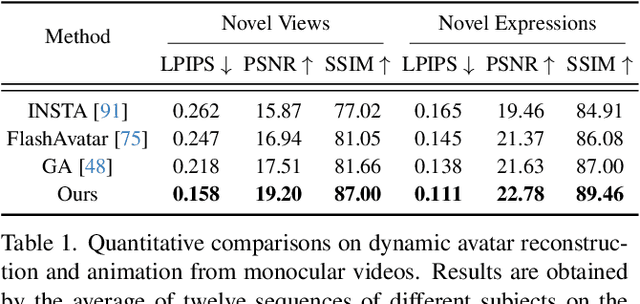
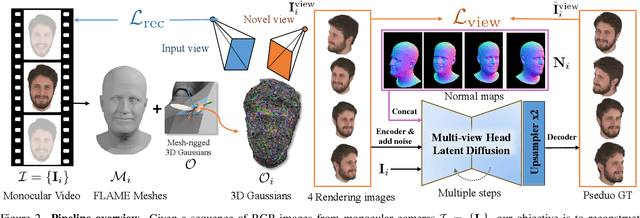
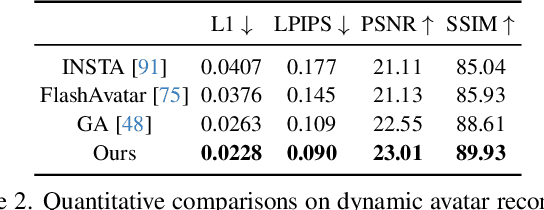
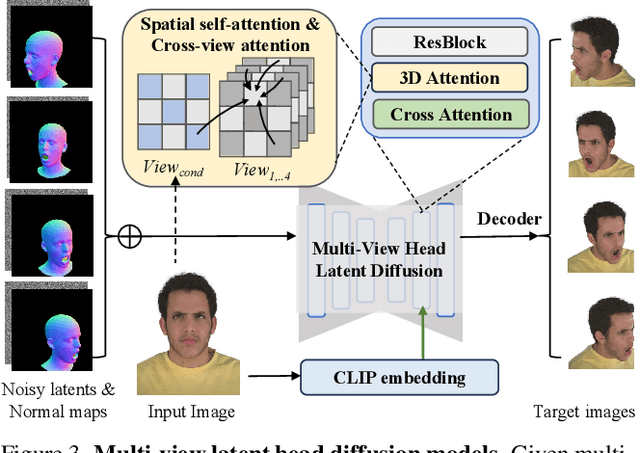
We propose a novel approach for reconstructing animatable 3D Gaussian avatars from monocular videos captured by commodity devices like smartphones. Photorealistic 3D head avatar reconstruction from such recordings is challenging due to limited observations, which leaves unobserved regions under-constrained and can lead to artifacts in novel views. To address this problem, we introduce a multi-view head diffusion model, leveraging its priors to fill in missing regions and ensure view consistency in Gaussian splatting renderings. To enable precise viewpoint control, we use normal maps rendered from FLAME-based head reconstruction, which provides pixel-aligned inductive biases. We also condition the diffusion model on VAE features extracted from the input image to preserve details of facial identity and appearance. For Gaussian avatar reconstruction, we distill multi-view diffusion priors by using iteratively denoised images as pseudo-ground truths, effectively mitigating over-saturation issues. To further improve photorealism, we apply latent upsampling to refine the denoised latent before decoding it into an image. We evaluate our method on the NeRSemble dataset, showing that GAF outperforms the previous state-of-the-art methods in novel view synthesis by a 5.34\% higher SSIM score. Furthermore, we demonstrate higher-fidelity avatar reconstructions from monocular videos captured on commodity devices.
GaussianSpeech: Audio-Driven Gaussian Avatars
Nov 27, 2024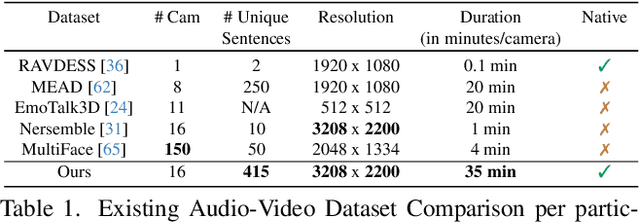
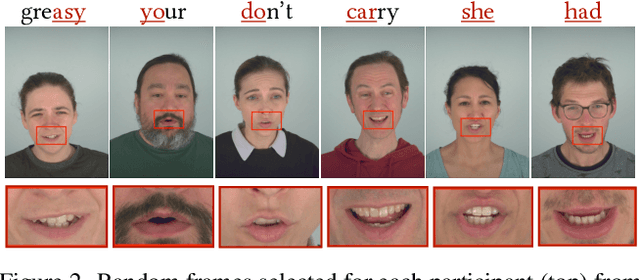
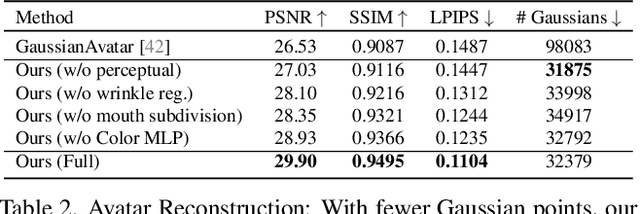
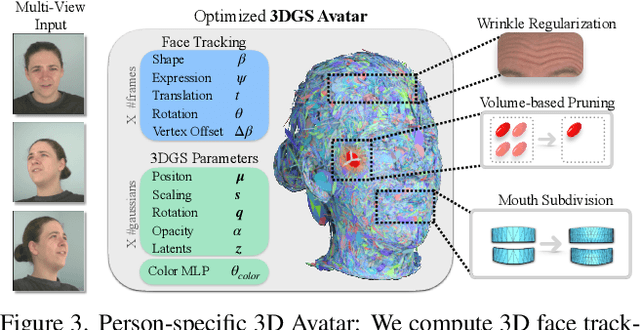
We introduce GaussianSpeech, a novel approach that synthesizes high-fidelity animation sequences of photo-realistic, personalized 3D human head avatars from spoken audio. To capture the expressive, detailed nature of human heads, including skin furrowing and finer-scale facial movements, we propose to couple speech signal with 3D Gaussian splatting to create realistic, temporally coherent motion sequences. We propose a compact and efficient 3DGS-based avatar representation that generates expression-dependent color and leverages wrinkle- and perceptually-based losses to synthesize facial details, including wrinkles that occur with different expressions. To enable sequence modeling of 3D Gaussian splats with audio, we devise an audio-conditioned transformer model capable of extracting lip and expression features directly from audio input. Due to the absence of high-quality datasets of talking humans in correspondence with audio, we captured a new large-scale multi-view dataset of audio-visual sequences of talking humans with native English accents and diverse facial geometry. GaussianSpeech consistently achieves state-of-the-art performance with visually natural motion at real time rendering rates, while encompassing diverse facial expressions and styles.