 Add to Chrome
 Add to Firefox
 Add to Edge
UMI-Bench 1.0: An Open and Reproducible Real-World Benchmark for Tabletop Robotic Manipulation with UMI Data
Jun 09, 2026
Real-robot evaluation is essential for understanding whether learned manipulation policies can operate reliably outside curated demonstrations. This need is particularly pressing for Universal Manipulation Interface (UMI)-style policies, whose performance depends on the coupling between wrist-view observations, action representation, data collection, and physical deployment. Existing real-world benchmarks have made important progress, but they are not designed around this UMI data-to-deployment setting. We present UMI-Bench 1.0, a local-first real-robot benchmark for standardized evaluation of UMI-style manipulation policies. To the best of our knowledge, this is the first benchmark dedicated to real-world evaluation of UMI-based manipulation models. UMI-Bench aligns data collection, scene reset, policy execution, result logging, and task-factor analysis within a unified protocol. By making the full evaluation process reproducible and auditable, UMI-Bench provides a practical testbed for measuring how UMI-trained policies generalize to real physical manipulation.

Learning Semantic Facial Descriptors for Accurate Face Animation
Jan 29, 2025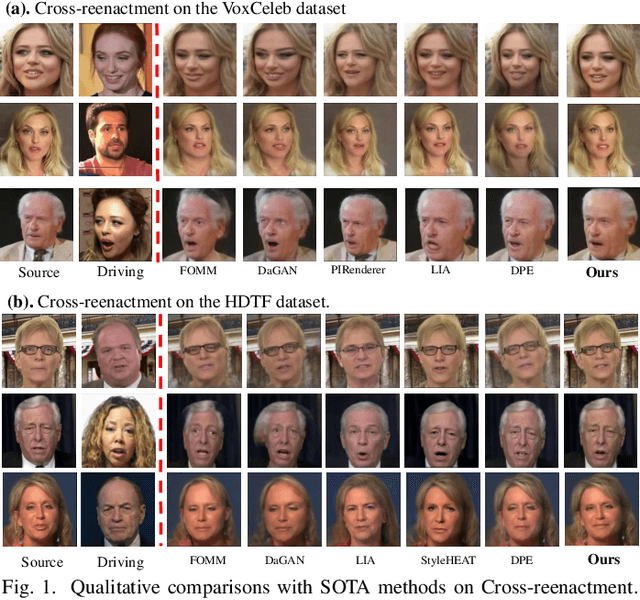
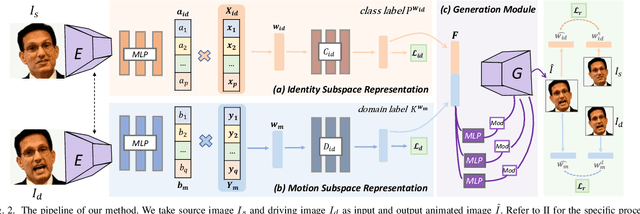
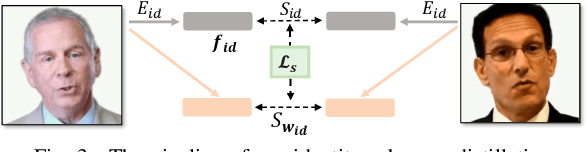
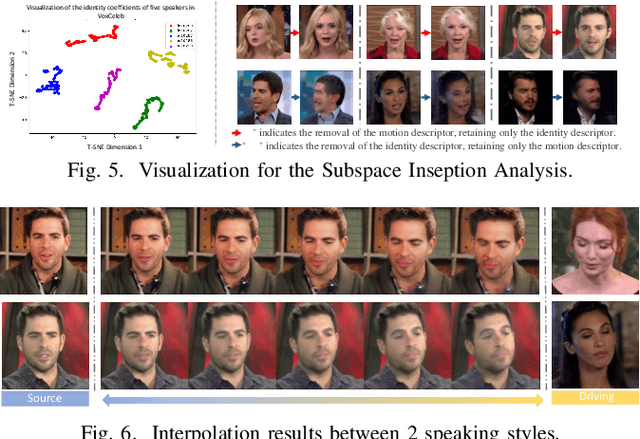
Face animation is a challenging task. Existing model-based methods (utilizing 3DMMs or landmarks) often result in a model-like reconstruction effect, which doesn't effectively preserve identity. Conversely, model-free approaches face challenges in attaining a decoupled and semantically rich feature space, thereby making accurate motion transfer difficult to achieve. We introduce the semantic facial descriptors in learnable disentangled vector space to address the dilemma. The approach involves decoupling the facial space into identity and motion subspaces while endowing each of them with semantics by learning complete orthogonal basis vectors. We obtain basis vector coefficients by employing an encoder on the source and driving faces, leading to effective facial descriptors in the identity and motion subspaces. Ultimately, these descriptors can be recombined as latent codes to animate faces. Our approach successfully addresses the issue of model-based methods' limitations in high-fidelity identity and the challenges faced by model-free methods in accurate motion transfer. Extensive experiments are conducted on three challenging benchmarks (i.e. VoxCeleb, HDTF, CelebV). Comprehensive quantitative and qualitative results demonstrate that our model outperforms SOTA methods with superior identity preservation and motion transfer.