 Add to Chrome
 Add to Firefox
 Add to Edge
ProtoAct: Turning Wet-Lab Protocols into Embodied Robotic Actions
Aug 03, 2026
Biological wet-lab protocols are written for trained researchers and often leave routine operations, state-dependent conditions, and contextual parameters implicit, making them difficult to translate into robot-executable actions. We present ProtoAct, a structured protocol-grounding framework that converts free-form biological procedures into state-aware, embodiment-ready action sequences. ProtoAct uses ProtoRAG to retrieve manually annotated examples for context-sensitive parsing, employs RefineChecker to detect and revise missing or inconsistent steps, and applies ActSchema to map the refined procedure into constrained JSON function sequences. We further introduce BioP2E, for which we manually annotate 22 cell-culture protocols into 258 monitoring conditions, 910 executable subtasks, and 962 grounded action calls. Evaluation across seven large language models demonstrates that ProtoAct can be effectively instantiated with different backbones. Ablations confirm that retrieval, posterior checking, and schema constraints make complementary contributions. The parsed subtasks further support demonstration collection and VLA model training, enabling successful execution in both simulation and real-robot settings. ProtoAct thus provides a practical interface between biological protocol understanding and embodied robotic execution.

BioVLN: A Simulation Platform for Visual Language Navigation in Biomedical Laboratories
Jul 29, 2026Biomedical laboratory robots must navigate to instruments before performing experimental procedures. Existing embodied navigation platforms are designed for household environments and treat a target as an object center or an arbitrary nearby position. This representation is inadequate for laboratory instruments, which must be approached from their operating side while maintaining safe clearance from surrounding equipment. We introduce BioVLN, a simulation platform for developing and evaluating visual-language navigation agents in biomedical laboratories. BioVLN represents each instrument with three regions: its physical body, a surrounding clearance region, and an operation area in front of the usable side. This model is applied consistently to scene generation, target placement, navigation evaluation, and safety analysis, so success depends on reaching a position from which the instrument can be accessed. BioVLN supports procedural scene generation and manually designed environments, producing 47 scenes and 1667 episodes. Standardized navigation and reinforcement-learning interfaces enable trajectory collection and policy training. Experiments show that geometric exploration reaches 74.4--87.5% success, while sampling multiple valid positions in the operation area improves success to 83.3--92.5% and reduces unsafe proximity.
An Embodied Simulation Platform, Benchmark, and Data-Efficient Augmentation Framework for Wet-Lab Robotics
Jun 11, 2026Wet-lab robots can improve the reproducibility, throughput, and safety of biomedical experiments, but scaling their learning requires customizable simulators for safe and reproducible task generation, open editable laboratory assets, and efficient pipelines that turn limited demonstrations into usable training data. We present Pipette, an embodied simulation platform, benchmark, and data-efficient augmentation framework for wet-lab robot learning. Pipette releases over 43 open-source and re-editable wet-lab assets, together with an extensible asset-building pipeline. A key component of Pipette is its simulation-based data augmentation pipeline, replaying human demonstrations in simulation, applies lighting, camera, speed, and action perturbations, and filters generated episodes with automatic task success checks, rapidly expanding usable training data from limited manual demonstrations. We further introduce an 11-task wet-lab embodied benchmark covering sample handling, culture-ware manipulation, device operation, and precision placement. With only 30 demonstrations per task, ACT achieves 65.5% average success rate, while simulation augmentation improves SmolVLA from 44.1% to 74.7% and π0 from 40.4% to 46.5%, validating the effectiveness of Pipette for data-efficient VLA training and evaluation. Pipette also supports natural-language-driven scene construction and task registration, lowering the barrier for non-expert users to define new wet-lab robotic tasks.
VISTA: Vision-Grounded and Physics-Validated Adaptation of UMI data for VLA Training
Jun 04, 2026Universal Manipulation Interface (UMI) enables scalable real-world robot data collection without hardware-specific teleoperation, yet leveraging UMI data to train large-scale Vision-Language-Action (VLA) models remains fundamentally challenging. We identify two critical mismatches: wrist-mounted fisheye views, with severe radial distortion and local gripper-centric perspectives, are out-of-distribution for pretrained VLMs; and human-collected trajectories frequently violate kinematic limits, incur collisions, or exceed controller bandwidth, teaching VLA policies physically infeasible actions. To address the challenges, we present VISTA, a framework that bridges this dual gap through three synergistic components. (i)~UMI-VQA, the first large-scale VQA dataset tailored to wrist-mounted fisheye observations, aligns VLM representations to the distorted visual regime via auxiliary vision-language supervision. (ii)~A systematic physical-validation pipeline performs a data-completeness pre-check and scores each valid trajectory for trajectory continuity, self-collision risk, and execution fidelity before it enters training. (iii)~A two-stage co-training recipe jointly learns vision-language grounding on UMI-VQA and action prediction on validated trajectories. Our experiments empirically show that incorporating UMI-VQA consistently improves downstream policy performance, and that physical-validation scores are strongly predictive of deployment success. On diverse simulation and real-world manipulation tasks, VISTA significantly outperforms strong baselines including $π_{0.5}$, LingBot-VLA, and Wall-X. We release the physical-validation pipeline, UMI-VQA, validated trajectory data, and the pre-trained model for the community.
Vision-Core Guided Contrastive Learning for Balanced Multi-modal Prognosis Prediction of Stroke
May 14, 2026Deep learning and multi-modal fusion have demonstrated transformative potential in medical diagnosis by integrating diverse data sources. However, accurate prognosis for ischemic stroke remains challenging due to limitations in existing multi-modal approaches. First, current methods are predominantly confined to dual-modal fusion, lacking a framework that effectively integrates the trifecta of medical images, structured clinical data, and unstructured text. Second, they often fail to establish deep bidirectional interactions between modalities; To address these critical gaps, this paper proposes a novel tri-modal fusion model for ischemic stroke prognosis. Our approach first enriches the data representation by employing a Large Language Model (LLM) to automatically generate semi-structured diagnostic text from brain MRIs. This process not only addresses the scarcity of expert annotations but also serves as a regularized semantic enhancement, improving multimodal fusion robustness. Furthermore, we design a core component termed the Vision-Conditioned Dual Alignment Fusion Module (VDAFM), which strategically uses visual features as a conditional prior to guide fine-grained interaction with the generated text. This module achieves a dynamic and profound fusion through a dual semantic alignment loss, effectively mitigating modal heterogeneity. Extensive experiments on a real-world clinical dataset demonstrate that our model achieves state-of-the-art performance.
MetaGAI: A Large-Scale and High-Quality Benchmark for Generative AI Model and Data Card Generation
Apr 26, 2026The rapid proliferation of Generative AI necessitates rigorous documentation standards for transparency and governance. However, manual creation of Model and Data Cards is not scalable, while automated approaches lack large-scale, high-fidelity benchmarks for systematic evaluation. We introduce MetaGAI, a comprehensive benchmark comprising 2,541 verified document triplets constructed through semantic triangulation of academic papers, GitHub repositories, and Hugging Face artifacts. Unlike prior single-source datasets, MetaGAI employs a multi-agent framework with specialized Retriever, Generator, and Editor agents, validated through four-dimensional human-in-the-loop assessment, including human evaluation of editor-refined ground truth. We establish a robust evaluation protocol combining automated metrics with validated LLM-as-a-Judge frameworks. Extensive analysis reveals that sparse Mixture-of-Experts architectures achieve superior cost-quality efficiency, while a fundamental trade-off exists between faithfulness and completeness. MetaGAI provides a foundational testbed for benchmarking, training, and analyzing automated Model and Data Card generation methods at scale. Our data and code are available at: https://github.com/haoxuan-unt2024/MetaGAI-Benchmark.
Re$^2$MoGen: Open-Vocabulary Motion Generation via LLM Reasoning and Physics-Aware Refinement
Apr 20, 2026Text-to-motion (T2M) generation aims to control the behavior of a target character via textual descriptions. Leveraging text-motion paired datasets, existing T2M models have achieved impressive performance in generating high-quality motions within the distribution of their training data. However, their performance deteriorates notably when the motion descriptions differ significantly from the training texts. To address this issue, we propose Re$^2$MoGen, a Reasoning and Refinement open-vocabulary Motion Generation framework that leverages enhanced Large Language Model (LLM) reasoning to generate an initial motion planning and then refine its physical plausibility via reinforcement learning (RL) post-training. Specifically, Re$^2$MoGen consists of three stages: We first employ Monte Carlo tree search to enhance the LLM's reasoning ability in generating reasonable keyframes of the motion based on text prompts, specifying only the root and several key joints' positions to ease the reasoning process. Then, we apply a human pose model as a prior to optimize the full-body poses based on the planned keyframes and use the resulting incomplete motion to supervise fine-tuning a pre-trained motion generator via a dynamic temporal matching objective, enabling spatiotemporal completion. Finally, we use post-training with physics-aware reward to refine motion quality to eliminate physical implausibility in LLM-planned motions. Extensive experiments demonstrate that our framework can generate semantically consistent and physically plausible motions and achieve state-of-the-art performance in open-vocabulary motion generation.
The Evolving Role of Large Language Models in Scientific Innovation: Evaluator, Collaborator, and Scientist
Jul 16, 2025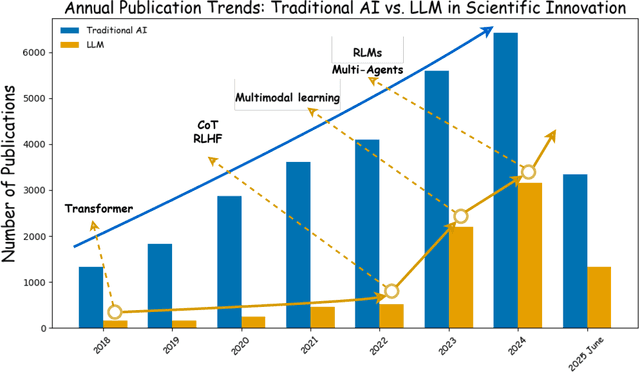
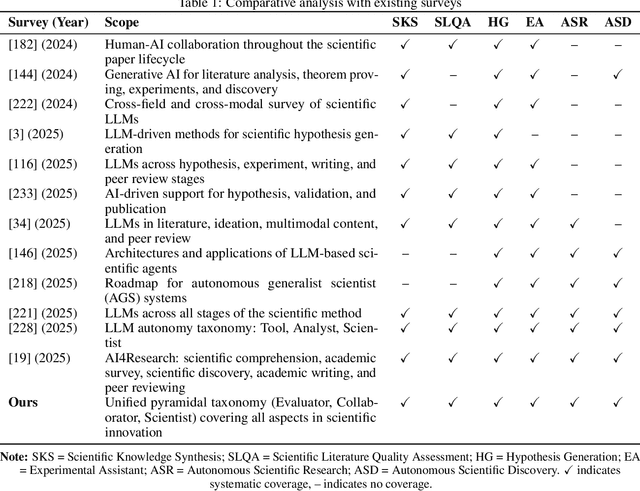
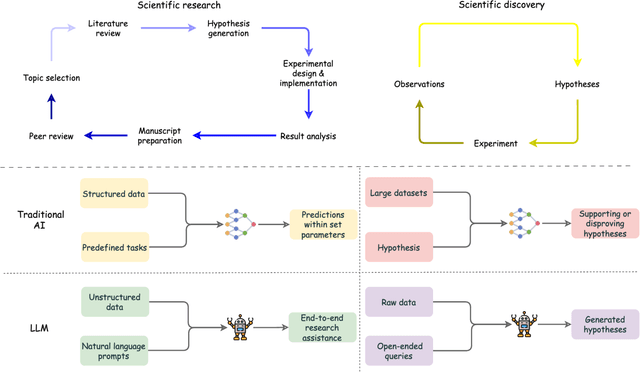
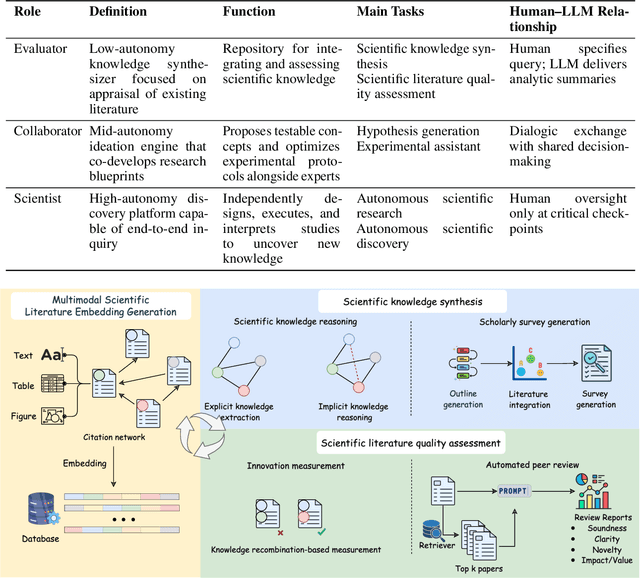
Scientific innovation is undergoing a paradigm shift driven by the rapid advancement of Large Language Models (LLMs). As science faces mounting challenges including information overload, disciplinary silos, and diminishing returns on conventional research methods, LLMs are emerging as powerful agents capable not only of enhancing scientific workflows but also of participating in and potentially leading the innovation process. Existing surveys mainly focus on different perspectives, phrases, and tasks in scientific research and discovery, while they have limitations in understanding the transformative potential and role differentiation of LLM. This survey proposes a comprehensive framework to categorize the evolving roles of LLMs in scientific innovation across three hierarchical levels: Evaluator, Collaborator, and Scientist. We distinguish between LLMs' contributions to structured scientific research processes and open-ended scientific discovery, thereby offering a unified taxonomy that clarifies capability boundaries, evaluation criteria, and human-AI interaction patterns at each level. Through an extensive analysis of current methodologies, benchmarks, systems, and evaluation metrics, this survey delivers an in-depth and systematic synthesis on LLM-driven scientific innovation. We present LLMs not only as tools for automating existing processes, but also as catalysts capable of reshaping the epistemological foundations of science itself. This survey offers conceptual clarity, practical guidance, and theoretical foundations for future research, while also highlighting open challenges and ethical considerations in the pursuit of increasingly autonomous AI-driven science. Resources related to this survey can be accessed on GitHub at: https://github.com/haoxuan-unt2024/llm4innovation.
HumanoidGen: Data Generation for Bimanual Dexterous Manipulation via LLM Reasoning
Jul 01, 2025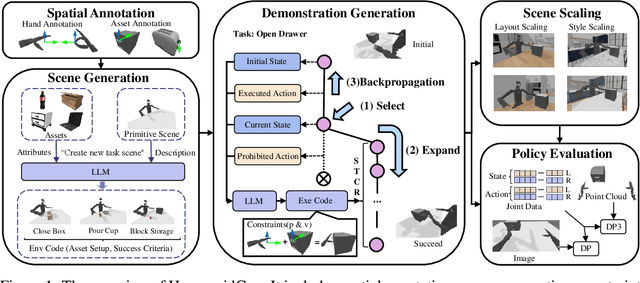
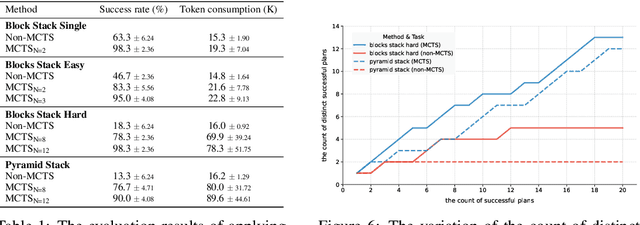
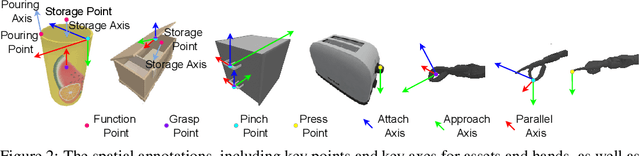
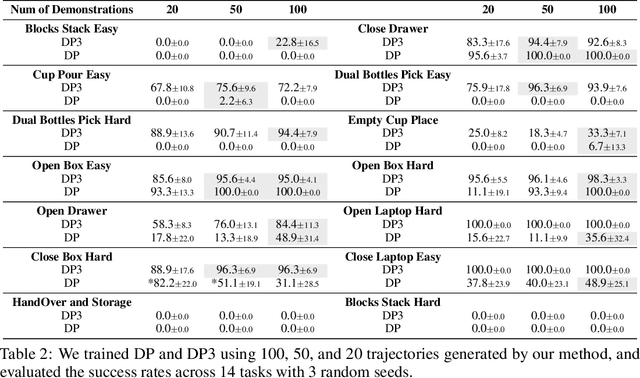
For robotic manipulation, existing robotics datasets and simulation benchmarks predominantly cater to robot-arm platforms. However, for humanoid robots equipped with dual arms and dexterous hands, simulation tasks and high-quality demonstrations are notably lacking. Bimanual dexterous manipulation is inherently more complex, as it requires coordinated arm movements and hand operations, making autonomous data collection challenging. This paper presents HumanoidGen, an automated task creation and demonstration collection framework that leverages atomic dexterous operations and LLM reasoning to generate relational constraints. Specifically, we provide spatial annotations for both assets and dexterous hands based on the atomic operations, and perform an LLM planner to generate a chain of actionable spatial constraints for arm movements based on object affordances and scenes. To further improve planning ability, we employ a variant of Monte Carlo tree search to enhance LLM reasoning for long-horizon tasks and insufficient annotation. In experiments, we create a novel benchmark with augmented scenarios to evaluate the quality of the collected data. The results show that the performance of the 2D and 3D diffusion policies can scale with the generated dataset. Project page is https://openhumanoidgen.github.io.
Unsupervised Skill Discovery through Skill Regions Differentiation
Jun 17, 2025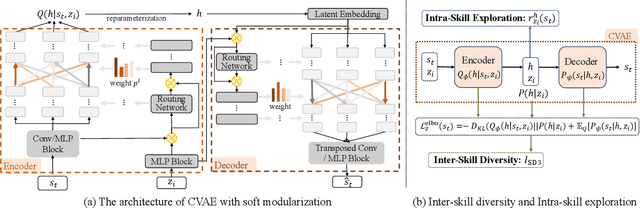
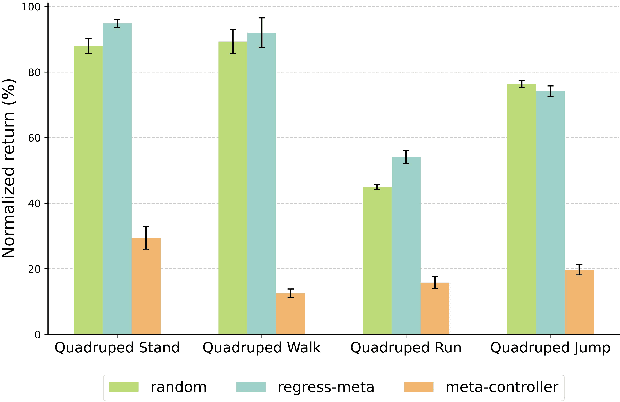
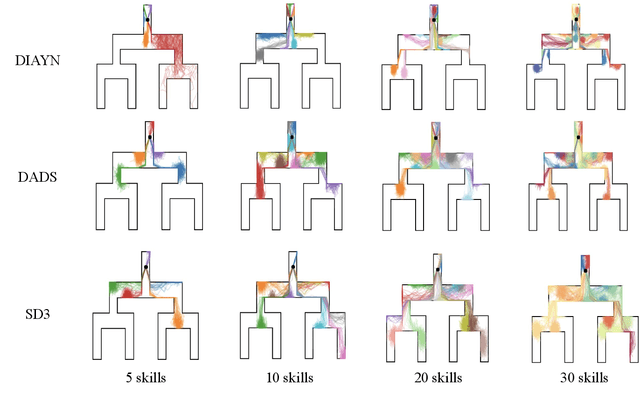

Unsupervised Reinforcement Learning (RL) aims to discover diverse behaviors that can accelerate the learning of downstream tasks. Previous methods typically focus on entropy-based exploration or empowerment-driven skill learning. However, entropy-based exploration struggles in large-scale state spaces (e.g., images), and empowerment-based methods with Mutual Information (MI) estimations have limitations in state exploration. To address these challenges, we propose a novel skill discovery objective that maximizes the deviation of the state density of one skill from the explored regions of other skills, encouraging inter-skill state diversity similar to the initial MI objective. For state-density estimation, we construct a novel conditional autoencoder with soft modularization for different skill policies in high-dimensional space. Meanwhile, to incentivize intra-skill exploration, we formulate an intrinsic reward based on the learned autoencoder that resembles count-based exploration in a compact latent space. Through extensive experiments in challenging state and image-based tasks, we find our method learns meaningful skills and achieves superior performance in various downstream tasks.