 Add to Chrome
 Add to Firefox
 Add to Edge
Traceable LLM Reasoning for Fake-Order Fraud Detection
Jul 25, 2026
Detecting fake-order fraud at scale remains a critical challenge for large online-to-offline (O2O) service platforms, as existing approaches often rely on expert-designed features, produce black-box decisions, and provide limited interpretability. To address these limitations, we propose DeepScrub, a reinforcement learning framework built upon large language models (LLMs) for fake-order fraud detection with traceable reasoning. DeepScrub introduces three innovations. First, a semantic unification module converts heterogeneous risk signals into textual descriptions that LLMs can understand. Second, continued pre-training on risk-control corpora injects domain knowledge, and task rewards jointly evaluate prediction correctness and reasoning quality. Third, the SUggest-REflect (SURE) mechanism incorporates expert feedback and model self-checking to iteratively refine reasoning paths. On a real-world fake-order fraud detection dataset, DeepScrub achieves a macro-F1 score of 85.3%, outperforming the best baseline by 2.7 percentage points. Our task-optimized 8B model further surpasses a 32B model, showing that domain adaptation can matter more than model scale in this setting. In a four-week live pilot, DeepScrub achieved 91.8% precision and 88.5% recall, improving over first-stage human reviewers by 16.6 and 38.8 percentage points. It reduced first-stage manual review workload by 94% and saved nearly one million RMB annually. These results show that DeepScrub improves fraud review accuracy, reduces first-stage review workload, and provides traceable evidence for production risk-review workflows.

GlaKG: A Biomarker-Centric Fundus Knowledge Graph for Explainable Glaucoma Diagnosis and Risk Assessment
Jul 06, 2026Glaucoma is a leading cause of irreversible blindness worldwide, yet most automated diagnosis systems rely on opaque deep-learning models that offer little clinical interpretability. We present GlaKG, a biomarker-centric fundus knowledge graph that integrates structural biomarkers, clinically grounded rules, and image features to produce traceable reasoning for glaucoma diagnosis and risk stratification. GlaKG encodes six entity types (Fundus Image, Optic Disc, Neural Rim, Pathology, Diagnosis, Risk Level), eight relation types, and 11 clinically validated rules into a unified graph, so that every prediction is accompanied by an explicit reasoning chain linking biomarker evidence to activated clinical rules. To keep knowledge-based reasoning strictly separate from label information, we adopt a post-processing fusion framework that combines ResNet50 image embeddings with a normalized KG reasoning-chain score via a tunable weight alpha, with all fitting confined to the training split. On a publicly available, AI-annotated fundus dataset, GlaKG reaches F1 = 0.9953 for binary glaucoma classification and 0.930 accuracy with 0.922 weighted F1 for four-class risk stratification; we report openly that the dataset's biomarker annotations are highly label-correlated, and therefore frame these figures as an upper bound attainable with clean structured biomarkers rather than as leakage-free image-only performance. Feature-importance analysis shows KG-derived and biomarker features contributing near-equally (51.1% vs. 48.9%), and the reasoning chain flags borderline cases by exposing low chain scores rather than failing silently. GlaKG's central contribution is therefore a clinically auditable reasoning framework that complements raw predictive performance by explicitly exposing the biomarker evidence and rule activations behind each decision.
GRAFT: Gain-Recalibrated Adapters for Transformer-Based Neural Population Activity Modeling
Jun 09, 2026Neural population activity models can recover rich temporal structure from binned spikes, but their read-in and readout layers often remain tied to a fixed set of recorded neurons. This coupling limits reuse in long-term brain-computer interfaces, where recorded neuron identities, counts, and response statistics can change across days. We introduce GRAFT, a Transformer-based neural population activity model that separates reusable temporal dynamics from a recalibratable neuron interface. The neuron interface controls how recorded neurons enter and leave the shared backbone, and auxiliary gain and positional mechanisms support neural activity modeling inside the Transformer. On MC Maze under the standard NLB'21 protocol, GRAFT reaches 0.3866 co-bps as an ensemble, setting a new state of the art on the primary co-bps metric among public and reported NLB'21 results. In a cross-day protocol constructed from the NLB'21 MC Maze dataset series, GRAFT recalibrates from MC Maze to the scaled MC Maze datasets (Large/Medium/Small) by updating only 9.21% of parameters, reaching 0.3749, 0.3112, and 0.3152 co-bps with restricted target-day support sets. These results show that the same interface-backbone separation supports both strong Transformer-based neural population activity modeling and data-efficient cross-day recalibration.
EgoAERO: Learning Dexterous Manipulation from a Single Egocentric Video without Object Assets
Jun 06, 2026Egocentric RGB-D videos offer a natural source of human dexterous manipulation demonstrations, but existing data is difficult to use for robot learning because object pose, geometry, and contact information are often missing or require pre-scanned object assets. We present EgoAERO, the first framework that learns dexterous manipulation from a single egocentric RGB-D human demonstration without object assets. EgoAERO reconstructs contact-consistent hand-object trajectories through asset-free object tracking and reconstruction, ego motion compensation, and adaptive contact optimization, then converts them into robot policies using two-stage residual learning. We further introduce an online quality assessment mechanism and construct EgoDex-R, a large-scale egocentric dataset with 4.3M RGB-D frames for dexterous policy learning. Simulation and real-world experiments show that EgoAERO enables single-demonstration dexterous manipulation and achieves downstream performance close to CAD-based reconstructions on HOI4D.
Deep reflective reasoning in interdependence constrained structured data extraction from clinical notes for digital health
Mar 20, 2026Extracting structured information from clinical notes requires navigating a dense web of interdependent variables where the value of one attribute logically constrains others. Existing Large Language Model (LLM)-based extraction pipelines often struggle to capture these dependencies, leading to clinically inconsistent outputs. We propose deep reflective reasoning, a large language model agent framework that iteratively self-critiques and revises structured outputs by checking consistency among variables, the input text, and retrieved domain knowledge, stopping when outputs converge. We extensively evaluate the proposed method in three diverse oncology applications: (1) On colorectal cancer synoptic reporting from gross descriptions (n=217), reflective reasoning improved average F1 across eight categorical synoptic variables from 0.828 to 0.911 and increased mean correct rate across four numeric variables from 0.806 to 0.895; (2) On Ewing sarcoma CD99 immunostaining pattern identification (n=200), the accuracy improved from 0.870 to 0.927; (3) On lung cancer tumor staging (n=100), tumor stage accuracy improved from 0.680 to 0.833 (pT: 0.842 -> 0.884; pN: 0.885 -> 0.948). The results demonstrate that deep reflective reasoning can systematically improve the reliability of LLM-based structured data extraction under interdependence constraints, enabling more consistent machine-operable clinical datasets and facilitating knowledge discovery with machine learning and data science towards digital health.
MEDVISTAGYM: A Scalable Training Environment for Thinking with Medical Images via Tool-Integrated Reinforcement Learning
Jan 12, 2026Vision language models (VLMs) achieve strong performance on general image understanding but struggle to think with medical images, especially when performing multi-step reasoning through iterative visual interaction. Medical VLMs often rely on static visual embeddings and single-pass inference, preventing models from re-examining, verifying, or refining visual evidence during reasoning. While tool-integrated reasoning offers a promising path forward, open-source VLMs lack the training infrastructure to learn effective tool selection, invocation, and coordination in multi-modal medical reasoning. We introduce MedVistaGym, a scalable and interactive training environment that incentivizes tool-integrated visual reasoning for medical image analysis. MedVistaGym equips VLMs to determine when and which tools to invoke, localize task-relevant image regions, and integrate single or multiple sub-image evidence into interleaved multimodal reasoning within a unified, executable interface for agentic training. Using MedVistaGym, we train MedVistaGym-R1 to interleave tool use with agentic reasoning through trajectory sampling and end-to-end reinforcement learning. Across six medical VQA benchmarks, MedVistaGym-R1-8B exceeds comparably sized tool-augmented baselines by 19.10% to 24.21%, demonstrating that structured agentic training--not tool access alone--unlocks effective tool-integrated reasoning for medical image analysis.
MedAgentGym: Training LLM Agents for Code-Based Medical Reasoning at Scale
Jun 04, 2025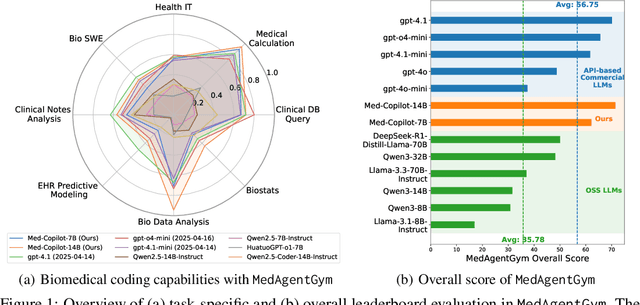
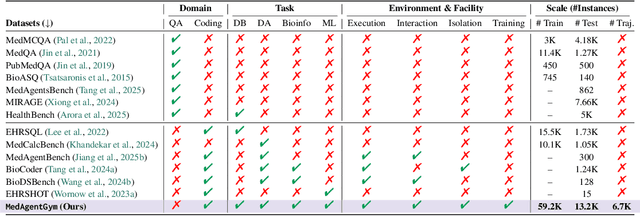
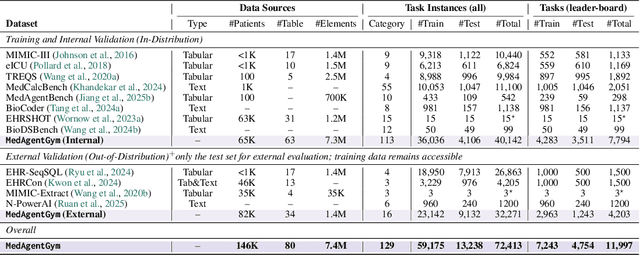
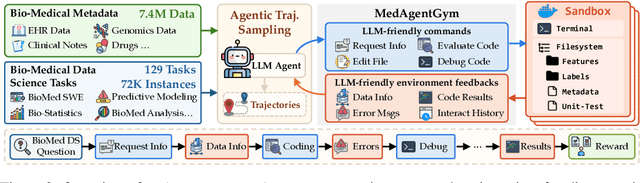
We introduce MedAgentGYM, the first publicly available training environment designed to enhance coding-based medical reasoning capabilities in large language model (LLM) agents. MedAgentGYM comprises 72,413 task instances across 129 categories derived from authentic real-world biomedical scenarios. Tasks are encapsulated within executable coding environments, each featuring detailed task descriptions, interactive feedback mechanisms, verifiable ground-truth annotations, and scalable training trajectory generation. Extensive benchmarking of over 30 LLMs reveals a notable performance disparity between commercial API-based models and open-source counterparts. Leveraging MedAgentGYM, Med-Copilot-7B achieves substantial performance gains through supervised fine-tuning (+36.44%) and continued reinforcement learning (+42.47%), emerging as an affordable and privacy-preserving alternative competitive with gpt-4o. By offering both a comprehensive benchmark and accessible, expandable training resources within unified execution environments, MedAgentGYM delivers an integrated platform to develop LLM-based coding assistants for advanced biomedical research and practice.
Large language models enabled multiagent ensemble method for efficient EHR data labeling
Oct 21, 2024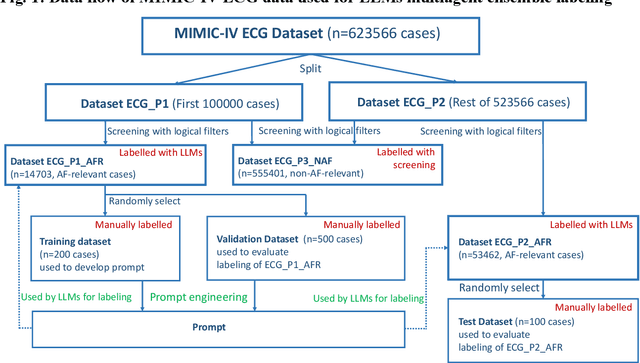
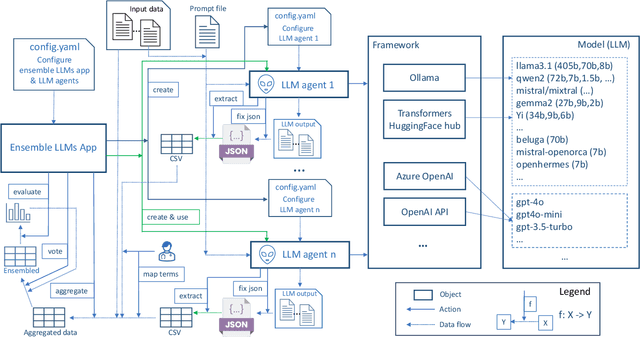

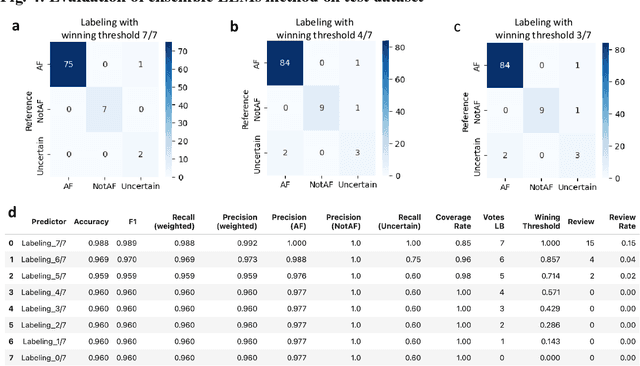
This study introduces a novel multiagent ensemble method powered by LLMs to address a key challenge in ML - data labeling, particularly in large-scale EHR datasets. Manual labeling of such datasets requires domain expertise and is labor-intensive, time-consuming, expensive, and error-prone. To overcome this bottleneck, we developed an ensemble LLMs method and demonstrated its effectiveness in two real-world tasks: (1) labeling a large-scale unlabeled ECG dataset in MIMIC-IV; (2) identifying social determinants of health (SDOH) from the clinical notes of EHR. Trading off benefits and cost, we selected a pool of diverse open source LLMs with satisfactory performance. We treat each LLM's prediction as a vote and apply a mechanism of majority voting with minimal winning threshold for ensemble. We implemented an ensemble LLMs application for EHR data labeling tasks. By using the ensemble LLMs and natural language processing, we labeled MIMIC-IV ECG dataset of 623,566 ECG reports with an estimated accuracy of 98.2%. We applied the ensemble LLMs method to identify SDOH from social history sections of 1,405 EHR clinical notes, also achieving competitive performance. Our experiments show that the ensemble LLMs can outperform individual LLM even the best commercial one, and the method reduces hallucination errors. From the research, we found that (1) the ensemble LLMs method significantly reduces the time and effort required for labeling large-scale EHR data, automating the process with high accuracy and quality; (2) the method generalizes well to other text data labeling tasks, as shown by its application to SDOH identification; (3) the ensemble of a group of diverse LLMs can outperform or match the performance of the best individual LLM; and (4) the ensemble method substantially reduces hallucination errors. This approach provides a scalable and efficient solution to data-labeling challenges.
Causal Effect Estimation using identifiable Variational AutoEncoder with Latent Confounders and Post-Treatment Variables
Aug 13, 2024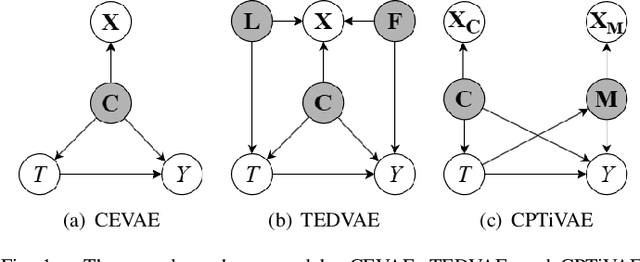
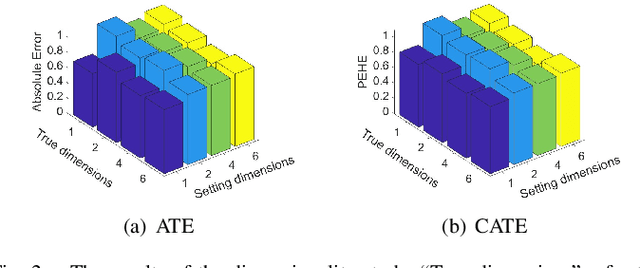
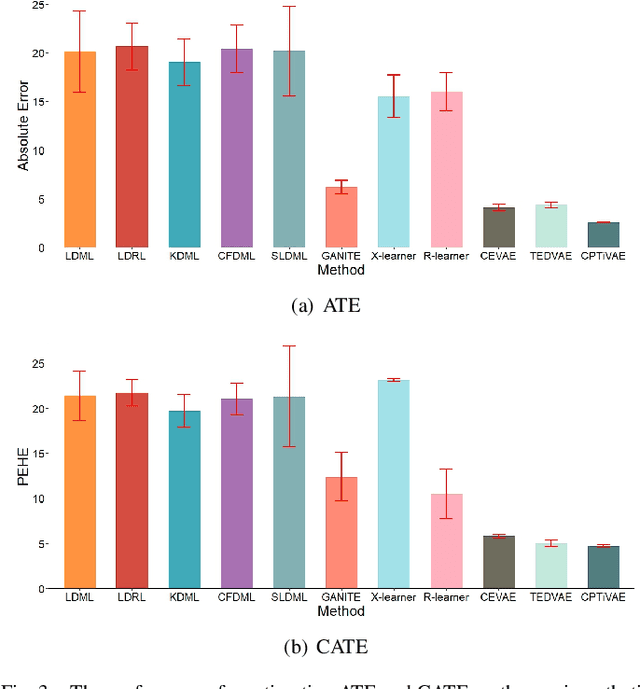
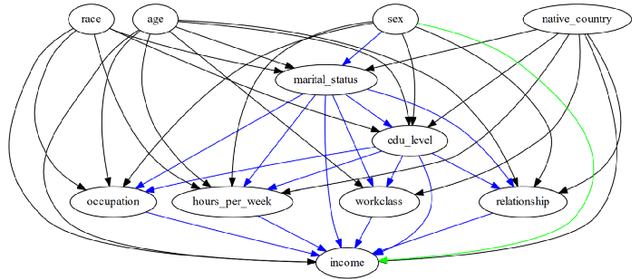
Estimating causal effects from observational data is challenging, especially in the presence of latent confounders. Much work has been done on addressing this challenge, but most of the existing research ignores the bias introduced by the post-treatment variables. In this paper, we propose a novel method of joint Variational AutoEncoder (VAE) and identifiable Variational AutoEncoder (iVAE) for learning the representations of latent confounders and latent post-treatment variables from their proxy variables, termed CPTiVAE, to achieve unbiased causal effect estimation from observational data. We further prove the identifiability in terms of the representation of latent post-treatment variables. Extensive experiments on synthetic and semi-synthetic datasets demonstrate that the CPTiVAE outperforms the state-of-the-art methods in the presence of latent confounders and post-treatment variables. We further apply CPTiVAE to a real-world dataset to show its potential application.
Disentangled Latent Representation Learning for Tackling the Confounding M-Bias Problem in Causal Inference
Dec 08, 2023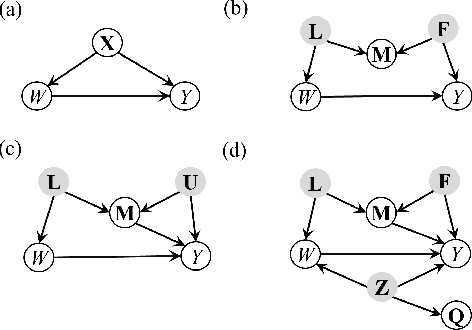
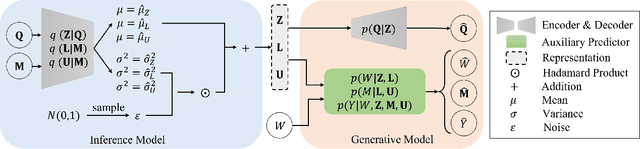
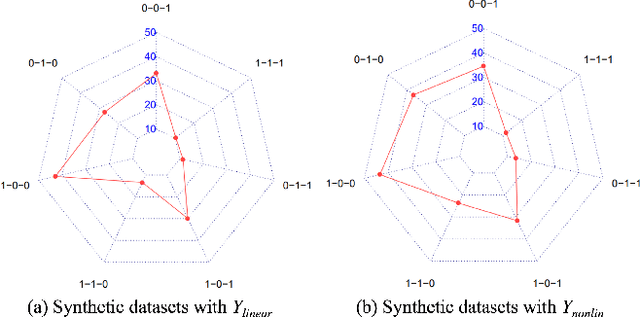
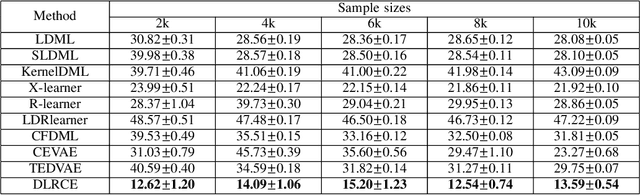
In causal inference, it is a fundamental task to estimate the causal effect from observational data. However, latent confounders pose major challenges in causal inference in observational data, for example, confounding bias and M-bias. Recent data-driven causal effect estimators tackle the confounding bias problem via balanced representation learning, but assume no M-bias in the system, thus they fail to handle the M-bias. In this paper, we identify a challenging and unsolved problem caused by a variable that leads to confounding bias and M-bias simultaneously. To address this problem with co-occurring M-bias and confounding bias, we propose a novel Disentangled Latent Representation learning framework for learning latent representations from proxy variables for unbiased Causal effect Estimation (DLRCE) from observational data. Specifically, DLRCE learns three sets of latent representations from the measured proxy variables to adjust for the confounding bias and M-bias. Extensive experiments on both synthetic and three real-world datasets demonstrate that DLRCE significantly outperforms the state-of-the-art estimators in the case of the presence of both confounding bias and M-bias.