 Add to Chrome
 Add to Firefox
 Add to Edge
VISTA: Vision-Grounded and Physics-Validated Adaptation of UMI data for VLA Training
Jun 04, 2026
Universal Manipulation Interface (UMI) enables scalable real-world robot data collection without hardware-specific teleoperation, yet leveraging UMI data to train large-scale Vision-Language-Action (VLA) models remains fundamentally challenging. We identify two critical mismatches: wrist-mounted fisheye views, with severe radial distortion and local gripper-centric perspectives, are out-of-distribution for pretrained VLMs; and human-collected trajectories frequently violate kinematic limits, incur collisions, or exceed controller bandwidth, teaching VLA policies physically infeasible actions. To address the challenges, we present VISTA, a framework that bridges this dual gap through three synergistic components. (i)~UMI-VQA, the first large-scale VQA dataset tailored to wrist-mounted fisheye observations, aligns VLM representations to the distorted visual regime via auxiliary vision-language supervision. (ii)~A systematic physical-validation pipeline performs a data-completeness pre-check and scores each valid trajectory for trajectory continuity, self-collision risk, and execution fidelity before it enters training. (iii)~A two-stage co-training recipe jointly learns vision-language grounding on UMI-VQA and action prediction on validated trajectories. Our experiments empirically show that incorporating UMI-VQA consistently improves downstream policy performance, and that physical-validation scores are strongly predictive of deployment success. On diverse simulation and real-world manipulation tasks, VISTA significantly outperforms strong baselines including $π_{0.5}$, LingBot-VLA, and Wall-X. We release the physical-validation pipeline, UMI-VQA, validated trajectory data, and the pre-trained model for the community.

PCHC: Enabling Preference Conditioned Humanoid Control via Multi-Objective Reinforcement Learning
Mar 25, 2026Humanoid robots often need to balance competing objectives, such as maximizing speed while minimizing energy consumption. While current reinforcement learning (RL) methods can master complex skills like fall recovery and perceptive locomotion, they are constrained by fixed weighting strategies that produce a single suboptimal policy, rather than providing a diverse set of solutions for sophisticated multi-objective control. In this paper, we propose a novel framework leveraging Multi-Objective Reinforcement Learning (MORL) to achieve Preference-Conditioned Humanoid Control (PCHC). Unlike conventional methods that require training a series of policies to approximate the Pareto front, our framework enables a single, preference-conditioned policy to exhibit a wide spectrum of diverse behaviors. To effectively integrate these requirements, we introduce a Beta distribution-based alignment mechanism based on preference vectors modulating a Mixture-of-Experts (MoE) module. We validated our approach on two representative humanoid tasks. Extensive simulations and real-world experiments demonstrate that the proposed framework allows the robot to adaptively shift its objective priorities in real-time based on the input preference condition.
X-Loco: Towards Generalist Humanoid Locomotion Control via Synergetic Policy Distillation
Mar 04, 2026While recent advances have demonstrated strong performance in individual humanoid skills such as upright locomotion, fall recovery and whole-body coordination, learning a single policy that masters all these skills remains challenging due to the diverse dynamics and conflicting control objectives involved. To address this, we introduce X-Loco, a framework for training a vision-based generalist humanoid locomotion policy. X-Loco trains multiple oracle specialist policies and adopts a synergetic policy distillation with a case-adaptive specialist selection mechanism, which dynamically leverages multiple specialist policies to guide a vision-based student policy. This design enables the student to acquire a broad spectrum of locomotion skills, ranging from fall recovery to terrain traversal and whole-body coordination skills. To the best of our knowledge, X-Loco is the first framework to demonstrate vision-based humanoid locomotion that jointly integrates upright locomotion, whole-body coordination and fall recovery, while operating solely under velocity commands without relying on reference motions. Experimental results show that X-Loco achieves superior performance, demonstrated by tasks such as fall recovery and terrain traversal. Ablation studies further highlight that our framework effectively leverages specialist expertise and enhances learning efficiency.
Towards Adaptive Humanoid Control via Multi-Behavior Distillation and Reinforced Fine-Tuning
Nov 11, 2025Humanoid robots are promising to learn a diverse set of human-like locomotion behaviors, including standing up, walking, running, and jumping. However, existing methods predominantly require training independent policies for each skill, yielding behavior-specific controllers that exhibit limited generalization and brittle performance when deployed on irregular terrains and in diverse situations. To address this challenge, we propose Adaptive Humanoid Control (AHC) that adopts a two-stage framework to learn an adaptive humanoid locomotion controller across different skills and terrains. Specifically, we first train several primary locomotion policies and perform a multi-behavior distillation process to obtain a basic multi-behavior controller, facilitating adaptive behavior switching based on the environment. Then, we perform reinforced fine-tuning by collecting online feedback in performing adaptive behaviors on more diverse terrains, enhancing terrain adaptability for the controller. We conduct experiments in both simulation and real-world experiments in Unitree G1 robots. The results show that our method exhibits strong adaptability across various situations and terrains. Project website: https://ahc-humanoid.github.io.
MoRE: Mixture of Residual Experts for Humanoid Lifelike Gaits Learning on Complex Terrains
Jun 12, 2025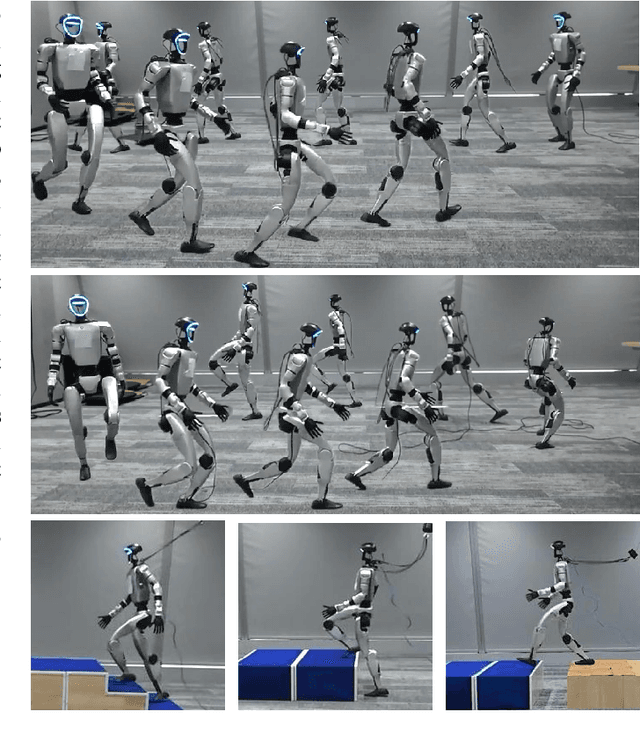
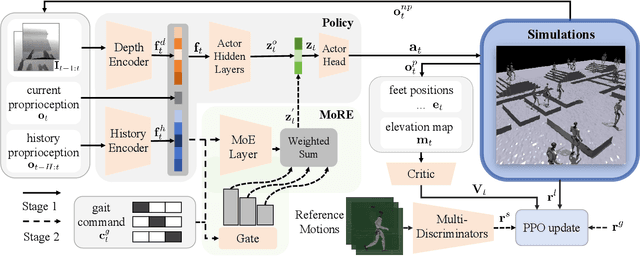
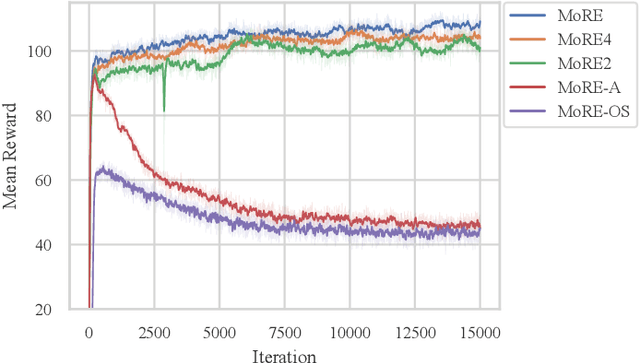
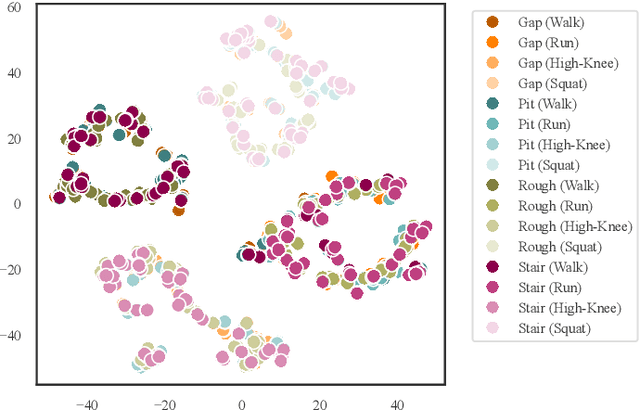
Humanoid robots have demonstrated robust locomotion capabilities using Reinforcement Learning (RL)-based approaches. Further, to obtain human-like behaviors, existing methods integrate human motion-tracking or motion prior in the RL framework. However, these methods are limited in flat terrains with proprioception only, restricting their abilities to traverse challenging terrains with human-like gaits. In this work, we propose a novel framework using a mixture of latent residual experts with multi-discriminators to train an RL policy, which is capable of traversing complex terrains in controllable lifelike gaits with exteroception. Our two-stage training pipeline first teaches the policy to traverse complex terrains using a depth camera, and then enables gait-commanded switching between human-like gait patterns. We also design gait rewards to adjust human-like behaviors like robot base height. Simulation and real-world experiments demonstrate that our framework exhibits exceptional performance in traversing complex terrains, and achieves seamless transitions between multiple human-like gait patterns.