 Add to Chrome
 Add to Firefox
 Add to Edge
Federated Hybrid Training and Self-Adversarial Distillation: Towards Robust Edge Networks
Dec 26, 2024
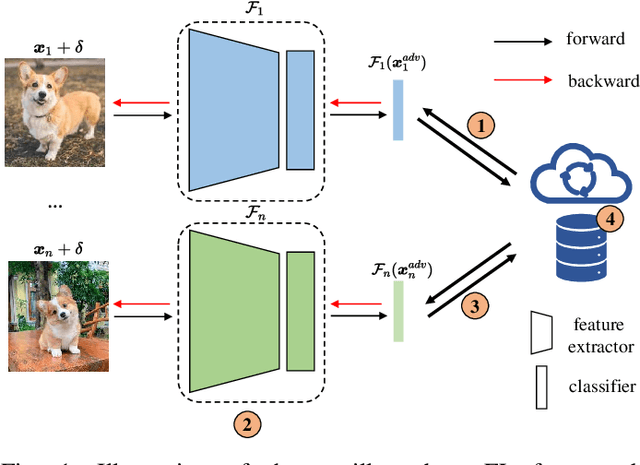
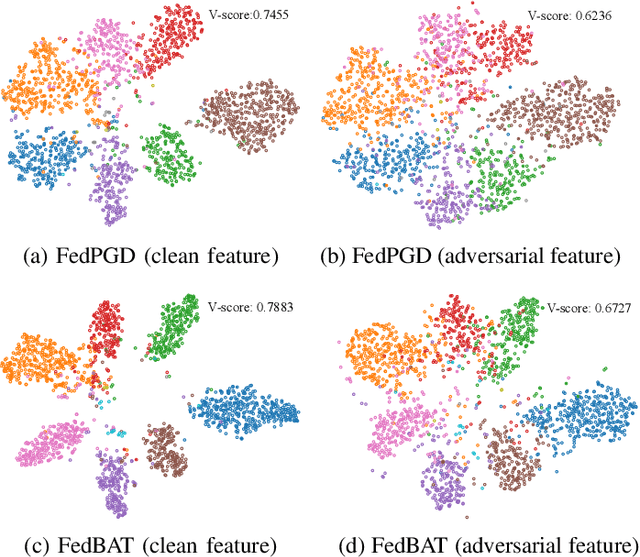
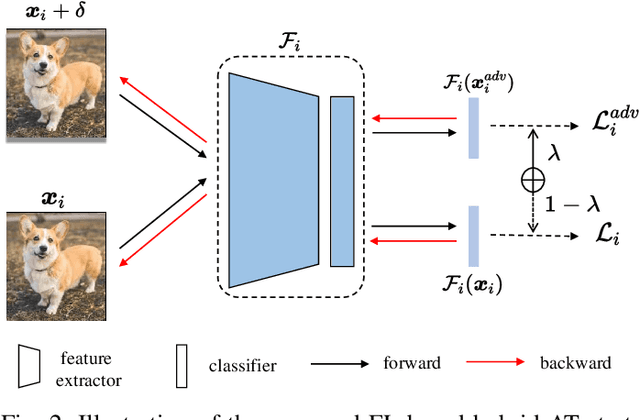
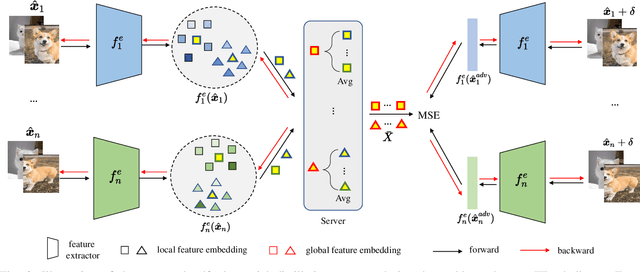
Federated learning (FL) is a distributed training technology that enhances data privacy in mobile edge networks by allowing data owners to collaborate without transmitting raw data to the edge server. However, data heterogeneity and adversarial attacks pose challenges to develop an unbiased and robust global model for edge deployment. To address this, we propose Federated hyBrid Adversarial training and self-adversarial disTillation (FedBAT), a new framework designed to improve both robustness and generalization of the global model. FedBAT seamlessly integrates hybrid adversarial training and self-adversarial distillation into the conventional FL framework from data augmentation and feature distillation perspectives. From a data augmentation perspective, we propose hybrid adversarial training to defend against adversarial attacks by balancing accuracy and robustness through a weighted combination of standard and adversarial training. From a feature distillation perspective, we introduce a novel augmentation-invariant adversarial distillation method that aligns local adversarial features of augmented images with their corresponding unbiased global clean features. This alignment can effectively mitigate bias from data heterogeneity while enhancing both the robustness and generalization of the global model. Extensive experimental results across multiple datasets demonstrate that FedBAT yields comparable or superior performance gains in improving robustness while maintaining accuracy compared to several baselines.

Task Preference Optimization: Improving Multimodal Large Language Models with Vision Task Alignment
Dec 26, 2024Current multimodal large language models (MLLMs) struggle with fine-grained or precise understanding of visuals though they give comprehensive perception and reasoning in a spectrum of vision applications. Recent studies either develop tool-using or unify specific visual tasks into the autoregressive framework, often at the expense of overall multimodal performance. To address this issue and enhance MLLMs with visual tasks in a scalable fashion, we propose Task Preference Optimization (TPO), a novel method that utilizes differentiable task preferences derived from typical fine-grained visual tasks. TPO introduces learnable task tokens that establish connections between multiple task-specific heads and the MLLM. By leveraging rich visual labels during training, TPO significantly enhances the MLLM's multimodal capabilities and task-specific performance. Through multi-task co-training within TPO, we observe synergistic benefits that elevate individual task performance beyond what is achievable through single-task training methodologies. Our instantiation of this approach with VideoChat and LLaVA demonstrates an overall 14.6% improvement in multimodal performance compared to baseline models. Additionally, MLLM-TPO demonstrates robust zero-shot capabilities across various tasks, performing comparably to state-of-the-art supervised models. The code will be released at https://github.com/OpenGVLab/TPO
HoVLE: Unleashing the Power of Monolithic Vision-Language Models with Holistic Vision-Language Embedding
Dec 20, 2024The rapid advance of Large Language Models (LLMs) has catalyzed the development of Vision-Language Models (VLMs). Monolithic VLMs, which avoid modality-specific encoders, offer a promising alternative to the compositional ones but face the challenge of inferior performance. Most existing monolithic VLMs require tuning pre-trained LLMs to acquire vision abilities, which may degrade their language capabilities. To address this dilemma, this paper presents a novel high-performance monolithic VLM named HoVLE. We note that LLMs have been shown capable of interpreting images, when image embeddings are aligned with text embeddings. The challenge for current monolithic VLMs actually lies in the lack of a holistic embedding module for both vision and language inputs. Therefore, HoVLE introduces a holistic embedding module that converts visual and textual inputs into a shared space, allowing LLMs to process images in the same way as texts. Furthermore, a multi-stage training strategy is carefully designed to empower the holistic embedding module. It is first trained to distill visual features from a pre-trained vision encoder and text embeddings from the LLM, enabling large-scale training with unpaired random images and text tokens. The whole model further undergoes next-token prediction on multi-modal data to align the embeddings. Finally, an instruction-tuning stage is incorporated. Our experiments show that HoVLE achieves performance close to leading compositional models on various benchmarks, outperforming previous monolithic models by a large margin. Model available at https://huggingface.co/OpenGVLab/HoVLE.
InternLM-XComposer2.5-OmniLive: A Comprehensive Multimodal System for Long-term Streaming Video and Audio Interactions
Dec 12, 2024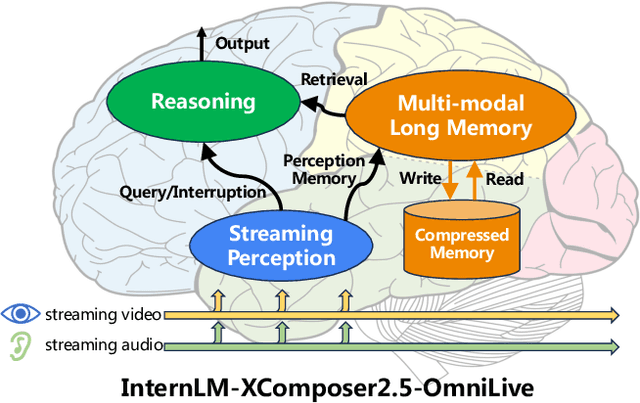


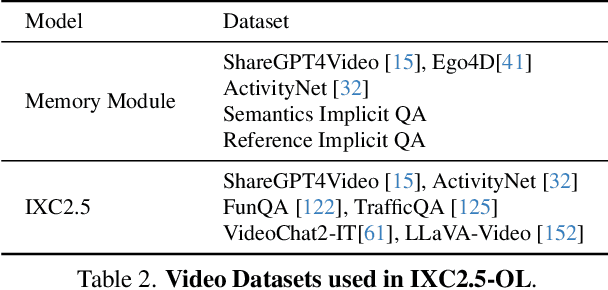
Creating AI systems that can interact with environments over long periods, similar to human cognition, has been a longstanding research goal. Recent advancements in multimodal large language models (MLLMs) have made significant strides in open-world understanding. However, the challenge of continuous and simultaneous streaming perception, memory, and reasoning remains largely unexplored. Current MLLMs are constrained by their sequence-to-sequence architecture, which limits their ability to process inputs and generate responses simultaneously, akin to being unable to think while perceiving. Furthermore, relying on long contexts to store historical data is impractical for long-term interactions, as retaining all information becomes costly and inefficient. Therefore, rather than relying on a single foundation model to perform all functions, this project draws inspiration from the concept of the Specialized Generalist AI and introduces disentangled streaming perception, reasoning, and memory mechanisms, enabling real-time interaction with streaming video and audio input. The proposed framework InternLM-XComposer2.5-OmniLive (IXC2.5-OL) consists of three key modules: (1) Streaming Perception Module: Processes multimodal information in real-time, storing key details in memory and triggering reasoning in response to user queries. (2) Multi-modal Long Memory Module: Integrates short-term and long-term memory, compressing short-term memories into long-term ones for efficient retrieval and improved accuracy. (3) Reasoning Module: Responds to queries and executes reasoning tasks, coordinating with the perception and memory modules. This project simulates human-like cognition, enabling multimodal large language models to provide continuous and adaptive service over time.
Bootstrapping Language-Guided Navigation Learning with Self-Refining Data Flywheel
Dec 11, 2024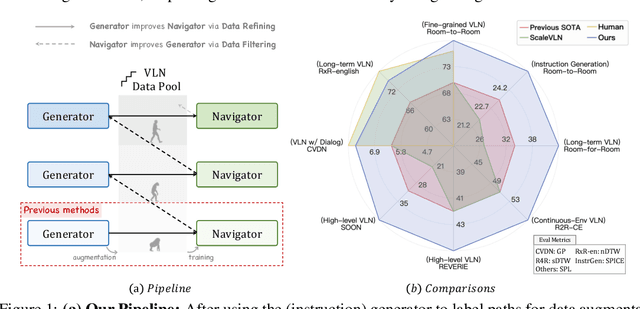
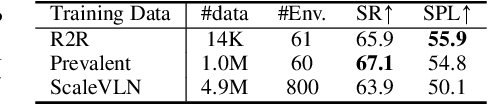
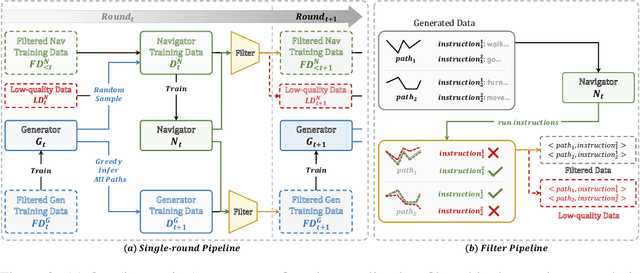
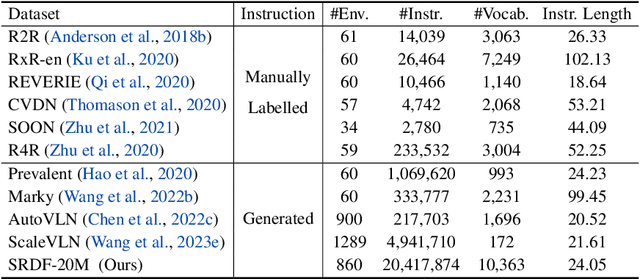
Creating high-quality data for training robust language-instructed agents is a long-lasting challenge in embodied AI. In this paper, we introduce a Self-Refining Data Flywheel (SRDF) that generates high-quality and large-scale navigational instruction-trajectory pairs by iteratively refining the data pool through the collaboration between two models, the instruction generator and the navigator, without any human-in-the-loop annotation. Specifically, SRDF starts with using a base generator to create an initial data pool for training a base navigator, followed by applying the trained navigator to filter the data pool. This leads to higher-fidelity data to train a better generator, which can, in turn, produce higher-quality data for training the next-round navigator. Such a flywheel establishes a data self-refining process, yielding a continuously improved and highly effective dataset for large-scale language-guided navigation learning. Our experiments demonstrate that after several flywheel rounds, the navigator elevates the performance boundary from 70% to 78% SPL on the classic R2R test set, surpassing human performance (76%) for the first time. Meanwhile, this process results in a superior generator, evidenced by a SPICE increase from 23.5 to 26.2, better than all previous VLN instruction generation methods. Finally, we demonstrate the scalability of our method through increasing environment and instruction diversity, and the generalization ability of our pre-trained navigator across various downstream navigation tasks, surpassing state-of-the-art methods by a large margin in all cases.
Evaluation Agent: Efficient and Promptable Evaluation Framework for Visual Generative Models
Dec 10, 2024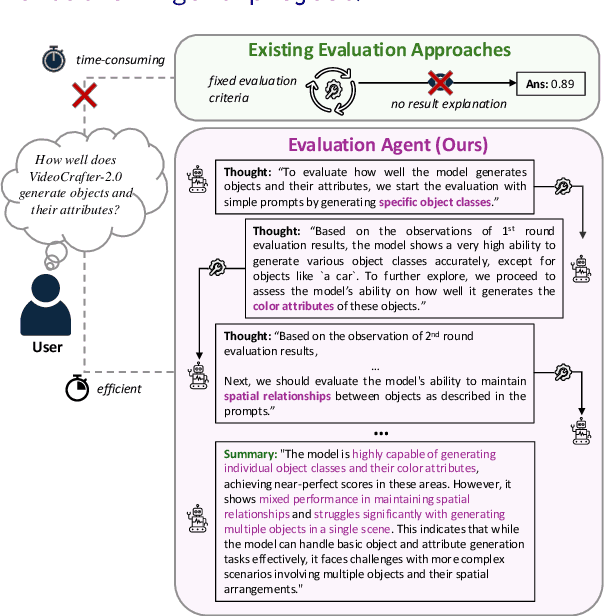

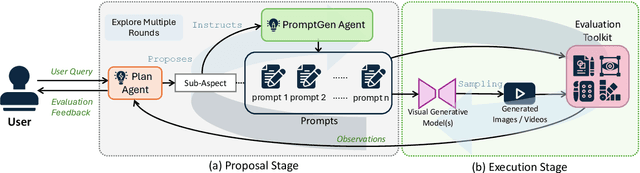
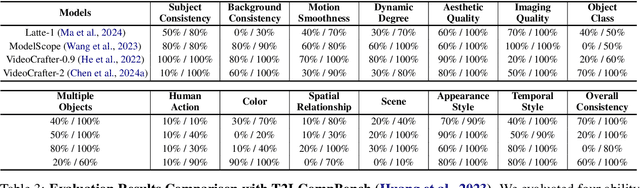
Recent advancements in visual generative models have enabled high-quality image and video generation, opening diverse applications. However, evaluating these models often demands sampling hundreds or thousands of images or videos, making the process computationally expensive, especially for diffusion-based models with inherently slow sampling. Moreover, existing evaluation methods rely on rigid pipelines that overlook specific user needs and provide numerical results without clear explanations. In contrast, humans can quickly form impressions of a model's capabilities by observing only a few samples. To mimic this, we propose the Evaluation Agent framework, which employs human-like strategies for efficient, dynamic, multi-round evaluations using only a few samples per round, while offering detailed, user-tailored analyses. It offers four key advantages: 1) efficiency, 2) promptable evaluation tailored to diverse user needs, 3) explainability beyond single numerical scores, and 4) scalability across various models and tools. Experiments show that Evaluation Agent reduces evaluation time to 10% of traditional methods while delivering comparable results. The Evaluation Agent framework is fully open-sourced to advance research in visual generative models and their efficient evaluation.
Expanding Performance Boundaries of Open-Source Multimodal Models with Model, Data, and Test-Time Scaling
Dec 06, 2024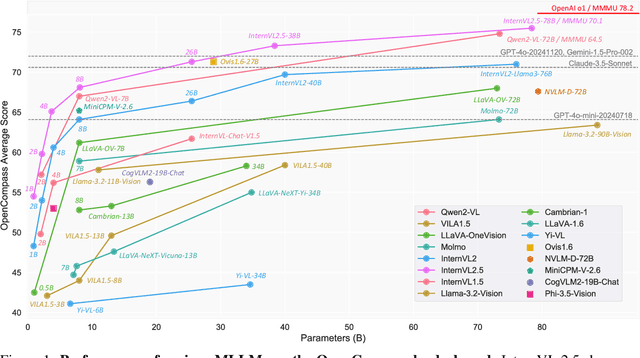

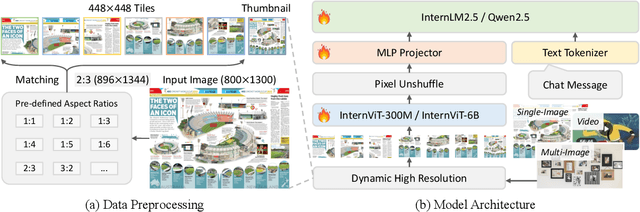

We introduce InternVL 2.5, an advanced multimodal large language model (MLLM) series that builds upon InternVL 2.0, maintaining its core model architecture while introducing significant enhancements in training and testing strategies as well as data quality. In this work, we delve into the relationship between model scaling and performance, systematically exploring the performance trends in vision encoders, language models, dataset sizes, and test-time configurations. Through extensive evaluations on a wide range of benchmarks, including multi-discipline reasoning, document understanding, multi-image / video understanding, real-world comprehension, multimodal hallucination detection, visual grounding, multilingual capabilities, and pure language processing, InternVL 2.5 exhibits competitive performance, rivaling leading commercial models such as GPT-4o and Claude-3.5-Sonnet. Notably, our model is the first open-source MLLMs to surpass 70% on the MMMU benchmark, achieving a 3.7-point improvement through Chain-of-Thought (CoT) reasoning and showcasing strong potential for test-time scaling. We hope this model contributes to the open-source community by setting new standards for developing and applying multimodal AI systems. HuggingFace demo see https://huggingface.co/spaces/OpenGVLab/InternVL
GATE OpenING: A Comprehensive Benchmark for Judging Open-ended Interleaved Image-Text Generation
Dec 01, 2024Multimodal Large Language Models (MLLMs) have made significant strides in visual understanding and generation tasks. However, generating interleaved image-text content remains a challenge, which requires integrated multimodal understanding and generation abilities. While the progress in unified models offers new solutions, existing benchmarks are insufficient for evaluating these methods due to data size and diversity limitations. To bridge this gap, we introduce GATE OpenING (OpenING), a comprehensive benchmark comprising 5,400 high-quality human-annotated instances across 56 real-world tasks. OpenING covers diverse daily scenarios such as travel guide, design, and brainstorming, offering a robust platform for challenging interleaved generation methods. In addition, we present IntJudge, a judge model for evaluating open-ended multimodal generation methods. Trained with a novel data pipeline, our IntJudge achieves an agreement rate of 82. 42% with human judgments, outperforming GPT-based evaluators by 11.34%. Extensive experiments on OpenING reveal that current interleaved generation methods still have substantial room for improvement. Key findings on interleaved image-text generation are further presented to guide the development of next-generation models. The OpenING is open-sourced at https://opening-benchmark.github.io.
SyncVIS: Synchronized Video Instance Segmentation
Dec 01, 2024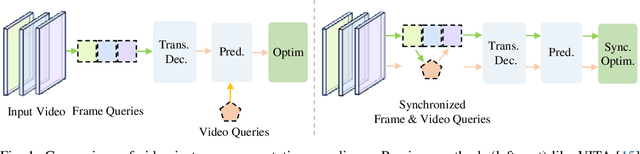
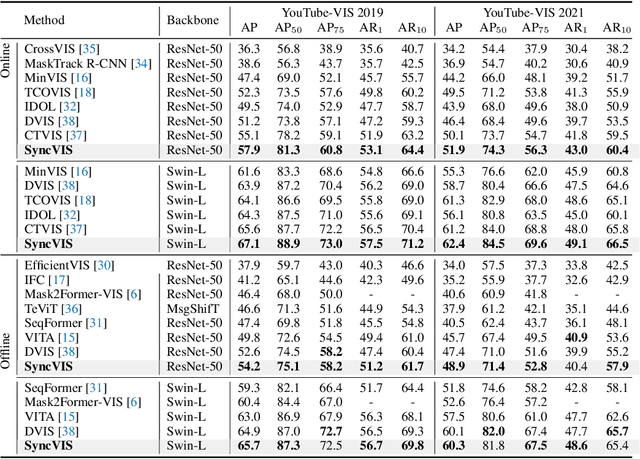

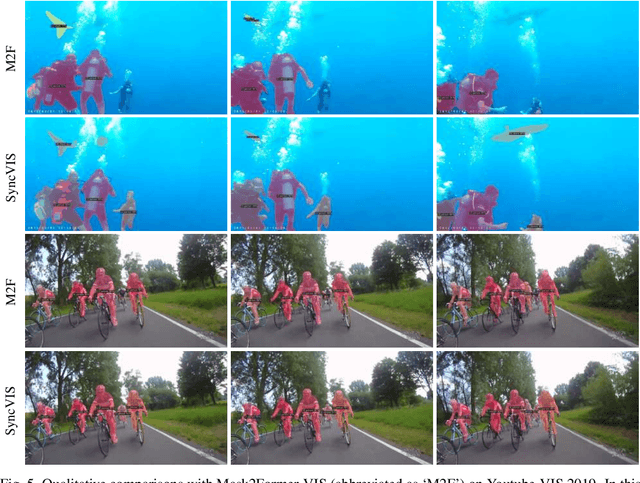
Recent DETR-based methods have advanced the development of Video Instance Segmentation (VIS) through transformers' efficiency and capability in modeling spatial and temporal information. Despite harvesting remarkable progress, existing works follow asynchronous designs, which model video sequences via either video-level queries only or adopting query-sensitive cascade structures, resulting in difficulties when handling complex and challenging video scenarios. In this work, we analyze the cause of this phenomenon and the limitations of the current solutions, and propose to conduct synchronized modeling via a new framework named SyncVIS. Specifically, SyncVIS explicitly introduces video-level query embeddings and designs two key modules to synchronize video-level query with frame-level query embeddings: a synchronized video-frame modeling paradigm and a synchronized embedding optimization strategy. The former attempts to promote the mutual learning of frame- and video-level embeddings with each other and the latter divides large video sequences into small clips for easier optimization. Extensive experimental evaluations are conducted on the challenging YouTube-VIS 2019 & 2021 & 2022, and OVIS benchmarks and SyncVIS achieves state-of-the-art results, which demonstrates the effectiveness and generality of the proposed approach. The code is available at https://github.com/rkzheng99/SyncVIS.
OASIS: Open Agent Social Interaction Simulations with One Million Agents
Nov 26, 2024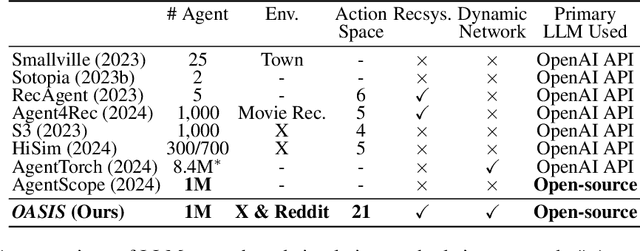

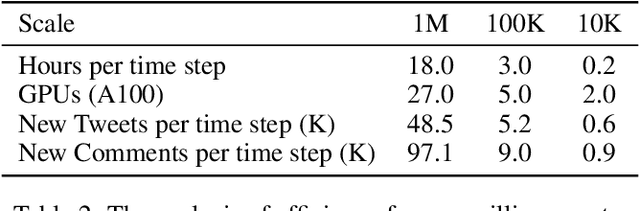
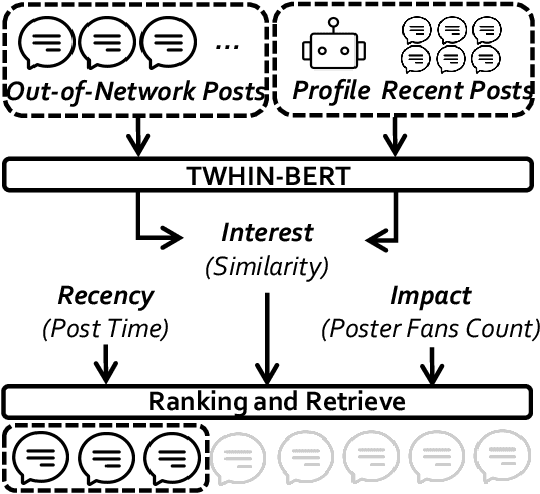
There has been a growing interest in enhancing rule-based agent-based models (ABMs) for social media platforms (i.e., X, Reddit) with more realistic large language model (LLM) agents, thereby allowing for a more nuanced study of complex systems. As a result, several LLM-based ABMs have been proposed in the past year. While they hold promise, each simulator is specifically designed to study a particular scenario, making it time-consuming and resource-intensive to explore other phenomena using the same ABM. Additionally, these models simulate only a limited number of agents, whereas real-world social media platforms involve millions of users. To this end, we propose OASIS, a generalizable and scalable social media simulator. OASIS is designed based on real-world social media platforms, incorporating dynamically updated environments (i.e., dynamic social networks and post information), diverse action spaces (i.e., following, commenting), and recommendation systems (i.e., interest-based and hot-score-based). Additionally, OASIS supports large-scale user simulations, capable of modeling up to one million users. With these features, OASIS can be easily extended to different social media platforms to study large-scale group phenomena and behaviors. We replicate various social phenomena, including information spreading, group polarization, and herd effects across X and Reddit platforms. Moreover, we provide observations of social phenomena at different agent group scales. We observe that the larger agent group scale leads to more enhanced group dynamics and more diverse and helpful agents' opinions. These findings demonstrate OASIS's potential as a powerful tool for studying complex systems in digital environments.