 Add to Chrome
 Add to Firefox
 Add to Edge
The Real Barrier to LLM Agent Usability is Agentic ROI
May 23, 2025
Large Language Model (LLM) agents represent a promising shift in human-AI interaction, moving beyond passive prompt-response systems to autonomous agents capable of reasoning, planning, and goal-directed action. Despite the widespread application in specialized, high-effort tasks like coding and scientific research, we highlight a critical usability gap in high-demand, mass-market applications. This position paper argues that the limited real-world adoption of LLM agents stems not only from gaps in model capabilities, but also from a fundamental tradeoff between the value an agent can provide and the costs incurred during real-world use. Hence, we call for a shift from solely optimizing model performance to a broader, utility-driven perspective: evaluating agents through the lens of the overall agentic return on investment (Agent ROI). By identifying key factors that determine Agentic ROI--information quality, agent time, and cost--we posit a zigzag development trajectory in optimizing agentic ROI: first scaling up to improve the information quality, then scaling down to minimize the time and cost. We outline the roadmap across different development stages to bridge the current usability gaps, aiming to make LLM agents truly scalable, accessible, and effective in real-world contexts.

InfoDeepSeek: Benchmarking Agentic Information Seeking for Retrieval-Augmented Generation
May 21, 2025Retrieval-Augmented Generation (RAG) enhances large language models (LLMs) by grounding responses with retrieved information. As an emerging paradigm, Agentic RAG further enhances this process by introducing autonomous LLM agents into the information seeking process. However, existing benchmarks fall short in evaluating such systems, as they are confined to a static retrieval environment with a fixed, limited corpus} and simple queries that fail to elicit agentic behavior. Moreover, their evaluation protocols assess information seeking effectiveness by pre-defined gold sets of documents, making them unsuitable for the open-ended and dynamic nature of real-world web environments. To bridge this gap, we present InfoDeepSeek, a new benchmark with challenging questions designed for assessing agentic information seeking in real-world, dynamic web environments. We propose a systematic methodology for constructing challenging queries satisfying the criteria of determinacy, difficulty, and diversity. Based on this, we develop the first evaluation framework tailored to dynamic agentic information seeking, including fine-grained metrics about the accuracy, utility, and compactness of information seeking outcomes. Through extensive experiments across LLMs, search engines, and question types, InfoDeepSeek reveals nuanced agent behaviors and offers actionable insights for future research.
NL-Debugging: Exploiting Natural Language as an Intermediate Representation for Code Debugging
May 21, 2025Debugging is a critical aspect of LLM's coding ability. Early debugging efforts primarily focused on code-level analysis, which often falls short when addressing complex programming errors that require a deeper understanding of algorithmic logic. Recent advancements in large language models (LLMs) have shifted attention toward leveraging natural language reasoning to enhance code-related tasks. However, two fundamental questions remain unanswered: What type of natural language format is most effective for debugging tasks? And what specific benefits does natural language reasoning bring to the debugging process? In this paper, we introduce NL-DEBUGGING, a novel framework that employs natural language as an intermediate representation to improve code debugging. By debugging at a natural language level, we demonstrate that NL-DEBUGGING outperforms traditional debugging methods and enables a broader modification space through direct refinement guided by execution feedback. Our findings highlight the potential of natural language reasoning to advance automated code debugging and address complex programming challenges.
A Survey of AI Agent Protocols
Apr 23, 2025The rapid development of large language models (LLMs) has led to the widespread deployment of LLM agents across diverse industries, including customer service, content generation, data analysis, and even healthcare. However, as more LLM agents are deployed, a major issue has emerged: there is no standard way for these agents to communicate with external tools or data sources. This lack of standardized protocols makes it difficult for agents to work together or scale effectively, and it limits their ability to tackle complex, real-world tasks. A unified communication protocol for LLM agents could change this. It would allow agents and tools to interact more smoothly, encourage collaboration, and triggering the formation of collective intelligence. In this paper, we provide a systematic overview of existing communication protocols for LLM agents. We classify them into four main categories and make an analysis to help users and developers select the most suitable protocols for specific applications. Additionally, we conduct a comparative performance analysis of these protocols across key dimensions such as security, scalability, and latency. Finally, we explore future challenges, such as how protocols can adapt and survive in fast-evolving environments, and what qualities future protocols might need to support the next generation of LLM agent ecosystems. We expect this work to serve as a practical reference for both researchers and engineers seeking to design, evaluate, or integrate robust communication infrastructures for intelligent agents.
AdvKT: An Adversarial Multi-Step Training Framework for Knowledge Tracing
Apr 07, 2025Knowledge Tracing (KT) monitors students' knowledge states and simulates their responses to question sequences. Existing KT models typically follow a single-step training paradigm, which leads to discrepancies with the multi-step inference process required in real-world simulations, resulting in significant error accumulation. This accumulation of error, coupled with the issue of data sparsity, can substantially degrade the performance of recommendation models in the intelligent tutoring systems. To address these challenges, we propose a novel Adversarial Multi-Step Training Framework for Knowledge Tracing (AdvKT), which, for the first time, focuses on the multi-step KT task. More specifically, AdvKT leverages adversarial learning paradigm involving a generator and a discriminator. The generator mimics high-reward responses, effectively reducing error accumulation across multiple steps, while the discriminator provides feedback to generate synthetic data. Additionally, we design specialized data augmentation techniques to enrich the training data with realistic variations, ensuring that the model generalizes well even in scenarios with sparse data. Experiments conducted on four real-world datasets demonstrate the superiority of AdvKT over existing KT models, showcasing its ability to address both error accumulation and data sparsity issues effectively.
Sell It Before You Make It: Revolutionizing E-Commerce with Personalized AI-Generated Items
Mar 28, 2025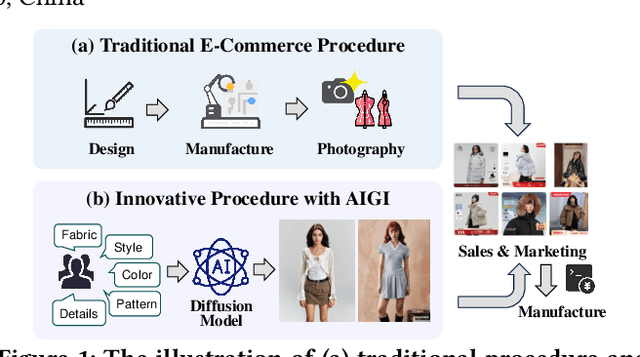
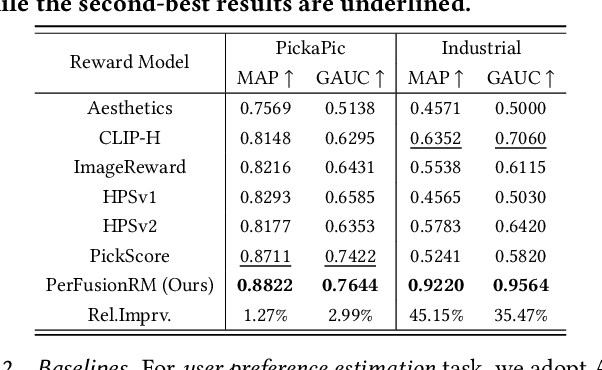
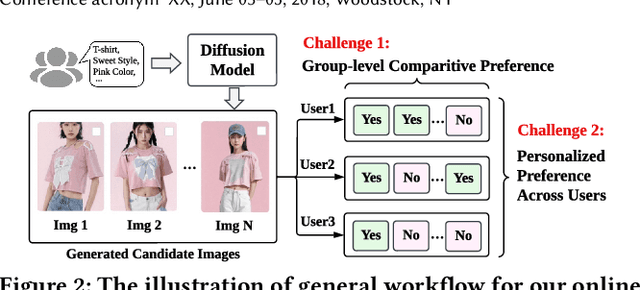
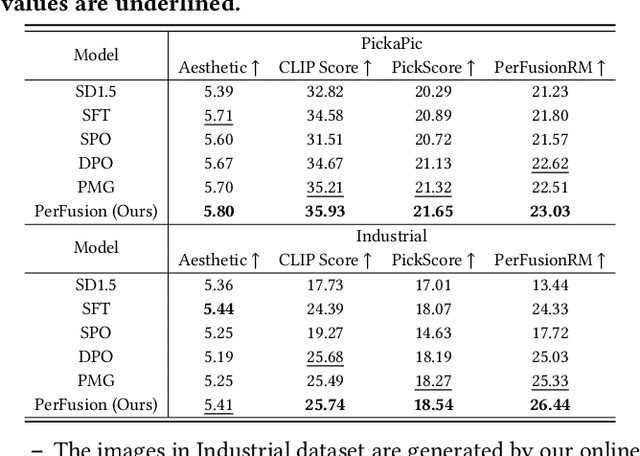
E-commerce has revolutionized retail, yet its traditional workflows remain inefficient, with significant time and resource costs tied to product design and manufacturing inventory. This paper introduces a novel system deployed at Alibaba that leverages AI-generated items (AIGI) to address these challenges with personalized text-to-image generation for e-commercial product design. AIGI enables an innovative business mode called "sell it before you make it", where merchants can design fashion items and generate photorealistic images with digital models based on textual descriptions. Only when the items have received a certain number of orders, do the merchants start to produce them, which largely reduces reliance on physical prototypes and thus accelerates time to market. For such a promising application, we identify the underlying key scientific challenge, i.e., capturing the users' group-level personalized preferences towards multiple generated candidate images. To this end, we propose a Personalized Group-Level Preference Alignment Framework for Diffusion Models (i.e., PerFusion). We first design PerFusion Reward Model for user preference estimation with a feature-crossing-based personalized plug-in. Then we develop PerFusion with a personalized adaptive network to model diverse preferences across users, and meanwhile derive the group-level preference optimization objective to capture the comparative behaviors among multiple candidates. Both offline and online experiments demonstrate the effectiveness of our proposed algorithm. The AI-generated items have achieved over 13% relative improvements for both click-through rate and conversion rate compared to their human-designed counterparts, validating the revolutionary potential of AI-generated items for e-commercial platforms.
PALo: Learning Posture-Aware Locomotion for Quadruped Robots
Mar 06, 2025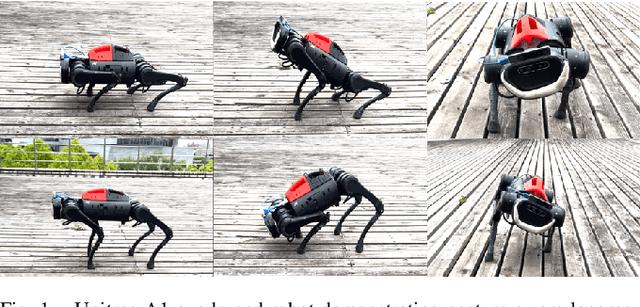

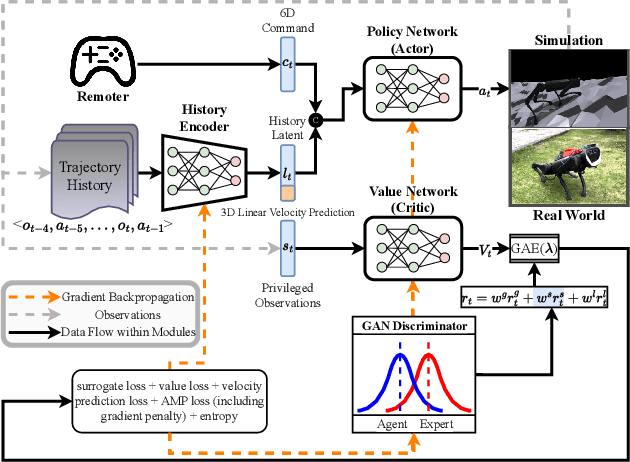
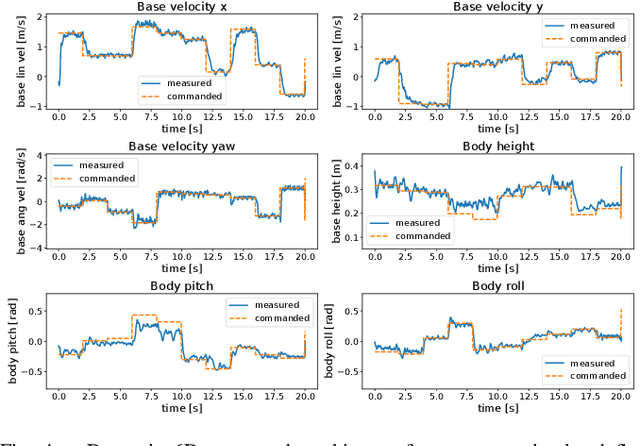
With the rapid development of embodied intelligence, locomotion control of quadruped robots on complex terrains has become a research hotspot. Unlike traditional locomotion control approaches focusing solely on velocity tracking, we pursue to balance the agility and robustness of quadruped robots on diverse and complex terrains. To this end, we propose an end-to-end deep reinforcement learning framework for posture-aware locomotion named PALo, which manages to handle simultaneous linear and angular velocity tracking and real-time adjustments of body height, pitch, and roll angles. In PALo, the locomotion control problem is formulated as a partially observable Markov decision process, and an asymmetric actor-critic architecture is adopted to overcome the sim-to-real challenge. Further, by incorporating customized training curricula, PALo achieves agile posture-aware locomotion control in simulated environments and successfully transfers to real-world settings without fine-tuning, allowing real-time control of the quadruped robot's locomotion and body posture across challenging terrains. Through in-depth experimental analysis, we identify the key components of PALo that contribute to its performance, further validating the effectiveness of the proposed method. The results of this study provide new possibilities for the low-level locomotion control of quadruped robots in higher dimensional command spaces and lay the foundation for future research on upper-level modules for embodied intelligence.
Retrieval-Augmented Process Reward Model for Generalizable Mathematical Reasoning
Feb 20, 2025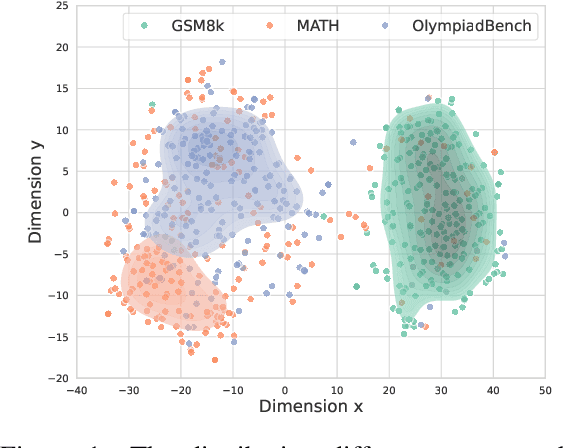
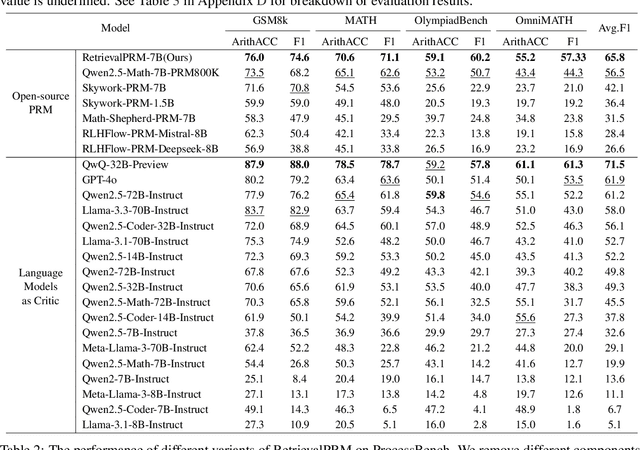
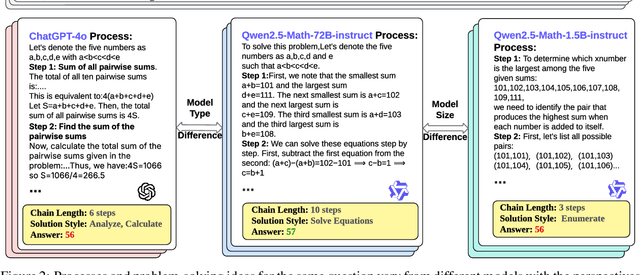
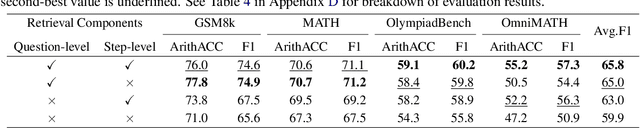
While large language models (LLMs) have significantly advanced mathematical reasoning, Process Reward Models (PRMs) have been developed to evaluate the logical validity of reasoning steps. However, PRMs still struggle with out-of-distribution (OOD) challenges. This paper identifies key OOD issues, including step OOD, caused by differences in reasoning patterns across model types and sizes, and question OOD, which arises from dataset shifts between training data and real-world problems. To address these issues, we introduce Retrieval-Augmented Process Reward Model (RetrievalPRM), a novel framework designed to tackle these OOD issues. By utilizing a two-stage retrieval-enhanced mechanism, RetrievalPRM retrieves semantically similar questions and steps as a warmup, enhancing PRM's ability to evaluate target steps and improving generalization and reasoning consistency across different models and problem types. Our extensive experiments demonstrate that RetrievalPRM outperforms existing baselines across multiple real-world datasets. Our open-source contributions include a retrieval-enhanced dataset, a tuning framework for PRM training, and the RetrievalPRM model, establishing a new standard for PRM performance.
Bursting Filter Bubble: Enhancing Serendipity Recommendations with Aligned Large Language Models
Feb 19, 2025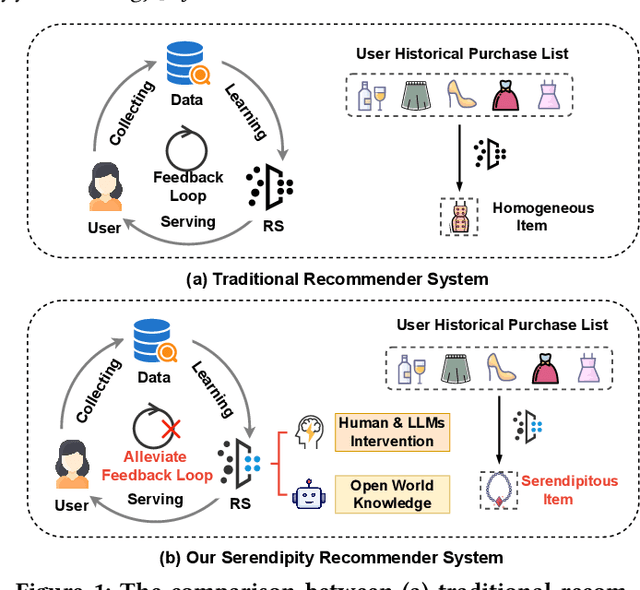
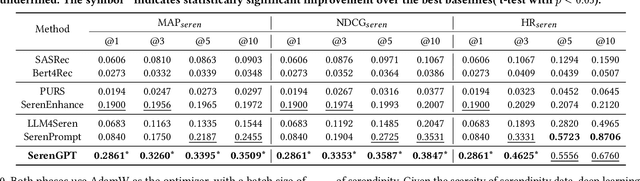
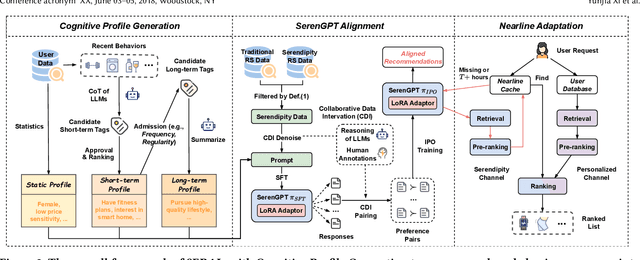
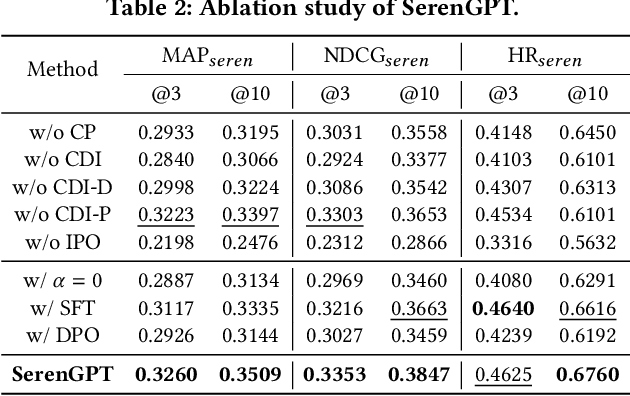
Recommender systems (RSs) often suffer from the feedback loop phenomenon, e.g., RSs are trained on data biased by their recommendations. This leads to the filter bubble effect that reinforces homogeneous content and reduces user satisfaction. To this end, serendipity recommendations, which offer unexpected yet relevant items, are proposed. Recently, large language models (LLMs) have shown potential in serendipity prediction due to their extensive world knowledge and reasoning capabilities. However, they still face challenges in aligning serendipity judgments with human assessments, handling long user behavior sequences, and meeting the latency requirements of industrial RSs. To address these issues, we propose SERAL (Serendipity Recommendations with Aligned Large Language Models), a framework comprising three stages: (1) Cognition Profile Generation to compress user behavior into multi-level profiles; (2) SerenGPT Alignment to align serendipity judgments with human preferences using enriched training data; and (3) Nearline Adaptation to integrate SerenGPT into industrial RSs pipelines efficiently. Online experiments demonstrate that SERAL improves exposure ratio (PVR), clicks, and transactions of serendipitous items by 5.7%, 29.56%, and 27.6%, enhancing user experience without much impact on overall revenue. Now, it has been fully deployed in the "Guess What You Like" of the Taobao App homepage.
RHINO: Learning Real-Time Humanoid-Human-Object Interaction from Human Demonstrations
Feb 18, 2025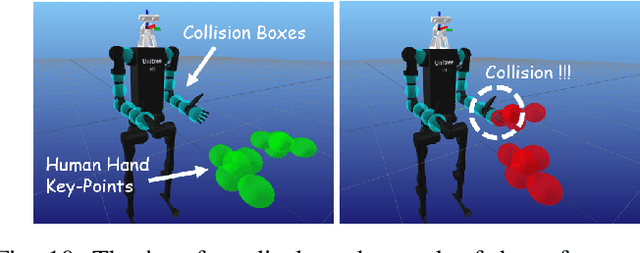
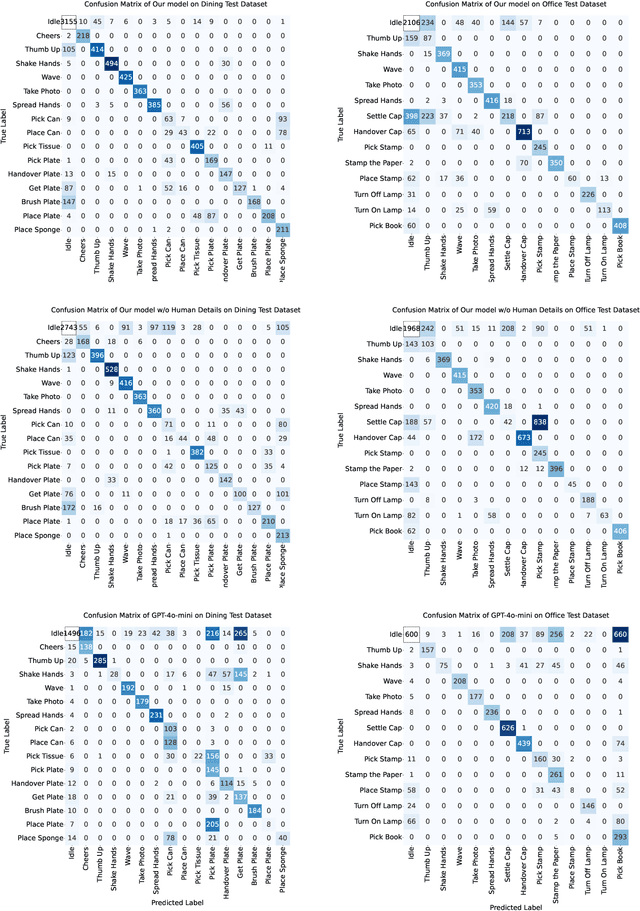
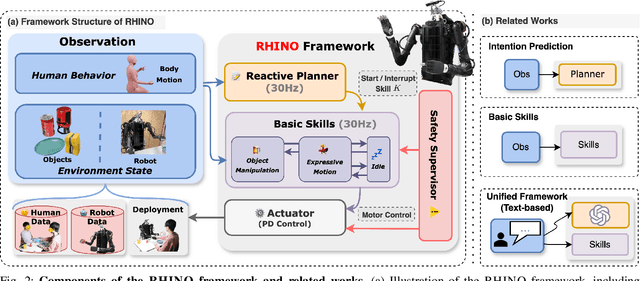
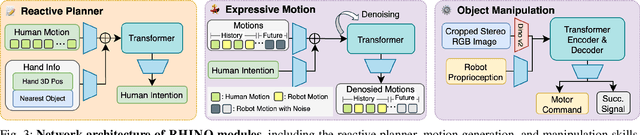
Humanoid robots have shown success in locomotion and manipulation. Despite these basic abilities, humanoids are still required to quickly understand human instructions and react based on human interaction signals to become valuable assistants in human daily life. Unfortunately, most existing works only focus on multi-stage interactions, treating each task separately, and neglecting real-time feedback. In this work, we aim to empower humanoid robots with real-time reaction abilities to achieve various tasks, allowing human to interrupt robots at any time, and making robots respond to humans immediately. To support such abilities, we propose a general humanoid-human-object interaction framework, named RHINO, i.e., Real-time Humanoid-human Interaction and Object manipulation. RHINO provides a unified view of reactive motion, instruction-based manipulation, and safety concerns, over multiple human signal modalities, such as languages, images, and motions. RHINO is a hierarchical learning framework, enabling humanoids to learn reaction skills from human-human-object demonstrations and teleoperation data. In particular, it decouples the interaction process into two levels: 1) a high-level planner inferring human intentions from real-time human behaviors; and 2) a low-level controller achieving reactive motion behaviors and object manipulation skills based on the predicted intentions. We evaluate the proposed framework on a real humanoid robot and demonstrate its effectiveness, flexibility, and safety in various scenarios.