 Add to Chrome
 Add to Firefox
 Add to Edge
Anticipate and Learn: Unleashing Idle-Time Compute in Proactive Agents
May 26, 2026
While AI agents demonstrate remarkable capabilities in reasoning and tool use, they remain fundamentally reactive: they compute responses only after explicit user prompts. This paradigm ignores a critical opportunity: the idle time between interactions is largely wasted, leaving agents unable to prepare for future user needs. To bridge this gap, we introduce ProAct, a proactive agent architecture that leverages idle-time compute to anticipate and fulfill likely upcoming user needs. By analyzing evolving dialogue history together with persistent memory, ProAct predicts upcoming needs and iteratively acquires information, allowing the agent to resolve knowledge gaps and prepare evidence before the user initiates a query. To rigorously evaluate proactive capabilities, we also introduce ProActEval, a comprehensive benchmark comprising 200 scenarios across 40 domains, featuring predictable need chains and diverse user cognitive profiles. Empirical results demonstrate significant advantages over reactive baselines. ProAct accelerates task completion by reducing required turns by 14.8%, decreases user effort by 11.7%, and cuts hallucination rates by 28.1% on ProActEval. Furthermore, MemBench evaluations confirm that ProAct achieves state-of-the-art reflective accuracy, underscoring its sustained and robust performance.

GUI-Eyes: Tool-Augmented Perception for Visual Grounding in GUI Agents
Jan 14, 2026Recent advances in vision-language models (VLMs) and reinforcement learning (RL) have driven progress in GUI automation. However, most existing methods rely on static, one-shot visual inputs and passive perception, lacking the ability to adaptively determine when, whether, and how to observe the interface. We present GUI-Eyes, a reinforcement learning framework for active visual perception in GUI tasks. To acquire more informative observations, the agent learns to make strategic decisions on both whether and how to invoke visual tools, such as cropping or zooming, within a two-stage reasoning process. To support this behavior, we introduce a progressive perception strategy that decomposes decision-making into coarse exploration and fine-grained grounding, coordinated by a two-level policy. In addition, we design a spatially continuous reward function tailored to tool usage, which integrates both location proximity and region overlap to provide dense supervision and alleviate the reward sparsity common in GUI environments. On the ScreenSpot-Pro benchmark, GUI-Eyes-3B achieves 44.8% grounding accuracy using only 3k labeled samples, significantly outperforming both supervised and RL-based baselines. These results highlight that tool-aware active perception, enabled by staged policy reasoning and fine-grained reward feedback, is critical for building robust and data-efficient GUI agents.
RecGPT-V2 Technical Report
Dec 16, 2025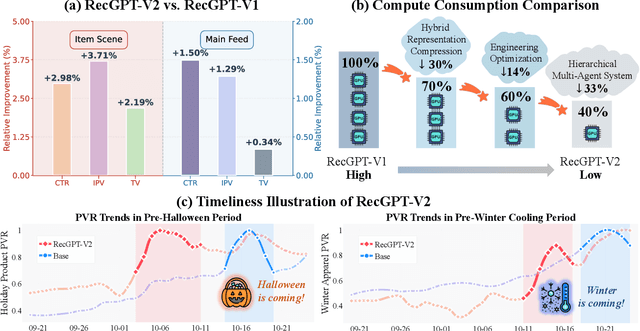
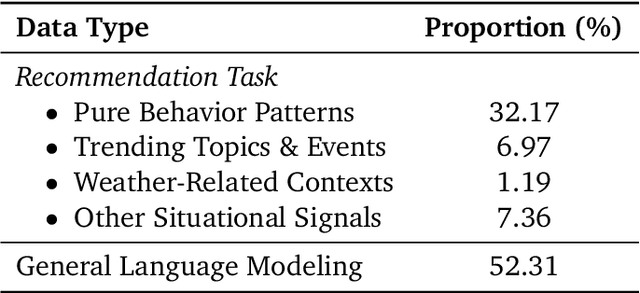
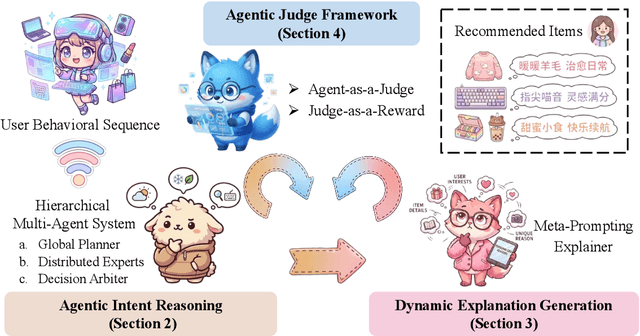

Large language models (LLMs) have demonstrated remarkable potential in transforming recommender systems from implicit behavioral pattern matching to explicit intent reasoning. While RecGPT-V1 successfully pioneered this paradigm by integrating LLM-based reasoning into user interest mining and item tag prediction, it suffers from four fundamental limitations: (1) computational inefficiency and cognitive redundancy across multiple reasoning routes; (2) insufficient explanation diversity in fixed-template generation; (3) limited generalization under supervised learning paradigms; and (4) simplistic outcome-focused evaluation that fails to match human standards. To address these challenges, we present RecGPT-V2 with four key innovations. First, a Hierarchical Multi-Agent System restructures intent reasoning through coordinated collaboration, eliminating cognitive duplication while enabling diverse intent coverage. Combined with Hybrid Representation Inference that compresses user-behavior contexts, our framework reduces GPU consumption by 60% and improves exclusive recall from 9.39% to 10.99%. Second, a Meta-Prompting framework dynamically generates contextually adaptive prompts, improving explanation diversity by +7.3%. Third, constrained reinforcement learning mitigates multi-reward conflicts, achieving +24.1% improvement in tag prediction and +13.0% in explanation acceptance. Fourth, an Agent-as-a-Judge framework decomposes assessment into multi-step reasoning, improving human preference alignment. Online A/B tests on Taobao demonstrate significant improvements: +2.98% CTR, +3.71% IPV, +2.19% TV, and +11.46% NER. RecGPT-V2 establishes both the technical feasibility and commercial viability of deploying LLM-powered intent reasoning at scale, bridging the gap between cognitive exploration and industrial utility.
A Survey of AI Agent Protocols
Apr 23, 2025The rapid development of large language models (LLMs) has led to the widespread deployment of LLM agents across diverse industries, including customer service, content generation, data analysis, and even healthcare. However, as more LLM agents are deployed, a major issue has emerged: there is no standard way for these agents to communicate with external tools or data sources. This lack of standardized protocols makes it difficult for agents to work together or scale effectively, and it limits their ability to tackle complex, real-world tasks. A unified communication protocol for LLM agents could change this. It would allow agents and tools to interact more smoothly, encourage collaboration, and triggering the formation of collective intelligence. In this paper, we provide a systematic overview of existing communication protocols for LLM agents. We classify them into four main categories and make an analysis to help users and developers select the most suitable protocols for specific applications. Additionally, we conduct a comparative performance analysis of these protocols across key dimensions such as security, scalability, and latency. Finally, we explore future challenges, such as how protocols can adapt and survive in fast-evolving environments, and what qualities future protocols might need to support the next generation of LLM agent ecosystems. We expect this work to serve as a practical reference for both researchers and engineers seeking to design, evaluate, or integrate robust communication infrastructures for intelligent agents.