 Add to Chrome
 Add to Firefox
 Add to Edge
Speaking Numbers to LLMs: Multi-Wavelet Number Embeddings for Time Series Forecasting
Jun 25, 2026
Large language models (LLMs) are attractive for context-aware time series forecasting because they can integrate heterogeneous textual signals, yet their discrete, language-oriented tokenization and embedding interfaces are misaligned with continuous numerical values, often harming numerical ordering and forecasting reliability. We propose TempoWave, a plug-and-play temporal wavelet digit interface that maps each scalar observation into digit-wise embeddings constructed from multi-wavelet, multi-scale coefficients. By directly overriding standard token representations, TempoWave seamlessly exposes both fine-grained local fluctuations and macro global structures in a transformer-compatible form, ensuring that precise numerical formatting, distinct digit identity, and robustness to common normalization operations are maintained throughout the LLM pipeline. Experiments across five context-enriched forecasting benchmarks demonstrate that TempoWave consistently improves LLM-based forecasters over standard numeric tokenization and alternative embedding interfaces, achieving a new state-of-the-art. These results highlight the numeric interface as a key bottleneck and suggest that principled multi-resolution embeddings can better couple LLMs' contextual reasoning with precise forecasting. Our code is available at https://github.com/DC-research/TempoWAVE and our model can be accessed at https://huggingface.co/Melady/TempoWAVE.

Adaptive Collaboration with Humans: Metacognitive Policy Optimization for Multi-Agent LLMs with Continual Learning
Mar 09, 2026While scaling individual Large Language Models (LLMs) has delivered remarkable progress, the next frontier lies in scaling collaboration through multi-agent systems (MAS). However, purely autonomous MAS remain ''closed-world'' systems, constrained by the static knowledge horizon of pre-trained models. This limitation makes them brittle on tasks requiring knowledge beyond training data, often leading to collective failure under novel challenges. To address this, we propose the Human-In-the-Loop Multi-Agent Collaboration (HILA) framework, a principled paradigm for human--agent collaboration. HILA trains agents to learn a metacognitive policy that governs when to solve problems autonomously and when to defer to a human expert. To operationalize this policy, we introduce Dual-Loop Policy Optimization, which disentangles immediate decision-making from long-term capability growth. The inner loop applies Group Relative Policy Optimization (GRPO) with a cost-aware reward to optimize deferral decisions, while the outer loop implements continual learning, transforming expert feedback into high-quality supervised signals that strengthen the agent's reasoning ability. Experiments on challenging mathematical and problem-solving benchmarks show that HILA, equipped with Dual-Loop Policy Optimization, consistently outperforms advanced MAS, establishing a principled foundation for collaborative and continually improving agentic systems.
TemporalBench: A Benchmark for Evaluating LLM-Based Agents on Contextual and Event-Informed Time Series Tasks
Feb 05, 2026It is unclear whether strong forecasting performance reflects genuine temporal understanding or the ability to reason under contextual and event-driven conditions. We introduce TemporalBench, a multi-domain benchmark designed to evaluate temporal reasoning behavior under progressively richer informational settings. TemporalBench adopts a four-tier task taxonomy that examines historical structure interpretation, context-free forecasting, contextual temporal reasoning, and event-conditioned prediction across four real-world domains: retail, healthcare, energy, and physical systems. By controlling access to future targets and contextual information, the benchmark enables a diagnostic analysis of whether models can correctly interpret temporal patterns, align them with external context, and adapt predictions when conditions change. Extensive baseline experiments show that strong numerical forecasting accuracy does not reliably translate into robust contextual or event-aware temporal reasoning; instead, existing agent frameworks exhibit fragmented strengths and systematic failure modes that remain largely hidden under forecasting-only benchmarks. The TemporalBench dataset is publicly available at https://huggingface.co/datasets/Melady/TemporalBench, and we additionally provide a public leaderboard at https://huggingface.co/spaces/Melady/TemporalBench_Leaderboard.
Bursting Filter Bubble: Enhancing Serendipity Recommendations with Aligned Large Language Models
Feb 19, 2025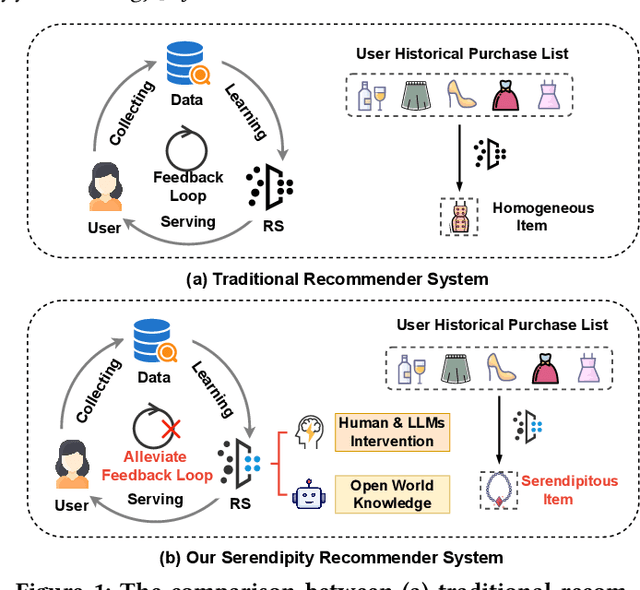
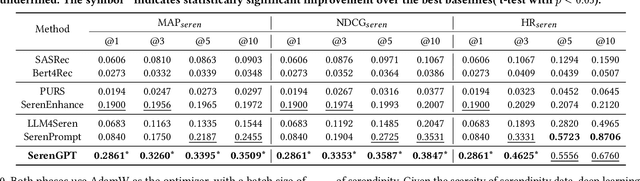
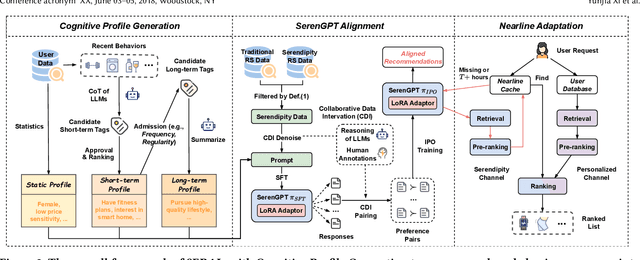
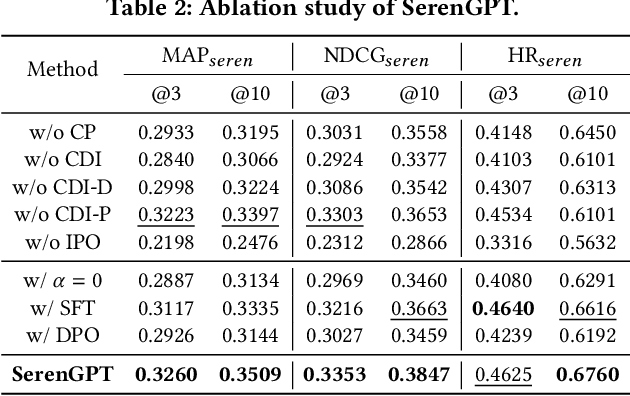
Recommender systems (RSs) often suffer from the feedback loop phenomenon, e.g., RSs are trained on data biased by their recommendations. This leads to the filter bubble effect that reinforces homogeneous content and reduces user satisfaction. To this end, serendipity recommendations, which offer unexpected yet relevant items, are proposed. Recently, large language models (LLMs) have shown potential in serendipity prediction due to their extensive world knowledge and reasoning capabilities. However, they still face challenges in aligning serendipity judgments with human assessments, handling long user behavior sequences, and meeting the latency requirements of industrial RSs. To address these issues, we propose SERAL (Serendipity Recommendations with Aligned Large Language Models), a framework comprising three stages: (1) Cognition Profile Generation to compress user behavior into multi-level profiles; (2) SerenGPT Alignment to align serendipity judgments with human preferences using enriched training data; and (3) Nearline Adaptation to integrate SerenGPT into industrial RSs pipelines efficiently. Online experiments demonstrate that SERAL improves exposure ratio (PVR), clicks, and transactions of serendipitous items by 5.7%, 29.56%, and 27.6%, enhancing user experience without much impact on overall revenue. Now, it has been fully deployed in the "Guess What You Like" of the Taobao App homepage.
Beyond Positive History: Re-ranking with List-level Hybrid Feedback
Oct 28, 2024

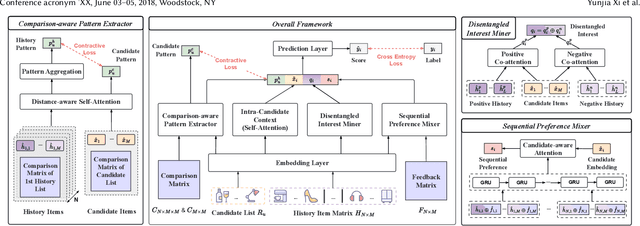

As the last stage of recommender systems, re-ranking generates a re-ordered list that aligns with the user's preference. However, previous works generally focus on item-level positive feedback as history (e.g., only clicked items) and ignore that users provide positive or negative feedback on items in the entire list. This list-level hybrid feedback can reveal users' holistic preferences and reflect users' comparison behavior patterns manifesting within a list. Such patterns could predict user behaviors on candidate lists, thus aiding better re-ranking. Despite appealing benefits, extracting and integrating preferences and behavior patterns from list-level hybrid feedback into re-ranking multiple items remains challenging. To this end, we propose Re-ranking with List-level Hybrid Feedback (dubbed RELIFE). It captures user's preferences and behavior patterns with three modules: a Disentangled Interest Miner to disentangle the user's preferences into interests and disinterests, a Sequential Preference Mixer to learn users' entangled preferences considering the context of feedback, and a Comparison-aware Pattern Extractor to capture user's behavior patterns within each list. Moreover, for better integration of patterns, contrastive learning is adopted to align the behavior patterns of candidate and historical lists. Extensive experiments show that RELIFE significantly outperforms SOTA re-ranking baselines.
Efficient and Deployable Knowledge Infusion for Open-World Recommendations via Large Language Models
Aug 20, 2024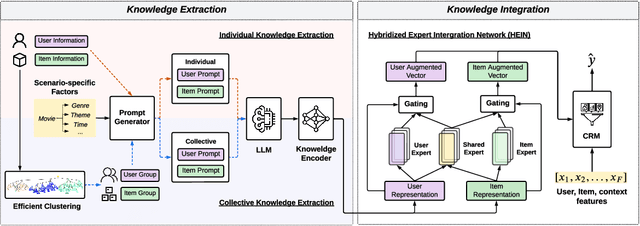


Recommender systems (RSs) play a pervasive role in today's online services, yet their closed-loop nature constrains their access to open-world knowledge. Recently, large language models (LLMs) have shown promise in bridging this gap. However, previous attempts to directly implement LLMs as recommenders fall short in meeting the requirements of industrial RSs, particularly in terms of online inference latency and offline resource efficiency. Thus, we propose REKI to acquire two types of external knowledge about users and items from LLMs. Specifically, we introduce factorization prompting to elicit accurate knowledge reasoning on user preferences and items. We develop individual knowledge extraction and collective knowledge extraction tailored for different scales of scenarios, effectively reducing offline resource consumption. Subsequently, generated knowledge undergoes efficient transformation and condensation into augmented vectors through a hybridized expert-integrated network, ensuring compatibility. The obtained vectors can then be used to enhance any conventional recommendation model. We also ensure efficient inference by preprocessing and prestoring the knowledge from LLMs. Experiments demonstrate that REKI outperforms state-of-the-art baselines and is compatible with lots of recommendation algorithms and tasks. Now, REKI has been deployed to Huawei's news and music recommendation platforms and gained a 7% and 1.99% improvement during the online A/B test.