 Add to Chrome
 Add to Firefox
 Add to Edge
Retrospective Progress-Aware Self-Refinement for LLM Agent Training
Jun 12, 2026
LLM-based agents trained with reinforcement learning optimize step-wise action prediction but lack metacognitive awareness of task progress, inducing a gap that hinders long-horizon scaling. A pilot study reveals that online progress prompting hurts performance while retrospective demonstrations help, yet this capability cannot emerge from outcome-reward training alone. We present RePro, Retrospective Progress-Aware Training, a framework that trains agents to self-generate progress signals via a forward-then-reflect rollout paradigm: the agent executes actions online, then retrospectively reassesses its step-wise progress given the completed trajectory and known outcome. RePro initializes with a Retrospection Warmup that teaches reflection format from minimal external demonstrations, then further trains through RePro-PO with a composite reward that produces self-generated signals without continuous external supervision. Experiments on WebShop, ALFWorld, and Sokoban show that RePro enhances the Qwen family's performance, with up to $12\%$ absolute success rate gains.

Plan-MCTS: Plan Exploration for Action Exploitation in Web Navigation
Feb 15, 2026Large Language Models (LLMs) have empowered autonomous agents to handle complex web navigation tasks. While recent studies integrate tree search to enhance long-horizon reasoning, applying these algorithms in web navigation faces two critical challenges: sparse valid paths that lead to inefficient exploration, and a noisy context that dilutes accurate state perception. To address this, we introduce Plan-MCTS, a framework that reformulates web navigation by shifting exploration to a semantic Plan Space. By decoupling strategic planning from execution grounding, it transforms sparse action space into a Dense Plan Tree for efficient exploration, and distills noisy contexts into an Abstracted Semantic History for precise state awareness. To ensure efficiency and robustness, Plan-MCTS incorporates a Dual-Gating Reward to strictly validate both physical executability and strategic alignment and Structural Refinement for on-policy repair of failed subplans. Extensive experiments on WebArena demonstrate that Plan-MCTS achieves state-of-the-art performance, surpassing current approaches with higher task effectiveness and search efficiency.
Adaptive Milestone Reward for GUI Agents
Feb 12, 2026Reinforcement Learning (RL) has emerged as a mainstream paradigm for training Mobile GUI Agents, yet it struggles with the temporal credit assignment problem inherent in long-horizon tasks. A primary challenge lies in the trade-off between reward fidelity and density: outcome reward offers high fidelity but suffers from signal sparsity, while process reward provides dense supervision but remains prone to bias and reward hacking. To resolve this conflict, we propose the Adaptive Milestone Reward (ADMIRE) mechanism. ADMIRE constructs a verifiable, adaptive reward system by anchoring trajectory to milestones, which are dynamically distilled from successful explorations. Crucially, ADMIRE integrates an asymmetric credit assignment strategy that denoises successful trajectories and scaffolds failed trajectories. Extensive experiments demonstrate that ADMIRE consistently yields over 10% absolute improvement in success rate across different base models on AndroidWorld. Moreover, the method exhibits robust generalizability, achieving strong performance across diverse RL algorithms and heterogeneous environments such as web navigation and embodied tasks.
Retrieval-Augmented Process Reward Model for Generalizable Mathematical Reasoning
Feb 20, 2025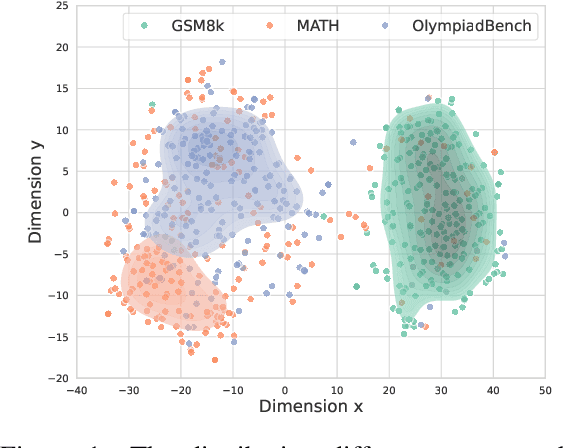
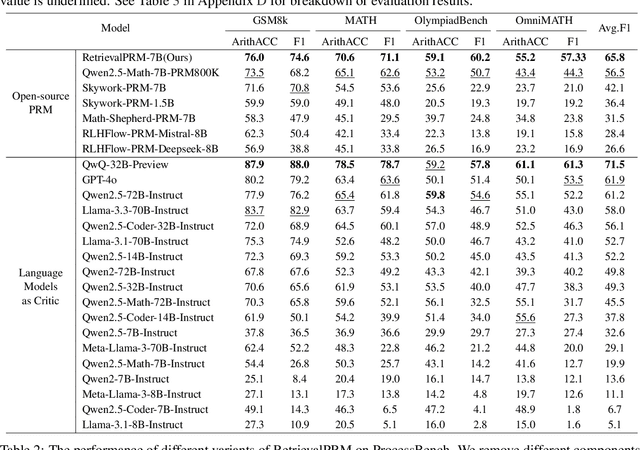
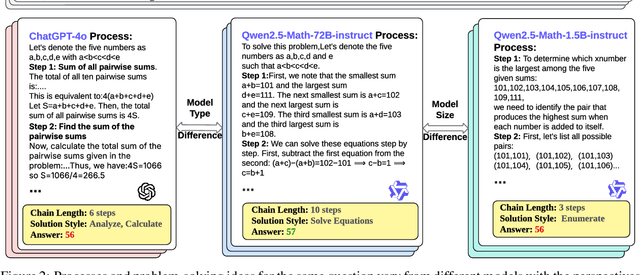
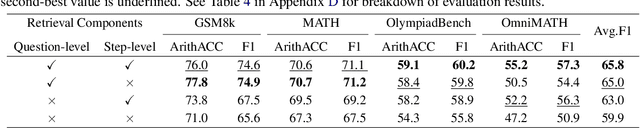
While large language models (LLMs) have significantly advanced mathematical reasoning, Process Reward Models (PRMs) have been developed to evaluate the logical validity of reasoning steps. However, PRMs still struggle with out-of-distribution (OOD) challenges. This paper identifies key OOD issues, including step OOD, caused by differences in reasoning patterns across model types and sizes, and question OOD, which arises from dataset shifts between training data and real-world problems. To address these issues, we introduce Retrieval-Augmented Process Reward Model (RetrievalPRM), a novel framework designed to tackle these OOD issues. By utilizing a two-stage retrieval-enhanced mechanism, RetrievalPRM retrieves semantically similar questions and steps as a warmup, enhancing PRM's ability to evaluate target steps and improving generalization and reasoning consistency across different models and problem types. Our extensive experiments demonstrate that RetrievalPRM outperforms existing baselines across multiple real-world datasets. Our open-source contributions include a retrieval-enhanced dataset, a tuning framework for PRM training, and the RetrievalPRM model, establishing a new standard for PRM performance.