 Add to Chrome
 Add to Firefox
 Add to Edge
A Survey on Multi-Turn Interaction Capabilities of Large Language Models
Jan 17, 2025
Multi-turn interaction in the dialogue system research refers to a system's ability to maintain context across multiple dialogue turns, enabling it to generate coherent and contextually relevant responses. Recent advancements in large language models (LLMs) have significantly expanded the scope of multi-turn interaction, moving beyond chatbots to enable more dynamic agentic interactions with users or environments. In this paper, we provide a focused review of the multi-turn capabilities of LLMs, which are critical for a wide range of downstream applications, including conversational search and recommendation, consultation services, and interactive tutoring. This survey explores four key aspects: (1) the core model capabilities that contribute to effective multi-turn interaction, (2) how multi-turn interaction is evaluated in current practice, (3) the general algorithms used to enhance multi-turn interaction, and (4) potential future directions for research in this field.

MMDocIR: Benchmarking Multi-Modal Retrieval for Long Documents
Jan 15, 2025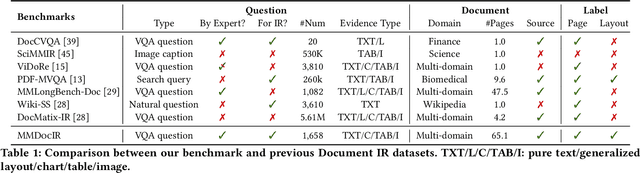


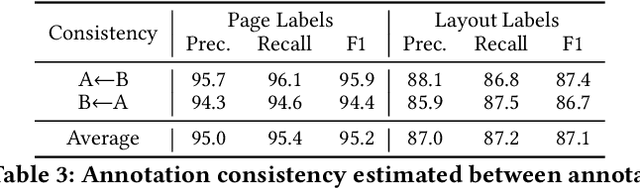
Multi-modal document retrieval is designed to identify and retrieve various forms of multi-modal content, such as figures, tables, charts, and layout information from extensive documents. Despite its significance, there is a notable lack of a robust benchmark to effectively evaluate the performance of systems in multi-modal document retrieval. To address this gap, this work introduces a new benchmark, named as MMDocIR, encompassing two distinct tasks: page-level and layout-level retrieval. The former focuses on localizing the most relevant pages within a long document, while the latter targets the detection of specific layouts, offering a more fine-grained granularity than whole-page analysis. A layout can refer to a variety of elements such as textual paragraphs, equations, figures, tables, or charts. The MMDocIR benchmark comprises a rich dataset featuring expertly annotated labels for 1,685 questions and bootstrapped labels for 173,843 questions, making it a pivotal resource for advancing multi-modal document retrieval for both training and evaluation. Through rigorous experiments, we reveal that (i) visual retrievers significantly outperform their text counterparts, (ii) MMDocIR train set can effectively benefit the training process of multi-modal document retrieval and (iii) text retrievers leveraging on VLM-text perform much better than those using OCR-text. These findings underscores the potential advantages of integrating visual elements for multi-modal document retrieval.
Densely Connected Parameter-Efficient Tuning for Referring Image Segmentation
Jan 15, 2025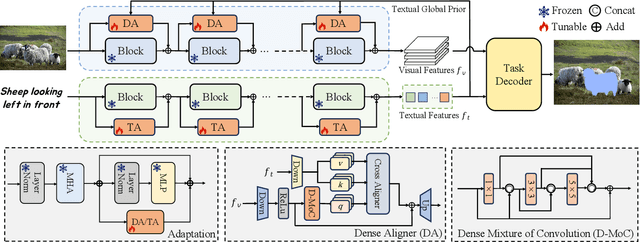

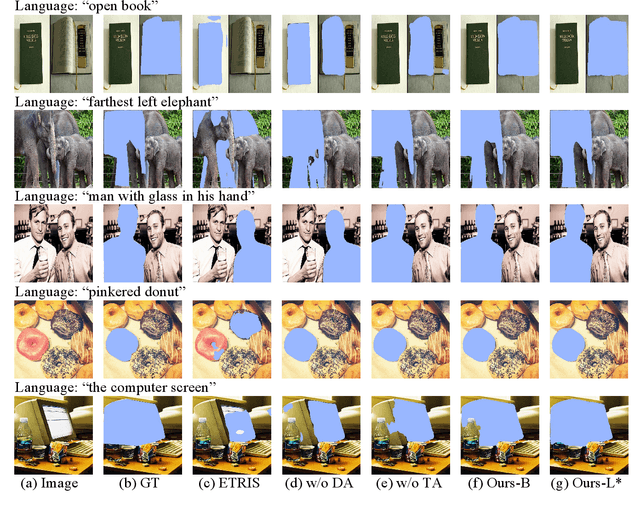
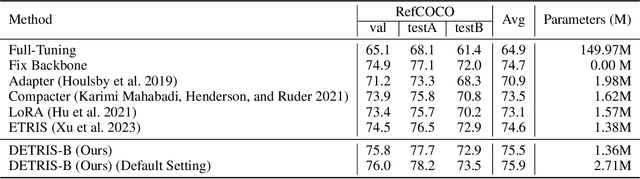
In the domain of computer vision, Parameter-Efficient Tuning (PET) is increasingly replacing the traditional paradigm of pre-training followed by full fine-tuning. PET is particularly favored for its effectiveness in large foundation models, as it streamlines transfer learning costs and optimizes hardware utilization. However, the current PET methods are mainly designed for single-modal optimization. While some pioneering studies have undertaken preliminary explorations, they still remain at the level of aligned encoders (e.g., CLIP) and lack exploration of misaligned encoders. These methods show sub-optimal performance with misaligned encoders, as they fail to effectively align the multimodal features during fine-tuning. In this paper, we introduce DETRIS, a parameter-efficient tuning framework designed to enhance low-rank visual feature propagation by establishing dense interconnections between each layer and all preceding layers, which enables effective cross-modal feature interaction and adaptation to misaligned encoders. We also suggest using text adapters to improve textual features. Our simple yet efficient approach greatly surpasses state-of-the-art methods with 0.9% to 1.8% backbone parameter updates, evaluated on challenging benchmarks. Our project is available at \url{https://github.com/jiaqihuang01/DETRIS}.
RWKV-UNet: Improving UNet with Long-Range Cooperation for Effective Medical Image Segmentation
Jan 14, 2025


In recent years, there have been significant advancements in deep learning for medical image analysis, especially with convolutional neural networks (CNNs) and transformer models. However, CNNs face limitations in capturing long-range dependencies while transformers suffer high computational complexities. To address this, we propose RWKV-UNet, a novel model that integrates the RWKV (Receptance Weighted Key Value) structure into the U-Net architecture. This integration enhances the model's ability to capture long-range dependencies and improve contextual understanding, which is crucial for accurate medical image segmentation. We build a strong encoder with developed inverted residual RWKV (IR-RWKV) blocks combining CNNs and RWKVs. We also propose a Cross-Channel Mix (CCM) module to improve skip connections with multi-scale feature fusion, achieving global channel information integration. Experiments on benchmark datasets, including Synapse, ACDC, BUSI, CVC-ClinicDB, CVC-ColonDB, Kvasir-SEG, ISIC 2017 and GLAS show that RWKV-UNet achieves state-of-the-art performance on various types of medical image segmentation. Additionally, smaller variants, RWKV-UNet-S and RWKV-UNet-T, balance accuracy and computational efficiency, making them suitable for broader clinical applications.
LeapVAD: A Leap in Autonomous Driving via Cognitive Perception and Dual-Process Thinking
Jan 14, 2025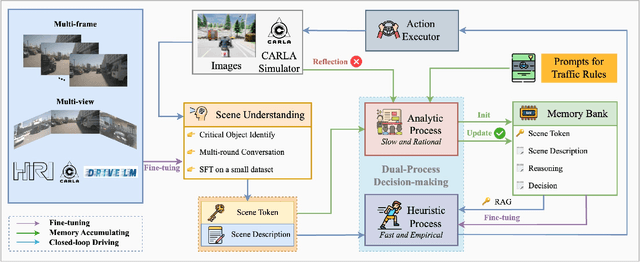
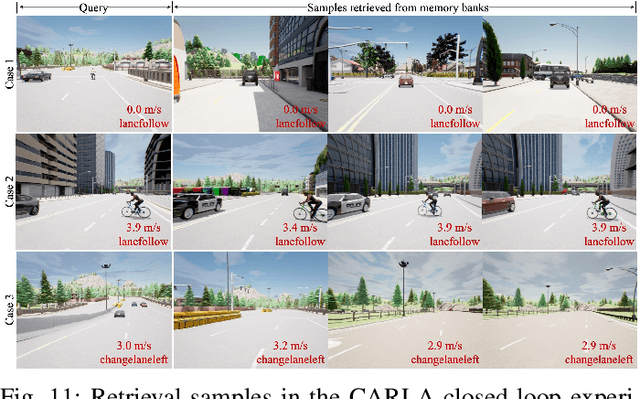
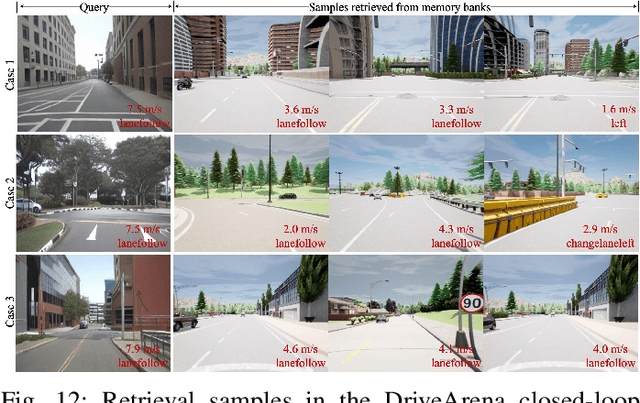
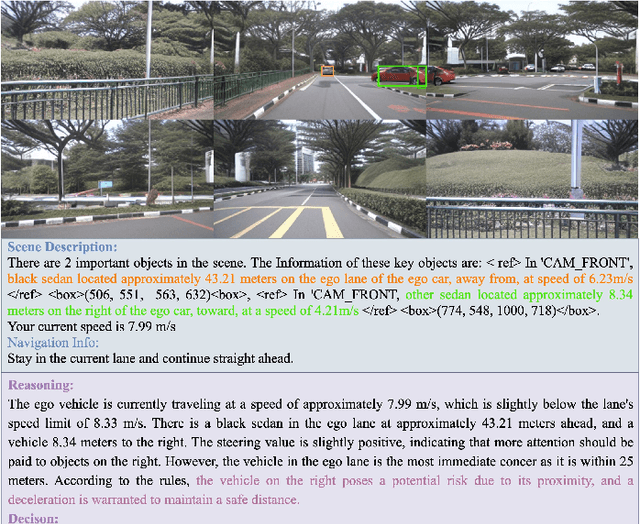
While autonomous driving technology has made remarkable strides, data-driven approaches still struggle with complex scenarios due to their limited reasoning capabilities. Meanwhile, knowledge-driven autonomous driving systems have evolved considerably with the popularization of visual language models. In this paper, we propose LeapVAD, a novel method based on cognitive perception and dual-process thinking. Our approach implements a human-attentional mechanism to identify and focus on critical traffic elements that influence driving decisions. By characterizing these objects through comprehensive attributes - including appearance, motion patterns, and associated risks - LeapVAD achieves more effective environmental representation and streamlines the decision-making process. Furthermore, LeapVAD incorporates an innovative dual-process decision-making module miming the human-driving learning process. The system consists of an Analytic Process (System-II) that accumulates driving experience through logical reasoning and a Heuristic Process (System-I) that refines this knowledge via fine-tuning and few-shot learning. LeapVAD also includes reflective mechanisms and a growing memory bank, enabling it to learn from past mistakes and continuously improve its performance in a closed-loop environment. To enhance efficiency, we develop a scene encoder network that generates compact scene representations for rapid retrieval of relevant driving experiences. Extensive evaluations conducted on two leading autonomous driving simulators, CARLA and DriveArena, demonstrate that LeapVAD achieves superior performance compared to camera-only approaches despite limited training data. Comprehensive ablation studies further emphasize its effectiveness in continuous learning and domain adaptation. Project page: https://pjlab-adg.github.io/LeapVAD/.
Hyperbolic Binary Neural Network
Jan 07, 2025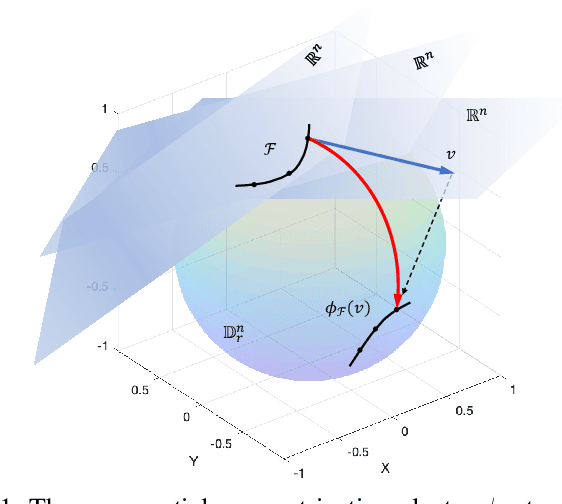
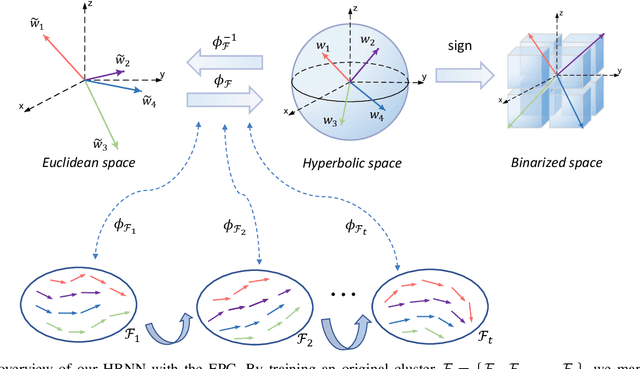
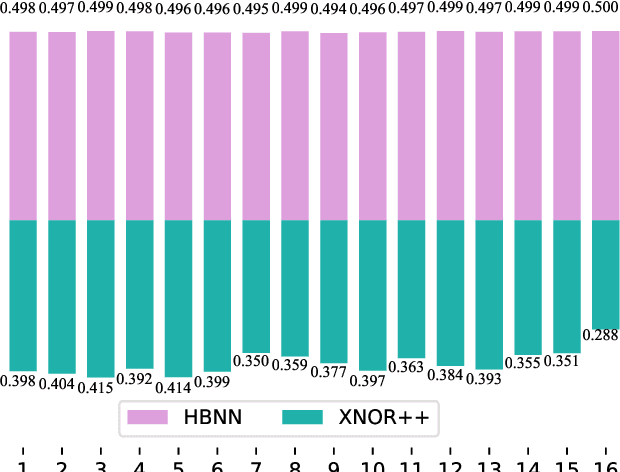
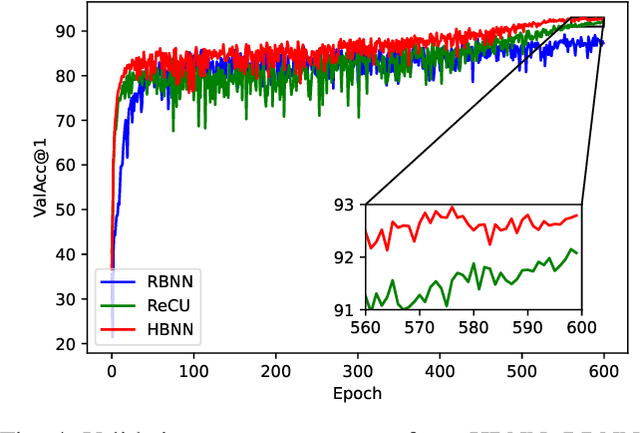
Binary Neural Network (BNN) converts full-precision weights and activations into their extreme 1-bit counterparts, making it particularly suitable for deployment on lightweight mobile devices. While binary neural networks are typically formulated as a constrained optimization problem and optimized in the binarized space, general neural networks are formulated as an unconstrained optimization problem and optimized in the continuous space. This paper introduces the Hyperbolic Binary Neural Network (HBNN) by leveraging the framework of hyperbolic geometry to optimize the constrained problem. Specifically, we transform the constrained problem in hyperbolic space into an unconstrained one in Euclidean space using the Riemannian exponential map. On the other hand, we also propose the Exponential Parametrization Cluster (EPC) method, which, compared to the Riemannian exponential map, shrinks the segment domain based on a diffeomorphism. This approach increases the probability of weight flips, thereby maximizing the information gain in BNNs. Experimental results on CIFAR10, CIFAR100, and ImageNet classification datasets with VGGsmall, ResNet18, and ResNet34 models illustrate the superior performance of our HBNN over state-of-the-art methods.
ADePT: Adaptive Decomposed Prompt Tuning for Parameter-Efficient Fine-tuning
Jan 06, 2025



Prompt Tuning (PT) enables the adaptation of Pre-trained Large Language Models (PLMs) to downstream tasks by optimizing a small amount of soft virtual tokens, which are prepended to the input token embeddings. Recently, Decomposed Prompt Tuning (DePT) has demonstrated superior adaptation capabilities by decomposing the soft prompt into a shorter soft prompt and a pair of low-rank matrices. The product of the pair of low-rank matrices is added to the input token embeddings to offset them. Additionally, DePT achieves faster inference compared to PT due to the shorter soft prompt. However, in this paper, we find that the position-based token embedding offsets of DePT restricts its ability to generalize across diverse model inputs, and that the shared embedding offsets across many token embeddings result in sub-optimization. To tackle these issues, we introduce \textbf{A}daptive \textbf{De}composed \textbf{P}rompt \textbf{T}uning (ADePT), which is composed of a short soft prompt and a shallow token-shared feed-forward neural network. ADePT utilizes the token-shared feed-forward neural network to learn the embedding offsets for each token, enabling adaptive embedding offsets that vary according to the model input and better optimization of token embedding offsets. This enables ADePT to achieve superior adaptation performance without requiring more inference time or additional trainable parameters compared to vanilla PT and its variants. In comprehensive experiments across 23 natural language processing (NLP) tasks and 4 typical PLMs of different scales, we show that ADePT consistently surpasses the leading parameter-efficient fine-tuning (PEFT) methods, and even outperforms the full fine-tuning baseline in certain scenarios. Code is available at \url{https://github.com/HungerPWAY/ADePT}.
Look Back for More: Harnessing Historical Sequential Updates for Personalized Federated Adapter Tuning
Jan 03, 2025

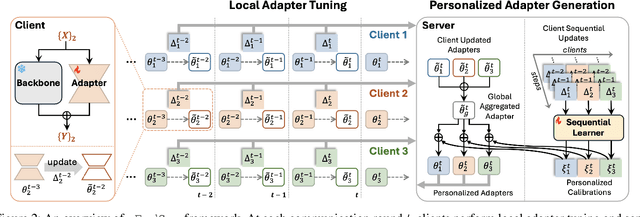

Personalized federated learning (PFL) studies effective model personalization to address the data heterogeneity issue among clients in traditional federated learning (FL). Existing PFL approaches mainly generate personalized models by relying solely on the clients' latest updated models while ignoring their previous updates, which may result in suboptimal personalized model learning. To bridge this gap, we propose a novel framework termed pFedSeq, designed for personalizing adapters to fine-tune a foundation model in FL. In pFedSeq, the server maintains and trains a sequential learner, which processes a sequence of past adapter updates from clients and generates calibrations for personalized adapters. To effectively capture the cross-client and cross-step relations hidden in previous updates and generate high-performing personalized adapters, pFedSeq adopts the powerful selective state space model (SSM) as the architecture of sequential learner. Through extensive experiments on four public benchmark datasets, we demonstrate the superiority of pFedSeq over state-of-the-art PFL methods.
SoftPatch+: Fully Unsupervised Anomaly Classification and Segmentation
Dec 30, 2024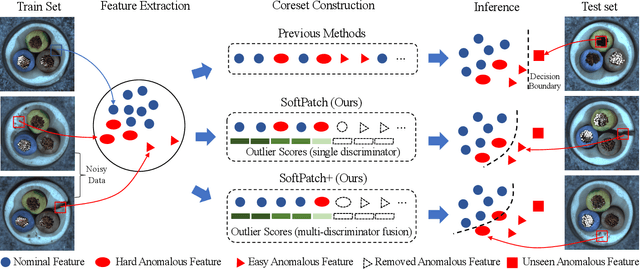


Although mainstream unsupervised anomaly detection (AD) (including image-level classification and pixel-level segmentation)algorithms perform well in academic datasets, their performance is limited in practical application due to the ideal experimental setting of clean training data. Training with noisy data is an inevitable problem in real-world anomaly detection but is seldom discussed. This paper is the first to consider fully unsupervised industrial anomaly detection (i.e., unsupervised AD with noisy data). To solve this problem, we proposed memory-based unsupervised AD methods, SoftPatch and SoftPatch+, which efficiently denoise the data at the patch level. Noise discriminators are utilized to generate outlier scores for patch-level noise elimination before coreset construction. The scores are then stored in the memory bank to soften the anomaly detection boundary. Compared with existing methods, SoftPatch maintains a strong modeling ability of normal data and alleviates the overconfidence problem in coreset, and SoftPatch+ has more robust performance which is articularly useful in real-world industrial inspection scenarios with high levels of noise (from 10% to 40%). Comprehensive experiments conducted in diverse noise scenarios demonstrate that both SoftPatch and SoftPatch+ outperform the state-of-the-art AD methods on the MVTecAD, ViSA, and BTAD benchmarks. Furthermore, the performance of SoftPatch and SoftPatch+ is comparable to that of the noise-free methods in conventional unsupervised AD setting. The code of the proposed methods can be found at https://github.com/TencentYoutuResearch/AnomalyDetection-SoftPatch.
DoTA: Weight-Decomposed Tensor Adaptation for Large Language Models
Dec 30, 2024


Low-rank adaptation (LoRA) reduces the computational and memory demands of fine-tuning large language models (LLMs) by approximating updates with low-rank matrices. However, low-rank approximation in two-dimensional space fails to capture high-dimensional structures within the target matrix. Recently, tensor decomposition methods have been explored for fine-tuning LLMs, leveraging their ability to extract structured information. Yet, these approaches primarily rely on random initialization, and the impact of initialization on tensor adaptation remains underexplored. In this paper, we reveal that random initialization significantly diverges from the validation loss achieved by full fine-tuning. To address this, we propose Weight-Decomposed Tensor Adaptation (DoTA), which leverages the Matrix Product Operator (MPO) decomposition of pre-trained weights for effective initialization in fine-tuning LLMs. Additionally, we introduce QDoTA, a quantized version of DoTA designed for 4-bit quantization. Experiments on commonsense and arithmetic reasoning tasks show that DoTA outperforms random initialization methods with fewer parameters. QDoTA further reduces memory consumption and achieves comparable performance to DoTA on commonsense reasoning tasks. We will release our code to support future research.