 Add to Chrome
 Add to Firefox
 Add to Edge
Trimming the Long-Tail of Visual World Modeling Evaluation
Jun 23, 2026
Physical interactions follow a long-tailed distribution: a set of common and regular interactions dominates human experience and visual data, while a broad spectrum of rare and irregular interactions remains underrepresented. Although recent visual world models, including image and video generation models, achieve impressive realism on existing benchmarks, they primarily focus on simulating common physical interactions. This raises a central question: Do current visual world models internalize and generalize physical principles? In this work, we introduce Tailor-Bench, a benchmark that challenges world models to simulate irregular physical interactions. To enable systematic evaluation, we design three scenario modes that progressively challenge model reasoning: Regular scenarios reflect common tool-task pairs, Unconventional scenarios replace conventional tools with attribute-compatible substitutes to test affordance generalization, and Impossible scenarios introduce attribute-violating tools to probe constraint awareness. Additionally, we design two complementary settings under a unified evaluation protocol: predictive generation requires inferring outcomes without guidance, while descriptive generation specifies the target outcome for faithful realization. Our experimental results reveal a clear long-tail gap in physical world modeling: performance degrades from Regular to Unconventional and Impossible scenarios, indicating limited generalization beyond common interactions. Failure analysis further shows that models rely on superficial visual patterns: image models fail to realize correct state changes, while video models further suffer from temporal inconsistencies.

ESI-Bench: Towards Embodied Spatial Intelligence that Closes the Perception-Action Loop
May 18, 2026Spatial intelligence unfolds through a perception-action loop: agents act to acquire observations, and reason about how observations vary as a function of action. Rather than passively processing what is seen, they actively uncover what is unseen - occluded structure, dynamics, containment, and functionality that cannot be resolved from passive sensing alone. We move beyond prior formulations of spatial intelligence that assume oracle observations by recasting the observer as an actor. We introduce ESI-BENCH, a comprehensive benchmark for embodied spatial intelligence spanning 10 task categories and 29 subcategories built on OmniGibson, grounded in Spelke's core knowledge systems. Agents must decide what abilities to deploy - perception, locomotion, and manipulation - and how to sequence them to actively accumulate task-relevant evidence. We conduct extensive experiments on state-of-the-art MLLMs and find that active exploration substantially outperforms passive counterparts, with agents spontaneously discovering emergent spatial strategies without explicit instructions, while random multi-view often adds noise rather than signal despite consuming far more images. Most failures stem not from weak perception but from action blindness: poor action choices lead to poor observations, which in turn drive cascading errors. While explicit 3D grounding stabilizes reasoning on depth-sensitive tasks, imperfect 3D representation proves more harmful than 2D baselines by distorting spatial relations. Human studies further reveal that unlike humans who seek falsifying viewpoints and revise beliefs under contradiction, models commit prematurely with high confidence regardless of evidence quality, exposing a metacognitive gap that neither better perception nor more embodied interaction alone can close.
Learning from Trials and Errors: Reflective Test-Time Planning for Embodied LLMs
Feb 24, 2026Embodied LLMs endow robots with high-level task reasoning, but they cannot reflect on what went wrong or why, turning deployment into a sequence of independent trials where mistakes repeat rather than accumulate into experience. Drawing upon human reflective practitioners, we introduce Reflective Test-Time Planning, which integrates two modes of reflection: \textit{reflection-in-action}, where the agent uses test-time scaling to generate and score multiple candidate actions using internal reflections before execution; and \textit{reflection-on-action}, which uses test-time training to update both its internal reflection model and its action policy based on external reflections after execution. We also include retrospective reflection, allowing the agent to re-evaluate earlier decisions and perform model updates with hindsight for proper long-horizon credit assignment. Experiments on our newly-designed Long-Horizon Household benchmark and MuJoCo Cupboard Fitting benchmark show significant gains over baseline models, with ablative studies validating the complementary roles of reflection-in-action and reflection-on-action. Qualitative analyses, including real-robot trials, highlight behavioral correction through reflection.
Envision: Embodied Visual Planning via Goal-Imagery Video Diffusion
Dec 27, 2025Embodied visual planning aims to enable manipulation tasks by imagining how a scene evolves toward a desired goal and using the imagined trajectories to guide actions. Video diffusion models, through their image-to-video generation capability, provide a promising foundation for such visual imagination. However, existing approaches are largely forward predictive, generating trajectories conditioned on the initial observation without explicit goal modeling, thus often leading to spatial drift and goal misalignment. To address these challenges, we propose Envision, a diffusion-based framework that performs visual planning for embodied agents. By explicitly constraining the generation with a goal image, our method enforces physical plausibility and goal consistency throughout the generated trajectory. Specifically, Envision operates in two stages. First, a Goal Imagery Model identifies task-relevant regions, performs region-aware cross attention between the scene and the instruction, and synthesizes a coherent goal image that captures the desired outcome. Then, an Env-Goal Video Model, built upon a first-and-last-frame-conditioned video diffusion model (FL2V), interpolates between the initial observation and the goal image, producing smooth and physically plausible video trajectories that connect the start and goal states. Experiments on object manipulation and image editing benchmarks demonstrate that Envision achieves superior goal alignment, spatial consistency, and object preservation compared to baselines. The resulting visual plans can directly support downstream robotic planning and control, providing reliable guidance for embodied agents.
Embodied Web Agents: Bridging Physical-Digital Realms for Integrated Agent Intelligence
Jun 18, 2025AI agents today are mostly siloed - they either retrieve and reason over vast amount of digital information and knowledge obtained online; or interact with the physical world through embodied perception, planning and action - but rarely both. This separation limits their ability to solve tasks that require integrated physical and digital intelligence, such as cooking from online recipes, navigating with dynamic map data, or interpreting real-world landmarks using web knowledge. We introduce Embodied Web Agents, a novel paradigm for AI agents that fluidly bridge embodiment and web-scale reasoning. To operationalize this concept, we first develop the Embodied Web Agents task environments, a unified simulation platform that tightly integrates realistic 3D indoor and outdoor environments with functional web interfaces. Building upon this platform, we construct and release the Embodied Web Agents Benchmark, which encompasses a diverse suite of tasks including cooking, navigation, shopping, tourism, and geolocation - all requiring coordinated reasoning across physical and digital realms for systematic assessment of cross-domain intelligence. Experimental results reveal significant performance gaps between state-of-the-art AI systems and human capabilities, establishing both challenges and opportunities at the intersection of embodied cognition and web-scale knowledge access. All datasets, codes and websites are publicly available at our project page https://embodied-web-agent.github.io/.
3DLLM-Mem: Long-Term Spatial-Temporal Memory for Embodied 3D Large Language Model
May 28, 2025Humans excel at performing complex tasks by leveraging long-term memory across temporal and spatial experiences. In contrast, current Large Language Models (LLMs) struggle to effectively plan and act in dynamic, multi-room 3D environments. We posit that part of this limitation is due to the lack of proper 3D spatial-temporal memory modeling in LLMs. To address this, we first introduce 3DMem-Bench, a comprehensive benchmark comprising over 26,000 trajectories and 2,892 embodied tasks, question-answering and captioning, designed to evaluate an agent's ability to reason over long-term memory in 3D environments. Second, we propose 3DLLM-Mem, a novel dynamic memory management and fusion model for embodied spatial-temporal reasoning and actions in LLMs. Our model uses working memory tokens, which represents current observations, as queries to selectively attend to and fuse the most useful spatial and temporal features from episodic memory, which stores past observations and interactions. Our approach allows the agent to focus on task-relevant information while maintaining memory efficiency in complex, long-horizon environments. Experimental results demonstrate that 3DLLM-Mem achieves state-of-the-art performance across various tasks, outperforming the strongest baselines by 16.5% in success rate on 3DMem-Bench's most challenging in-the-wild embodied tasks.
From Hazard Identification to Controller Design: Proactive and LLM-Supported Safety Engineering for ML-Powered Systems
Feb 11, 2025
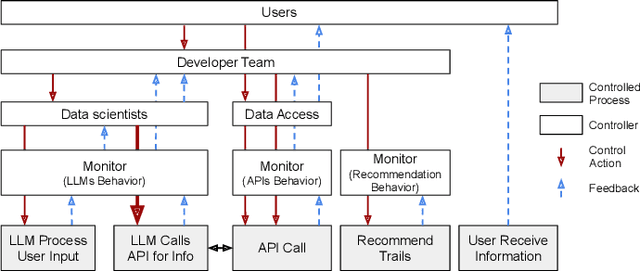
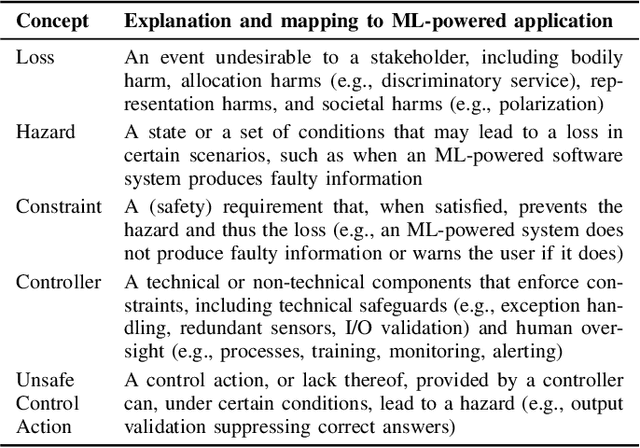
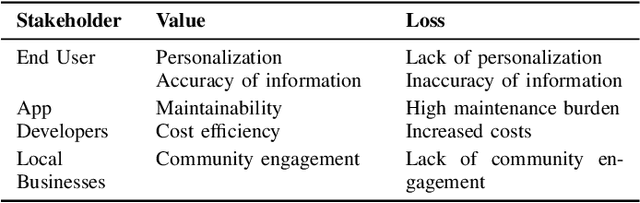
Machine learning (ML) components are increasingly integrated into software products, yet their complexity and inherent uncertainty often lead to unintended and hazardous consequences, both for individuals and society at large. Despite these risks, practitioners seldom adopt proactive approaches to anticipate and mitigate hazards before they occur. Traditional safety engineering approaches, such as Failure Mode and Effects Analysis (FMEA) and System Theoretic Process Analysis (STPA), offer systematic frameworks for early risk identification but are rarely adopted. This position paper advocates for integrating hazard analysis into the development of any ML-powered software product and calls for greater support to make this process accessible to developers. By using large language models (LLMs) to partially automate a modified STPA process with human oversight at critical steps, we expect to address two key challenges: the heavy dependency on highly experienced safety engineering experts, and the time-consuming, labor-intensive nature of traditional hazard analysis, which often impedes its integration into real-world development workflows. We illustrate our approach with a running example, demonstrating that many seemingly unanticipated issues can, in fact, be anticipated.
SlowFast-VGen: Slow-Fast Learning for Action-Driven Long Video Generation
Oct 30, 2024


Human beings are endowed with a complementary learning system, which bridges the slow learning of general world dynamics with fast storage of episodic memory from a new experience. Previous video generation models, however, primarily focus on slow learning by pre-training on vast amounts of data, overlooking the fast learning phase crucial for episodic memory storage. This oversight leads to inconsistencies across temporally distant frames when generating longer videos, as these frames fall beyond the model's context window. To this end, we introduce SlowFast-VGen, a novel dual-speed learning system for action-driven long video generation. Our approach incorporates a masked conditional video diffusion model for the slow learning of world dynamics, alongside an inference-time fast learning strategy based on a temporal LoRA module. Specifically, the fast learning process updates its temporal LoRA parameters based on local inputs and outputs, thereby efficiently storing episodic memory in its parameters. We further propose a slow-fast learning loop algorithm that seamlessly integrates the inner fast learning loop into the outer slow learning loop, enabling the recall of prior multi-episode experiences for context-aware skill learning. To facilitate the slow learning of an approximate world model, we collect a large-scale dataset of 200k videos with language action annotations, covering a wide range of scenarios. Extensive experiments show that SlowFast-VGen outperforms baselines across various metrics for action-driven video generation, achieving an FVD score of 514 compared to 782, and maintaining consistency in longer videos, with an average of 0.37 scene cuts versus 0.89. The slow-fast learning loop algorithm significantly enhances performances on long-horizon planning tasks as well. Project Website: https://slowfast-vgen.github.io
What Is Wrong with My Model? Identifying Systematic Problems with Semantic Data Slicing
Sep 14, 2024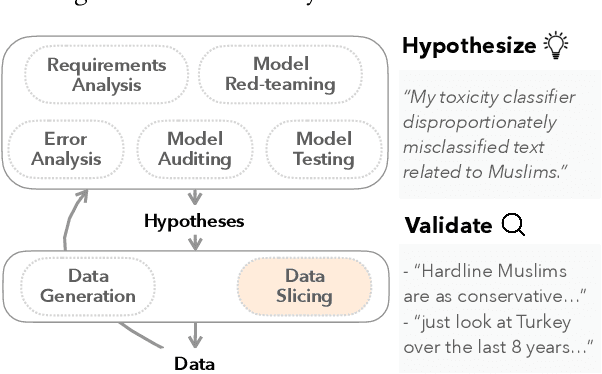
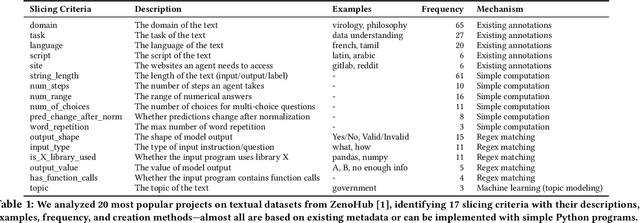
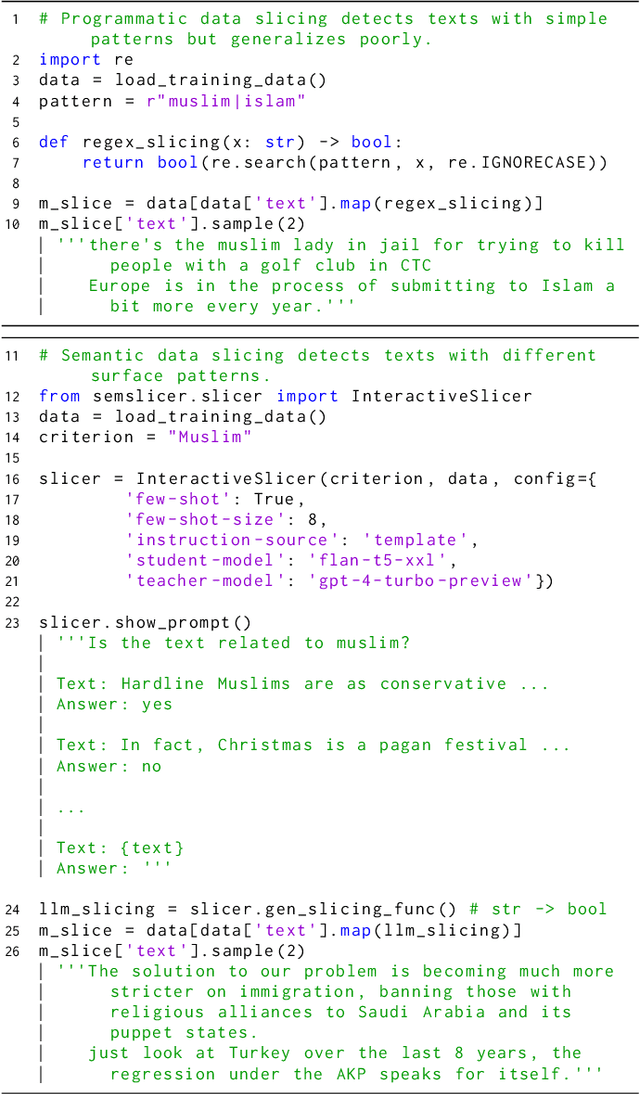
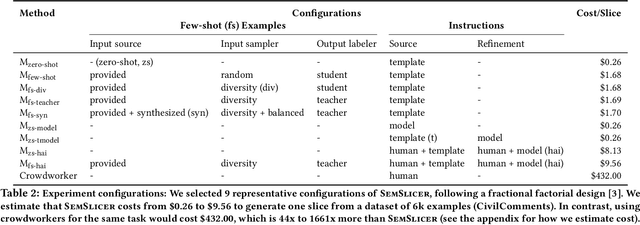
Machine learning models make mistakes, yet sometimes it is difficult to identify the systematic problems behind the mistakes. Practitioners engage in various activities, including error analysis, testing, auditing, and red-teaming, to form hypotheses of what can go (or has gone) wrong with their models. To validate these hypotheses, practitioners employ data slicing to identify relevant examples. However, traditional data slicing is limited by available features and programmatic slicing functions. In this work, we propose SemSlicer, a framework that supports semantic data slicing, which identifies a semantically coherent slice, without the need for existing features. SemSlicer uses Large Language Models to annotate datasets and generate slices from any user-defined slicing criteria. We show that SemSlicer generates accurate slices with low cost, allows flexible trade-offs between different design dimensions, reliably identifies under-performing data slices, and helps practitioners identify useful data slices that reflect systematic problems.
FlexAttention for Efficient High-Resolution Vision-Language Models
Jul 29, 2024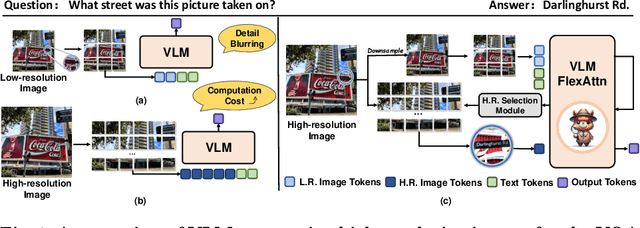

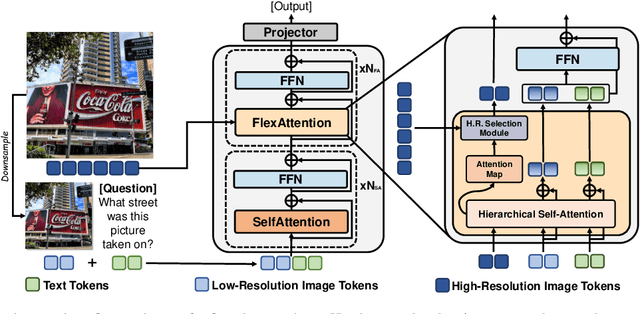
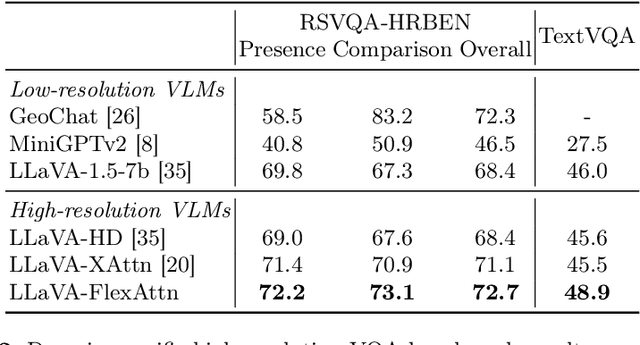
Current high-resolution vision-language models encode images as high-resolution image tokens and exhaustively take all these tokens to compute attention, which significantly increases the computational cost. To address this problem, we propose FlexAttention, a flexible attention mechanism for efficient high-resolution vision-language models. Specifically, a high-resolution image is encoded both as high-resolution tokens and low-resolution tokens, where only the low-resolution tokens and a few selected high-resolution tokens are utilized to calculate the attention map, which greatly shrinks the computational cost. The high-resolution tokens are selected via a high-resolution selection module which could retrieve tokens of relevant regions based on an input attention map. The selected high-resolution tokens are then concatenated to the low-resolution tokens and text tokens, and input to a hierarchical self-attention layer which produces an attention map that could be used for the next-step high-resolution token selection. The hierarchical self-attention process and high-resolution token selection process are performed iteratively for each attention layer. Experiments on multimodal benchmarks prove that our FlexAttention outperforms existing high-resolution VLMs (e.g., relatively ~9% in V* Bench, ~7% in TextVQA), while also significantly reducing the computational cost by nearly 40%.