 Add to Chrome
 Add to Firefox
 Add to Edge
LEEPS: Latent-Guided Explore-Exploit Prompt Sampling for Efficient RLVR in Large Language Models
Jul 30, 2026
Reinforcement learning with verifiable rewards (RLVR) improves the reasoning capabilities of large language models, but prompt groups with identical rollout rewards consume generation budget without effective learning signals. Pre-rollout prompt selection can reduce this waste by screening prompts before rollout generation. However, existing pre-rollout methods struggle to balance exploitation and exploration: repeatedly exploiting historically informative prompts can narrow training coverage, whereas broader exploration can lower the fraction of informative prompts. To address these limitations, we introduce LEEPS, a Latent-Guided Explore--Exploit Prompt Sampler that adaptively balances the reuse of previously observed informative prompts with continued exploration of uncertain ones. LEEPS partitions candidates into exploit and explore portfolios and adaptively allocates rollout budget according to their recent non-trivial ratios. It further uses representation-space neighbors and historical rollout outcomes to prioritize uncertain prompts likely to yield non-zero reward variance, thereby making exploration more targeted without additional rollouts. Across six mathematical reasoning benchmarks, LEEPS achieves the highest average score at both model scales, with relative gains of 2.6\% and 3.7\% over the strongest baseline for Qwen2.5-Math-1.5B and 7B, respectively, and generally improves faster during the training process. It also achieves the highest average score across the three evaluated OOD general-reasoning benchmarks at both model scales and adds only about 2 seconds of online sampling overhead per training step. Code is available at https://github.com/ShuangLiangX/LEEPS.

HiLo-Token: Input-Adaptive High-Low Frequency Token Compression for Efficient Image Editing
Jun 11, 2026Creative image editing tools, such as Photoshop's Remove or Generative Fill buttons, are central to everyday customer use and account for a major share of traffic in Photoshop and Lightroom. However, current generative AI models face significant latency challenges, which become even more pronounced when transitioning from convolution-based U-Nets to Diffusion Transformers (DiTs). In our evaluation on hundreds of representative image editing samples spanning a wide range of mask ratios, the DiT module alone accounts for an average of 73% of the total model latency, even after being distilled from 50 timesteps down to 8 timesteps. To tackle this challenge, we propose $\textbf{HiLo-Token}$, an input-adaptive token compression framework that allocates more token budget to high-frequency, rich-context regions while assigning fewer tokens to low-frequency areas. Specifically, for the editing region specified by the user mask, we retain all tokens within a dilated mask to preserve strong locality and contextual relevance. Outside the editing region, we introduce a simple yet effective high-frequency token selection strategy based on spatial frequency to capture important local details, while using tokens from a 16x downsampled image to represent low-frequency components and preserve the blurry but global structure. Extensive experiments on production-level evaluation data validate the effectiveness of the proposed method, achieving 3.13x, 2.59x, and 1.67x DiT speedups on A100-80GB for image editing tasks across small, medium, and large mask ratio categories with average ratios of 6.38%, 15.92%, and 35.36%, respectively, without any regression in generation quality.
OmniMem: Scalable and Adaptive Memory Retrieval for Long Video Generation
May 28, 2026Autoregressive (AR) video generation extends videos by producing latent chunks sequentially, but scaling to long videos requires repeated access to a growing historical KV cache. Existing methods reduce this cost by truncating the KV cache or compressing it into implicit memory, but both lose explicit access to query-relevant historical details. We propose OmniMem, an explicit full-range memory retrieval framework that performs sparse KV retrieval over the historical cache. To make this practical for chunk-based AR video generation, OmniMem addresses two issues: (i) local bias in sparse KV selection and (ii) Union Explosion in memory access. Adaptive Window Exclusion removes local-window blocks from the selection candidates when sufficient long-range history is available, preserving the sparse budget for informative long-range retrieval. Query-Shared KV Selection reduces cross-query diversity, while Per-Head Scattered KV Access avoids expanding head-specific selections into a large selected KV buffer. This allows each attention head to retrieve non-contiguous KV blocks according to its own selection pattern. Experiments on long-video generation show that OmniMem improves Dynamic Degree by 52.3% and preserves strong consistency over strong baselines, while maintaining comparable memory usage.
Complete-muE: Optimal Hyperparameter Transfer and Scaling for MoE Models
May 22, 2026We propose Complete-muE, a framework which targets hyperparameter transfer across dense FFN and any Mixture-of-Experts (MoE) setups in transformer blocks. Existing tools such as $μ$P (requires fixed architectue) or SDE (requires fixed per-step token count) cannot directly solve the hyperparameter transfer problem in MoE setups because Dense to MoE transfer or MoE total experts scaling changes both architecture and tokens per expert. Complete-muE solves this challenge with a two-bridge system: Bridge~I maps between dense FFN and Dense MoE by active-width $μ$P with a normalized router scale. Bridge~II maps between Dense MoE and sparse MoE by activated-expert scaling, where the first-order SDE LR/WD correction cancels while a bounded residual $σ_0$ shift remains. The resulting transfer rule, which we term as Complete muE, covers changes in activated experts, total capacity, granularity, and shared/group-balanced hybrids for MoE models as well as network width/depth, batch size, and duration changes for general Transformer models. Extensive language model and diffusion model pretraining experiments confirm that complete-muE yields relatively stable hyperparameter optima across model architectures and parameter counts -- with only minor drift consistent with the non-strict SDE behavior of Bridge~II. In practice this drift is small enough that hyperparameters tuned on a single dense reference transfer near-optimally to all MoE configurations -- \emph{tune dense once, transfer to all} is the practical recipe at the core of Complete-muE. This enables MoE models to achieve accelerated convergence speedup over dense models when scaling model capacity without costly hyperparameter search.
Sparsity-Controllable Dynamic Top-p MoE for Large Foundation Model Pre-training
Dec 16, 2025Sparse Mixture-of-Experts (MoE) architectures effectively scale model capacity by activating only a subset of experts for each input token. However, the standard Top-k routing strategy imposes a uniform sparsity pattern that ignores the varying difficulty of tokens. While Top-p routing offers a flexible alternative, existing implementations typically rely on a fixed global probability threshold, which results in uncontrolled computational costs and sensitivity to hyperparameter selection. In this paper, we propose DTop-p MoE, a sparsity-controllable dynamic Top-p routing mechanism. To resolve the challenge of optimizing a non-differentiable threshold, we utilize a Proportional-Integral (PI) Controller that dynamically adjusts the probability threshold to align the running activated-expert sparsity with a specified target. Furthermore, we introduce a dynamic routing normalization mechanism that adapts layer-wise routing logits, allowing different layers to learn distinct expert-selection patterns while utilizing a global probability threshold. Extensive experiments on Large Language Models and Diffusion Transformers demonstrate that DTop-p consistently outperforms both Top-k and fixed-threshold Top-p baselines. Our analysis confirms that DTop-p maintains precise control over the number of activated experts while adaptively allocating resources across different tokens and layers. Furthermore, DTop-p exhibits strong scaling properties with respect to expert granularity, expert capacity, model size, and dataset size, offering a robust framework for large-scale MoE pre-training.
RECALL: REpresentation-aligned Catastrophic-forgetting ALLeviation via Hierarchical Model Merging
Oct 23, 2025We unveil that internal representations in large language models (LLMs) serve as reliable proxies of learned knowledge, and propose RECALL, a novel representation-aware model merging framework for continual learning without access to historical data. RECALL computes inter-model similarity from layer-wise hidden representations over clustered typical samples, and performs adaptive, hierarchical parameter fusion to align knowledge across models. This design enables the preservation of domain-general features in shallow layers while allowing task-specific adaptation in deeper layers. Unlike prior methods that require task labels or incur performance trade-offs, RECALL achieves seamless multi-domain integration and strong resistance to catastrophic forgetting. Extensive experiments across five NLP tasks and multiple continual learning scenarios show that RECALL outperforms baselines in both knowledge retention and generalization, providing a scalable and data-free solution for evolving LLMs.
Improving Practical Aspects of End-to-End Multi-Talker Speech Recognition for Online and Offline Scenarios
Jun 17, 2025We extend the frameworks of Serialized Output Training (SOT) to address practical needs of both streaming and offline automatic speech recognition (ASR) applications. Our approach focuses on balancing latency and accuracy, catering to real-time captioning and summarization requirements. We propose several key improvements: (1) Leveraging Continuous Speech Separation (CSS) single-channel front-end with end-to-end (E2E) systems for highly overlapping scenarios, challenging the conventional wisdom of E2E versus cascaded setups. The CSS framework improves the accuracy of the ASR system by separating overlapped speech from multiple speakers. (2) Implementing dual models -- Conformer Transducer for streaming and Sequence-to-Sequence for offline -- or alternatively, a two-pass model based on cascaded encoders. (3) Exploring segment-based SOT (segSOT) which is better suited for offline scenarios while also enhancing readability of multi-talker transcriptions.
Enabling Flexible Multi-LLM Integration for Scalable Knowledge Aggregation
May 28, 2025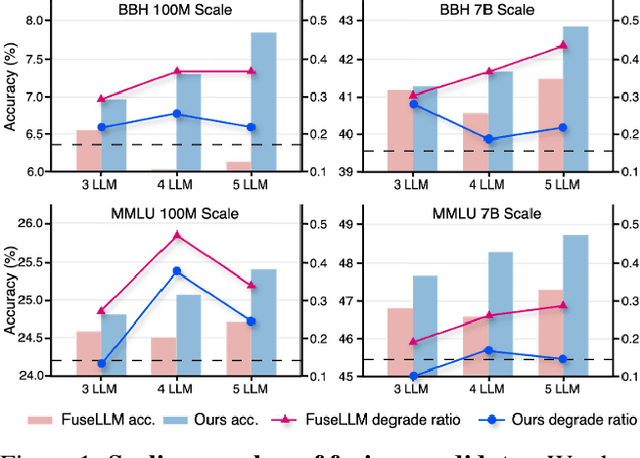
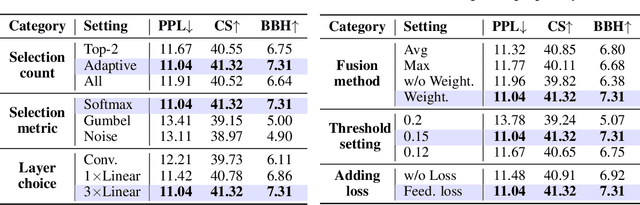
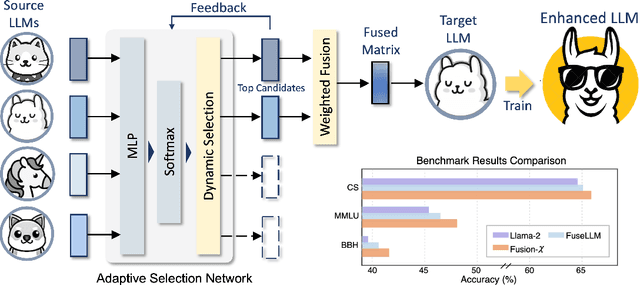
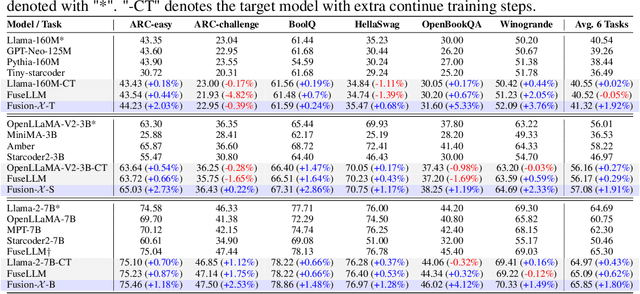
Large language models (LLMs) have shown remarkable promise but remain challenging to continually improve through traditional finetuning, particularly when integrating capabilities from other specialized LLMs. Popular methods like ensemble and weight merging require substantial memory and struggle to adapt to changing data environments. Recent efforts have transferred knowledge from multiple LLMs into a single target model; however, they suffer from interference and degraded performance among tasks, largely due to limited flexibility in candidate selection and training pipelines. To address these issues, we propose a framework that adaptively selects and aggregates knowledge from diverse LLMs to build a single, stronger model, avoiding the high memory overhead of ensemble and inflexible weight merging. Specifically, we design an adaptive selection network that identifies the most relevant source LLMs based on their scores, thereby reducing knowledge interference. We further propose a dynamic weighted fusion strategy that accounts for the inherent strengths of candidate LLMs, along with a feedback-driven loss function that prevents the selector from converging on a single subset of sources. Experimental results demonstrate that our method can enable a more stable and scalable knowledge aggregation process while reducing knowledge interference by up to 50% compared to existing approaches. Code is avaliable at https://github.com/ZLKong/LLM_Integration
LazyDiT: Lazy Learning for the Acceleration of Diffusion Transformers
Dec 17, 2024Diffusion Transformers have emerged as the preeminent models for a wide array of generative tasks, demonstrating superior performance and efficacy across various applications. The promising results come at the cost of slow inference, as each denoising step requires running the whole transformer model with a large amount of parameters. In this paper, we show that performing the full computation of the model at each diffusion step is unnecessary, as some computations can be skipped by lazily reusing the results of previous steps. Furthermore, we show that the lower bound of similarity between outputs at consecutive steps is notably high, and this similarity can be linearly approximated using the inputs. To verify our demonstrations, we propose the \textbf{LazyDiT}, a lazy learning framework that efficiently leverages cached results from earlier steps to skip redundant computations. Specifically, we incorporate lazy learning layers into the model, effectively trained to maximize laziness, enabling dynamic skipping of redundant computations. Experimental results show that LazyDiT outperforms the DDIM sampler across multiple diffusion transformer models at various resolutions. Furthermore, we implement our method on mobile devices, achieving better performance than DDIM with similar latency.
Fast and Memory-Efficient Video Diffusion Using Streamlined Inference
Nov 02, 2024


The rapid progress in artificial intelligence-generated content (AIGC), especially with diffusion models, has significantly advanced development of high-quality video generation. However, current video diffusion models exhibit demanding computational requirements and high peak memory usage, especially for generating longer and higher-resolution videos. These limitations greatly hinder the practical application of video diffusion models on standard hardware platforms. To tackle this issue, we present a novel, training-free framework named Streamlined Inference, which leverages the temporal and spatial properties of video diffusion models. Our approach integrates three core components: Feature Slicer, Operator Grouping, and Step Rehash. Specifically, Feature Slicer effectively partitions input features into sub-features and Operator Grouping processes each sub-feature with a group of consecutive operators, resulting in significant memory reduction without sacrificing the quality or speed. Step Rehash further exploits the similarity between adjacent steps in diffusion, and accelerates inference through skipping unnecessary steps. Extensive experiments demonstrate that our approach significantly reduces peak memory and computational overhead, making it feasible to generate high-quality videos on a single consumer GPU (e.g., reducing peak memory of AnimateDiff from 42GB to 11GB, featuring faster inference on 2080Ti).