 Add to Chrome
 Add to Firefox
 Add to Edge
Sparsity-Controllable Dynamic Top-p MoE for Large Foundation Model Pre-training
Dec 16, 2025
Sparse Mixture-of-Experts (MoE) architectures effectively scale model capacity by activating only a subset of experts for each input token. However, the standard Top-k routing strategy imposes a uniform sparsity pattern that ignores the varying difficulty of tokens. While Top-p routing offers a flexible alternative, existing implementations typically rely on a fixed global probability threshold, which results in uncontrolled computational costs and sensitivity to hyperparameter selection. In this paper, we propose DTop-p MoE, a sparsity-controllable dynamic Top-p routing mechanism. To resolve the challenge of optimizing a non-differentiable threshold, we utilize a Proportional-Integral (PI) Controller that dynamically adjusts the probability threshold to align the running activated-expert sparsity with a specified target. Furthermore, we introduce a dynamic routing normalization mechanism that adapts layer-wise routing logits, allowing different layers to learn distinct expert-selection patterns while utilizing a global probability threshold. Extensive experiments on Large Language Models and Diffusion Transformers demonstrate that DTop-p consistently outperforms both Top-k and fixed-threshold Top-p baselines. Our analysis confirms that DTop-p maintains precise control over the number of activated experts while adaptively allocating resources across different tokens and layers. Furthermore, DTop-p exhibits strong scaling properties with respect to expert granularity, expert capacity, model size, and dataset size, offering a robust framework for large-scale MoE pre-training.

Accel-GCN: High-Performance GPU Accelerator Design for Graph Convolution Networks
Aug 22, 2023

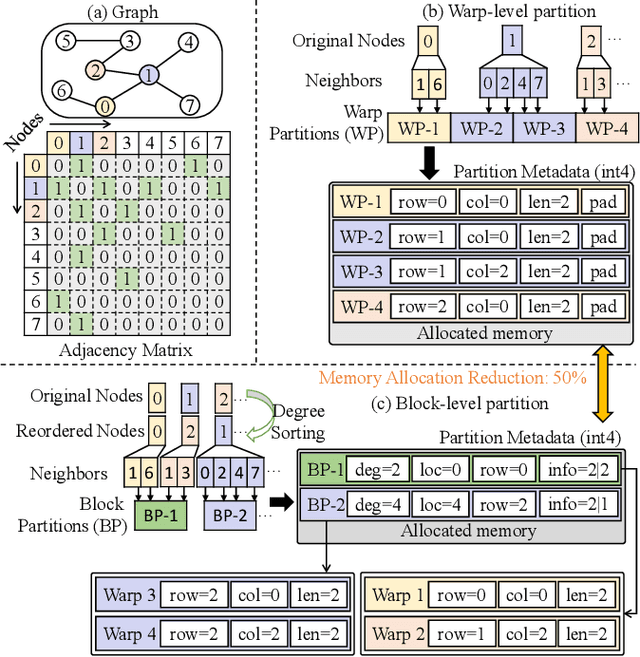

Graph Convolutional Networks (GCNs) are pivotal in extracting latent information from graph data across various domains, yet their acceleration on mainstream GPUs is challenged by workload imbalance and memory access irregularity. To address these challenges, we present Accel-GCN, a GPU accelerator architecture for GCNs. The design of Accel-GCN encompasses: (i) a lightweight degree sorting stage to group nodes with similar degree; (ii) a block-level partition strategy that dynamically adjusts warp workload sizes, enhancing shared memory locality and workload balance, and reducing metadata overhead compared to designs like GNNAdvisor; (iii) a combined warp strategy that improves memory coalescing and computational parallelism in the column dimension of dense matrices. Utilizing these principles, we formulated a kernel for sparse matrix multiplication (SpMM) in GCNs that employs block-level partitioning and combined warp strategy. This approach augments performance and multi-level memory efficiency and optimizes memory bandwidth by exploiting memory coalescing and alignment. Evaluation of Accel-GCN across 18 benchmark graphs reveals that it outperforms cuSPARSE, GNNAdvisor, and graph-BLAST by factors of 1.17 times, 1.86 times, and 2.94 times respectively. The results underscore Accel-GCN as an effective solution for enhancing GCN computational efficiency.