 Add to Chrome
 Add to Firefox
 Add to Edge
TAD: Temporal-Aware Trajectory Self-Distillation for Fast and Accurate Diffusion LLM
May 10, 2026
Diffusion large language models (dLLMs) offer a promising paradigm for parallel text generation, but in practice they face an accuracy-parallelism trade-off, where increasing tokens per forward (TPF) often degrades generation quality. Existing acceleration methods often gain speed at the cost of accuracy. To address this limitation, we propose TAD, a Temporal-Aware trajectory self-Distillation framework. During data construction, we condition a teacher model on both the prompt and the ground-truth response to generate decoding trajectories, recording the intermediate masked states throughout the process. Based on how many decoding steps remain before each masked token is revealed, we partition masked positions into near and distant subsets. For near tokens, we train the student with a hard cross-entropy loss using the teacher trajectory tokens as labels, encouraging confident predictions for tokens that are about to be decoded. For distant tokens, we apply a soft KL divergence loss between the teacher and student token distributions, providing softer supervision and preserving future planning knowledge. This temporal-aware partition naturally gives rise to two deployment configurations: a Quality model that prioritizes accuracy and a Speed model that favors more aggressive acceleration. Experiments show that TAD consistently improves the accuracy-parallelism trade-off. On LLaDA, it raises average accuracy from 46.2\% to 51.6\% with the Quality model and average AUP from 46.2 to 257.1 with the Speed model. Our code is available at: https://github.com/BHmingyang/TAD

Beyond Matching to Tiles: Bridging Unaligned Aerial and Satellite Views for Vision-Only UAV Navigation
Mar 23, 2026Recent advances in cross-view geo-localization (CVGL) methods have shown strong potential for supporting unmanned aerial vehicle (UAV) navigation in GNSS-denied environments. However, existing work predominantly focuses on matching UAV views to onboard map tiles, which introduces an inherent trade-off between accuracy and storage overhead, and overlooks the importance of the UAV's heading during navigation. Moreover, the substantial discrepancies and varying overlaps in cross-view scenarios have been insufficiently considered, limiting their generalization to real-world scenarios. In this paper, we present Bearing-UAV, a purely vision-driven cross-view navigation method that jointly predicts UAV absolute location and heading from neighboring features, enabling accurate, lightweight, and robust navigation in the wild. Our method leverages global and local structural features and explicitly encodes relative spatial relationships, making it robust to cross-view variations, misalignment, and feature-sparse conditions. We also present Bearing-UAV-90k, a multi-city benchmark for evaluating cross-view localization and navigation. Extensive experiments show encouraging results that Bearing-UAV yields lower localization error than previous matching/retrieval paradigm across diverse terrains. Our code and dataset will be made publicly available.
MovieChat: From Dense Token to Sparse Memory for Long Video Understanding
Jul 31, 2023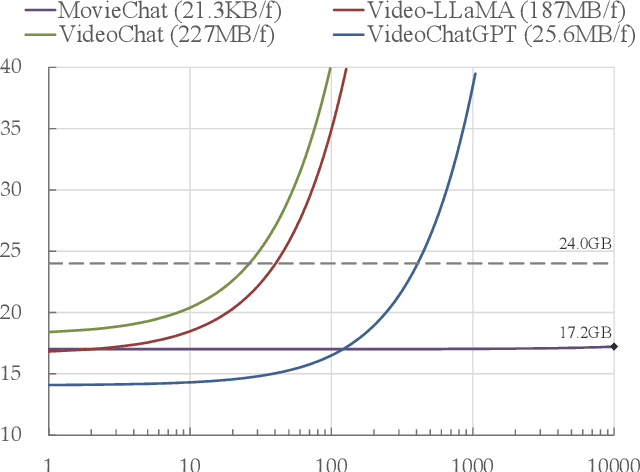
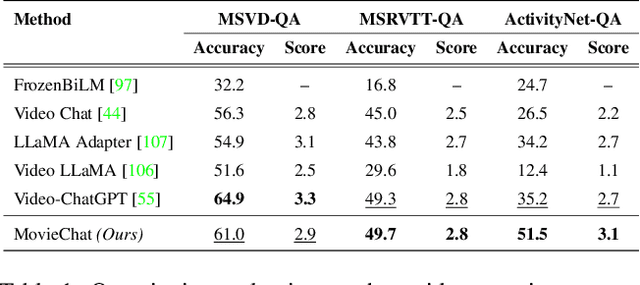


Recently, integrating video foundation models and large language models to build a video understanding system overcoming the limitations of specific pre-defined vision tasks. Yet, existing systems can only handle videos with very few frames. For long videos, the computation complexity, memory cost, and long-term temporal connection are the remaining challenges. Inspired by Atkinson-Shiffrin memory model, we develop an memory mechanism including a rapidly updated short-term memory and a compact thus sustained long-term memory. We employ tokens in Transformers as the carriers of memory. MovieChat achieves state-of-the-art performace in long video understanding.