 Add to Chrome
 Add to Firefox
 Add to Edge
Optimizing What Policies Learn From: Recoverability-aware Rollout Intervention Learning
Aug 05, 2026
Critic-free group-based reinforcement learning has become a scalable approach for post-training large language models. However, most existing methods allocate the same number of rollouts to every task and trajectory state, even though some rollouts provide much more useful learning signals than others. Recent work has started to treat rollout generation as an adaptive decision, but two important limitations remain. First, intervention strategies are often based on fixed heuristics and therefore cannot adjust as the policy changes during training. Second, these methods usually decide only how many rollouts to generate, without explicitly controlling where and how to intervene. To address these limitations, we propose Recoverability-Aware Intervention Learning (RAIL), a training-time framework that learns how to generate rollouts based on the improvement produced by each intervention. RAIL models intervention selection as an online contextual-bandit problem and trains a recoverability controller using intervention traces collected through a shadow-to-live procedure. This allows the controller to keep learning while the underlying policy evolves. We evaluate RAIL in terms of effectiveness, adaptivity, expressiveness, and efficiency. Across multiple settings, RAIL consistently improves performance under limited rollout budgets. These results show that recoverability-aware intervention provides a principled way to generate more informative and less redundant rollouts, leading to stronger learning signals during post-training.

Splaxel: Efficient Distributed Training of 3D Gaussian Splatting for Large-scale Scene Reconstruction via Pixel-level Communication
Jun 17, 20263D Gaussian Splatting (3DGS) enables high-fidelity and real-time 3D scene reconstruction, but scaling training to large-scale scenes requires optimizing hundreds of millions of Gaussians across multiple GPUs. Existing distributed approaches either partition scenes into isolated regions, causing global inconsistency, or rely on global Gaussian-level exchanges, which lead to substantial growth in inter-GPU communication and quickly dominate iteration time. We propose Splaxel, a communication-efficient distributed 3DGS training framework based on pixel-level local rendering and global composition. Instead of synchronizing Gaussians, each GPU renders its local subset and exchanges only partial pixel values, maintaining mathematical consistency while keeping communication cost stable as the scene size increases. Splaxel further reduces pixel-level redundancy through geometric and transmittance visibility prediction and improves GPU utilization via conflict-free camera-view consolidation. Evaluated on large-scale datasets with up to 120M Gaussians, Splaxel achieves up to 7.6$\times$ speedup over the state-of-the-art distributed 3DGS framework while preserving high reconstruction quality.
FragFuse: Bypassing Access Control of Large Language Model Agents via Memory-Based Query Fragmentation and Fusion
Jun 14, 2026Large language model (LLM) agents increasingly rely on long-term memory to support complex task execution, user personalization, and domain adaptation. Meanwhile, emerging access-control mechanisms for LLM agents are being explored to block policy-violating requests and prevent misuse. We reveal a novel attack surface arising from agent memory operations: prohibited content that would trigger access control can be fragmented across interactions, stored in long-term memory in benign-appearing form, and later reconstructed through memory retrieval without appearing explicitly in the final user query. We propose FragFuse, the first attack that enables unprivileged users to bypass agent access control by exploiting this temporal channel introduced by long-term memory. FragFuse operates in three stages: (1) identifying rejection-responsive fragments via black-box adaptive querying with fragment masking; (2) injecting these fragments into memory using marker carrier queries; and (3) retrieving and fusing the stored fragments through a follow-up attack query. Although FragFuse can be instantiated manually for individual agents, we further develop a surrogate-based optimization scheme that tunes fusion instructions and marker designs, enabling automated attack generation without violating the attacker's threat-model assumptions. We evaluate FragFuse across four representative agent settings and task domains, covering three state-of-the-art agent access-control mechanisms. FragFuse achieves an average bypass success rate of 86.3% and an average end-to-end harmful task success rate of 41.1% across all settings, with only 4.4% average task-success degradation compared with configurations without access control. We also show that alternative defenses, including state-of-the-art prompt-injection detectors and perplexity detectors, do not effectively address this attack.
ReacTOD: Bounded Neuro-Symbolic Agentic NLU for Zero-Shot Dialogue State Tracking
May 18, 2026Task-oriented dialogue systems -- handling transactions, reservations, and service requests -- require predictable behavior, yet the moderately-sized LLMs needed for practical latency are prone to hallucination and format errors that cascade into incorrect actions (e.g., a hotel booked for the wrong date). We propose ReacTOD, a bounded neuro-symbolic architecture that reformulates NLU as discrete tool calls within a self-correcting ReAct loop governed by deterministic validation. A bounded ReAct loop enables iterative self-correction, improving accuracy by up to 9.3 percentage points over single-pass inference on MultiWOZ. A symbolic validator enforces action compliance, schema conformance, and coreference consistency on every dialogue state update, achieving a 93.1% self-correction rate on intercepted errors and producing structured execution traces. Incremental state prediction and on-demand history retrieval keep prompts compact, empirically improving instruction adherence in parameter-constrained models. On MultiWOZ 2.1, ReacTOD achieves a new zero-shot state-of-the-art: gpt-oss-20B reaches 52.71% joint goal accuracy, surpassing the previous best by 14 percentage points, while Qwen3-8B achieves 47.34% with only 8B parameters. On the Schema-Guided Dialogue (SGD) benchmark, ReacTOD with Claude-Opus-4.6 achieves 80.68% JGA under fully end-to-end evaluation with predicted domains, and Qwen3-32B reaches 64.09% -- demonstrating cross-benchmark generalization without task-specific training data.
Gaussians on a Diet: High-Quality Memory-Bounded 3D Gaussian Splatting Training
Apr 21, 20263D Gaussian Splatting (3DGS) has revolutionized novel view synthesis with high-quality rendering through continuous aggregations of millions of 3D Gaussian primitives. However, it suffers from a substantial memory footprint, particularly during training due to uncontrolled densification, posing a critical bottleneck for deployment on memory-constrained edge devices. While existing methods prune redundant Gaussians post-training, they fail to address the peak memory spikes caused by the abrupt growth of Gaussians early in the training process. To solve the training memory consumption problem, we propose a systematic memory-bounded training framework that dynamically optimizes Gaussians through iterative growth and pruning. In other words, the proposed framework alternates between incremental pruning of low-impact Gaussians and strategic growing of new primitives with an adaptive Gaussian compensation, maintaining a near-constant low memory usage while progressively refining rendering fidelity. We comprehensively evaluate the proposed training framework on various real-world datasets under strict memory constraints, showing significant improvements over existing state-of-the-art methods. Particularly, our proposed method practically enables memory-efficient 3DGS training on NVIDIA Jetson AGX Xavier, achieving similar visual quality with up to 80% lower peak training memory consumption than the original 3DGS.
When Should a Robot Think? Resource-Aware Reasoning via Reinforcement Learning for Embodied Robotic Decision-Making
Mar 17, 2026Embodied robotic systems increasingly rely on large language model (LLM)-based agents to support high-level reasoning, planning, and decision-making during interactions with the environment. However, invoking LLM reasoning introduces substantial computational latency and resource overhead, which can interrupt action execution and reduce system reliability. Excessive reasoning may delay actions, while insufficient reasoning often leads to incorrect decisions and task failures. This raises a fundamental question for embodied agents: when should the agent reason, and when should it act? In this work, we propose RARRL (Resource-Aware Reasoning via Reinforcement Learning), a hierarchical framework for resource-aware orchestration of embodied agents. Rather than learning low-level control policies, RARRL learns a high-level orchestration policy that operates at the agent's decision-making layer. This policy enables the agent to adaptively determine whether to invoke reasoning, which reasoning role to employ, and how much computational budget to allocate based on current observations, execution history, and remaining resources. Extensive experiments, including evaluations with empirical latency profiles derived from the ALFRED benchmark, show that RARRL consistently improves task success rates while reducing execution latency and enhancing robustness compared with fixed or heuristic reasoning strategies. These results demonstrate that adaptive reasoning control is essential for building reliable and efficient embodied robotic agents.
FlashMem: Supporting Modern DNN Workloads on Mobile with GPU Memory Hierarchy Optimizations
Feb 17, 2026The increasing size and complexity of modern deep neural networks (DNNs) pose significant challenges for on-device inference on mobile GPUs, with limited memory and computational resources. Existing DNN acceleration frameworks primarily deploy a weight preloading strategy, where all model parameters are loaded into memory before execution on mobile GPUs. We posit that this approach is not adequate for modern DNN workloads that comprise very large model(s) and possibly execution of several distinct models in succession. In this work, we introduce FlashMem, a memory streaming framework designed to efficiently execute large-scale modern DNNs and multi-DNN workloads while minimizing memory consumption and reducing inference latency. Instead of fully preloading weights, FlashMem statically determines model loading schedules and dynamically streams them on demand, leveraging 2.5D texture memory to minimize data transformations and improve execution efficiency. Experimental results on 11 models demonstrate that FlashMem achieves 2.0x to 8.4x memory reduction and 1.7x to 75.0x speedup compared to existing frameworks, enabling efficient execution of large-scale models and multi-DNN support on resource-constrained mobile GPUs.
WISE-Flow: Workflow-Induced Structured Experience for Self-Evolving Conversational Service Agents
Jan 13, 2026Large language model (LLM)-based agents are widely deployed in user-facing services but remain error-prone in new tasks, tend to repeat the same failure patterns, and show substantial run-to-run variability. Fixing failures via environment-specific training or manual patching is costly and hard to scale. To enable self-evolving agents in user-facing service environments, we propose WISE-Flow, a workflow-centric framework that converts historical service interactions into reusable procedural experience by inducing workflows with prerequisite-augmented action blocks. At deployment, WISE-Flow aligns the agent's execution trajectory to retrieved workflows and performs prerequisite-aware feasibility reasoning to achieve state-grounded next actions. Experiments on ToolSandbox and $τ^2$-bench show consistent improvement across base models.
From Bits to Chips: An LLM-based Hardware-Aware Quantization Agent for Streamlined Deployment of LLMs
Jan 07, 2026Deploying models, especially large language models (LLMs), is becoming increasingly attractive to a broader user base, including those without specialized expertise. However, due to the resource constraints of certain hardware, maintaining high accuracy with larger model while meeting the hardware requirements remains a significant challenge. Model quantization technique helps mitigate memory and compute bottlenecks, yet the added complexities of tuning and deploying quantized models further exacerbates these challenges, making the process unfriendly to most of the users. We introduce the Hardware-Aware Quantization Agent (HAQA), an automated framework that leverages LLMs to streamline the entire quantization and deployment process by enabling efficient hyperparameter tuning and hardware configuration, thereby simultaneously improving deployment quality and ease of use for a broad range of users. Our results demonstrate up to a 2.3x speedup in inference, along with increased throughput and improved accuracy compared to unoptimized models on Llama. Additionally, HAQA is designed to implement adaptive quantization strategies across diverse hardware platforms, as it automatically finds optimal settings even when they appear counterintuitive, thereby reducing extensive manual effort and demonstrating superior adaptability. Code will be released.
OUSAC: Optimized Guidance Scheduling with Adaptive Caching for DiT Acceleration
Dec 16, 2025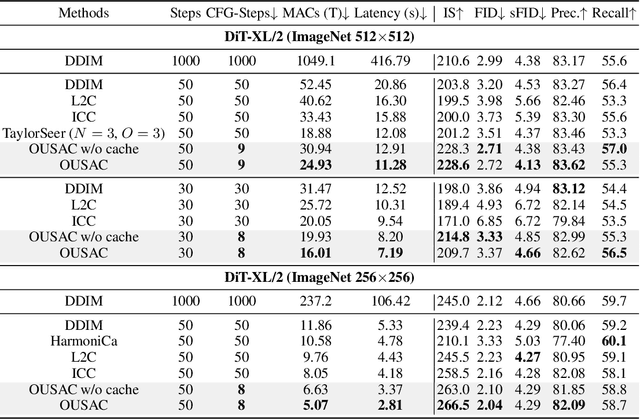
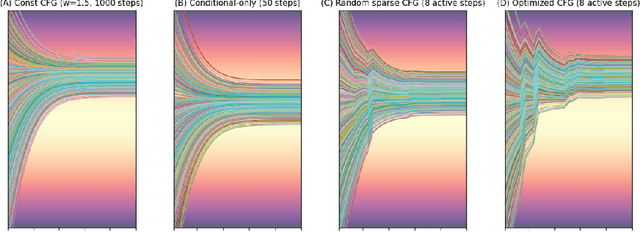
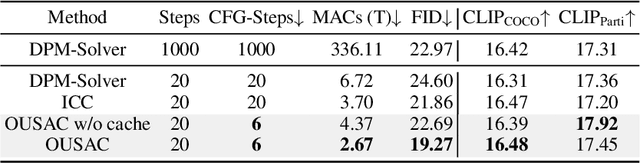
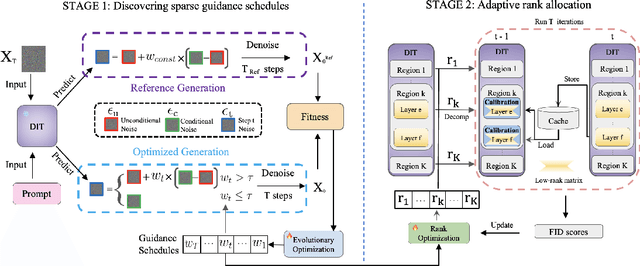
Diffusion models have emerged as the dominant paradigm for high-quality image generation, yet their computational expense remains substantial due to iterative denoising. Classifier-Free Guidance (CFG) significantly enhances generation quality and controllability but doubles the computation by requiring both conditional and unconditional forward passes at every timestep. We present OUSAC (Optimized gUidance Scheduling with Adaptive Caching), a framework that accelerates diffusion transformers (DiT) through systematic optimization. Our key insight is that variable guidance scales enable sparse computation: adjusting scales at certain timesteps can compensate for skipping CFG at others, enabling both fewer total sampling steps and fewer CFG steps while maintaining quality. However, variable guidance patterns introduce denoising deviations that undermine standard caching methods, which assume constant CFG scales across steps. Moreover, different transformer blocks are affected at different levels under dynamic conditions. This paper develops a two-stage approach leveraging these insights. Stage-1 employs evolutionary algorithms to jointly optimize which timesteps to skip and what guidance scale to use, eliminating up to 82% of unconditional passes. Stage-2 introduces adaptive rank allocation that tailors calibration efforts per transformer block, maintaining caching effectiveness under variable guidance. Experiments demonstrate that OUSAC significantly outperforms state-of-the-art acceleration methods, achieving 53% computational savings with 15% quality improvement on DiT-XL/2 (ImageNet 512x512), 60% savings with 16.1% improvement on PixArt-alpha (MSCOCO), and 5x speedup on FLUX while improving CLIP Score over the 50-step baseline.