 Add to Chrome
 Add to Firefox
 Add to Edge
JoyNexus: Service-Oriented Multi-Tenant Post-Training for VLA Models
Jul 17, 2026
The post-training of Vision-Language-Action (VLA) models is essential due to the diversity of simulators, robot embodiments, and task objectives. Existing compute services, whether offered as direct accelerator rental or batch-workload submission, typically allocate an exclusive set of GPU and CPU resources to a single tenant. While this paradigm maximizes client flexibility, it burdens users with infrastructure adaptation, and the fixed card-hour accounting model renders short or bursty workloads both expensive for tenants and inefficient for the service provider. To address these challenges, we present JoyNexus, a unified service for multi-tenant VLA supervised fine-tuning, reinforcement learning, and evaluation. JoyNexus decouples the Training Model Service, Inference Model Service, and Environment Service, each accessed through APIs and backed by resident shared base models with tenant-specific slots. Tenants can directly invoke high-level semantic APIs for training, rollout, and evaluation, or compose custom algorithms using lower-level APIs and their assigned endpoints. Multiple tenants submit workloads concurrently; their action modules, optimizers, rollout records, and policy versions remain isolated, and the service is scheduled by the global Training Queue and Inference Queue. To further improve multi-tenant training efficiency, JoyNexus introduces group batching for heterogeneous VLA data schemas that share a compatible model-facing prefix, enabling a single shared backbone forward pass over grouped samples. Finally, we evaluate JoyNexus through workload simulation and a group-batching pipeline in a realistic embodied scenario. Results show that, compared with isolated single-tenant execution, JoyNexus reduces aggregate GPU time and improves service utilization via cross-tenant scheduling on shared resources.

DataLadder: A Simulation-Enabled Interconversion Toolchain for the Embodied Data Pyramid
Jun 15, 2026Generalist robot policies require trustworthy evaluation and robot-usable training data, but both are difficult to scale with physical robots alone. Real-robot trials and demonstrations remain the most faithful source of deployment signals, yet they are slow, costly, and hard to reproduce. We present DataLadder, a simulation-enabled interconversion toolchain for human-robot aligned model evaluation and data generation, denoted as Robot $\rightleftharpoons$ Simulation $\rightleftharpoons$ Human. On the one hand, the Robot $\rightarrow$ Simulation $\rightarrow$ Human pathway supports human-robot aligned model evaluation by reconstructing real-robot tabletop organization tasks as calibrated digital twins for scalable evaluation, while using human embodied feedback to inspect and refine the naturalness of simulated motions. On the other hand, the Human $\rightarrow$ Simulation $\rightarrow$ Robot pathway supports human-robot aligned data generation: it lifts ego-centric human demonstrations into simulation, checks them under robot physical constraints, and converts them into robot-centered trajectories, annotations, and visual observations. Together, these pathways use the JoySim simulator as both a scalable evaluation layer and a physical consistency filter for robot data generation. We further package the core reconstruction, simulation, rendering, and realism-augmentation modules as cloud services on JD Cloud, turning the system into reusable infrastructure for robot data generation and model evaluation.
D-VLA: A High-Concurrency Distributed Asynchronous Reinforcement Learning Framework for Vision-Language-Action Models
May 14, 2026The rapid evolution of Embodied AI has enabled Vision-Language-Action (VLA) models to excel in multimodal perception and task execution. However, applying Reinforcement Learning (RL) to these massive models in large-scale distributed environments faces severe systemic bottlenecks, primarily due to the resource conflict between high-fidelity physical simulation and the intensive VRAM/bandwidth demands of deep learning. This conflict often leaves overall throughput constrained by execution-phase inefficiencies. To address these challenges, we propose D-VLA, a high-concurrency, low-latency distributed RL framework for large-scale embodied foundation models. D-VLA introduces "Plane Decoupling," physically isolating high-frequency training data from low-frequency weight control to eliminate interference between simulation and optimization. We further design a four-thread asynchronous "Swimlane" pipeline, enabling full parallel overlap of sampling, inference, gradient computation, and parameter distribution. Additionally, a dual-pool VRAM management model and topology-aware replication resolve memory fragmentation and optimize communication efficiency. Experiments on benchmarks like LIBERO show that D-VLA significantly outperforms mainstream RL frameworks in throughput and sampling efficiency for billion-parameter VLA models. In trillion-parameter scalability tests, our framework maintains exceptional stability and linear speedup, providing a robust system for high-performance general-purpose embodied agents.
EgoLive: A Large-Scale Egocentric Dataset from Real-World Human Tasks
Apr 26, 2026The advancement of robot learning is currently hindered by the scarcity of large-scale, high-quality datasets. While established data collection methods such as teleoperation and universal manipulation interfaces dominate current datasets, they suffer from inherent limitations in scalability and real-world deployability. Human egocentric video collection, by contrast, has emerged as a promising approach to enable scalable, natural and in-the-wild data collection. As such, we present EgoLive, a large-scale, high-quality egocentric dataset designed explicitly for robot manipulation learning. EgoLive establishes three distinctive technical advantages over existing egocentric datasets: first, it represents the largest open-source annotated egocentric dataset focused on real-world task-oriented human routines to date; second, it delivers leading data quality via a customized head-mounted capture device and comprehensive high-precision multi-modal annotations; third, all data is collected exclusively in unconstrained real-world scenarios and encompasses vertical field human working data, including home service, retail, and other practical work scenarios, providing superior diversity and ecological validity. With the introduction of EgoLive, we aim to provide the research community with a scalable, high-quality dataset that accelerates breakthroughs in generalizable robotic models and facilitates the real-world deployment of robot systems.
JoyAI-RA 0.1: A Foundation Model for Robotic Autonomy
Apr 22, 2026Robotic autonomy in open-world environments is fundamentally limited by insufficient data diversity and poor cross-embodiment generalization. Existing robotic datasets are often limited in scale and task coverage, while relatively large differences across robot embodiments impede effective behavior knowledge transfer. To address these challenges, we propose JoyAI-RA, a vision-language-action (VLA) embodied foundation model tailored for generalizable robotic manipulation. JoyAI-RA presents a multi-source multi-level pretraining framework that integrates web data, large-scale egocentric human manipulation videos, simulation-generated trajectories, and real-robot data. Through training on heterogeneous multi-source data with explicit action-space unification, JoyAI-RA effectively bridges embodiment gaps, particularly between human manipulation and robotic control, thereby enhancing cross-embodiment behavior learning. JoyAI-RA outperforms state-of-the-art methods in both simulation and real-world benchmarks, especially on diverse tasks with generalization demands.
Giving Faces Their Feelings Back: Explicit Emotion Control for Feedforward Single-Image 3D Head Avatars
Apr 16, 2026We present a framework for explicit emotion control in feed-forward, single-image 3D head avatar reconstruction. Unlike existing pipelines where emotion is implicitly entangled with geometry or appearance, we treat emotion as a first-class control signal that can be manipulated independently and consistently across identities. Our method injects emotion into existing feed-forward architectures via a dual-path modulation mechanism without modifying their core design. Geometry modulation performs emotion-conditioned normalization in the original parametric space, disentangling emotional state from speech-driven articulation, while appearance modulation captures identity-aware, emotion-dependent visual cues beyond geometry. To enable learning under this setting, we construct a time-synchronized, emotion-consistent multi-identity dataset by transferring aligned emotional dynamics across identities. Integrated into multiple state-of-the-art backbones, our framework preserves reconstruction and reenactment fidelity while enabling controllable emotion transfer, disentangled manipulation, and smooth emotion interpolation, advancing expressive and scalable 3D head avatars.
JoyAI-LLM Flash: Advancing Mid-Scale LLMs with Token Efficiency
Apr 03, 2026We introduce JoyAI-LLM Flash, an efficient Mixture-of-Experts (MoE) language model designed to redefine the trade-off between strong performance and token efficiency in the sub-50B parameter regime. JoyAI-LLM Flash is pretrained on a massive corpus of 20 trillion tokens and further optimized through a rigorous post-training pipeline, including supervised fine-tuning (SFT), Direct Preference Optimization (DPO), and large-scale reinforcement learning (RL) across diverse environments. To improve token efficiency, JoyAI-LLM Flash strategically balances \emph{thinking} and \emph{non-thinking} cognitive modes and introduces FiberPO, a novel RL algorithm inspired by fibration theory that decomposes trust-region maintenance into global and local components, providing unified multi-scale stability control for LLM policy optimization. To enhance architectural sparsity, the model comprises 48B total parameters while activating only 2.7B parameters per forward pass, achieving a substantially higher sparsity ratio than contemporary industry leading models of comparable scale. To further improve inference throughput, we adopt a joint training-inference co-design that incorporates dense Multi-Token Prediction (MTP) and Quantization-Aware Training (QAT). We release the checkpoints for both JoyAI-LLM-48B-A3B Base and its post-trained variants on Hugging Face to support the open-source community.
Thousand-GPU Large-Scale Training and Optimization Recipe for AI-Native Cloud Embodied Intelligence Infrastructure
Mar 11, 2026Embodied intelligence is a key step towards Artificial General Intelligence (AGI), yet its development faces multiple challenges including data, frameworks, infrastructure, and evaluation systems. To address these issues, we have, for the first time in the industry, launched a cloud-based, thousand-GPU distributed training platform for embodied intelligence, built upon the widely adopted LeRobot framework, and have systematically overcome bottlenecks across the entire pipeline. At the data layer, we have restructured the data pipeline to optimize the flow of embodied training data. In terms of training, for the GR00T-N1.5 model, utilizing thousand-GPU clusters and data at the scale of hundreds of millions, the single-round training time has been reduced from 15 hours to just 22 minutes, achieving a 40-fold speedup. At the model layer, by combining variable-length FlashAttention and Data Packing, we have moved from sample redundancy to sequence integration, resulting in a 188% speed increase; π-0.5 attention optimization has accelerated training by 165%; and FP8 quantization has delivered a 140% speedup. On the infrastructure side, relying on high-performance storage, a 3.2T RDMA network, and a Ray-driven elastic AI data lake, we have achieved deep synergy among data, storage, communication, and computation. We have also built an end-to-end evaluation system, creating a closed loop from training to simulation to assessment. This framework has already been fully validated on thousand-GPU clusters, laying a crucial technical foundation for the development and application of next-generation autonomous intelligent robots, and is expected to accelerate the arrival of the era of human-machine integration.
RL-VLA$^3$: Reinforcement Learning VLA Accelerating via Full Asynchronism
Feb 05, 2026In recent years, Vision-Language-Action (VLA) models have emerged as a crucial pathway towards general embodied intelligence, yet their training efficiency has become a key bottleneck. Although existing reinforcement learning (RL)-based training frameworks like RLinf can enhance model generalization, they still rely on synchronous execution, leading to severe resource underutilization and throughput limitations during environment interaction, policy generation (rollout), and model update phases (actor). To overcome this challenge, this paper, for the first time, proposes and implements a fully-asynchronous policy training framework encompassing the entire pipeline from environment interaction, rollout generation, to actor policy updates. Systematically drawing inspiration from asynchronous optimization ideas in large model RL, our framework designs a multi-level decoupled architecture. This includes asynchronous parallelization of environment interaction and trajectory collection, streaming execution for policy generation, and decoupled scheduling for training updates. We validated the effectiveness of our method across diverse VLA models and environments. On the LIBERO benchmark, the framework achieves throughput improvements of up to 59.25\% compared to existing synchronous strategies. When deeply optimizing separation strategies, throughput can be increased by as much as 126.67\%. We verified the effectiveness of each asynchronous component via ablation studies. Scaling law validation across 8 to 256 GPUs demonstrates our method's excellent scalability under most conditions.
Counterfactual experience augmented off-policy reinforcement learning
Mar 18, 2025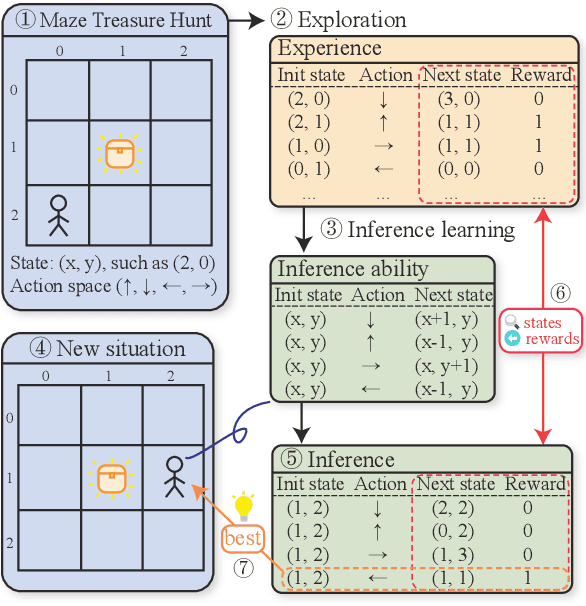
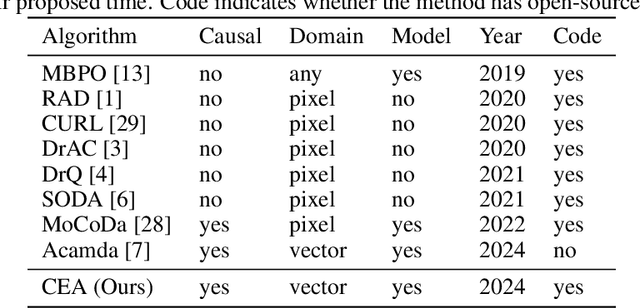
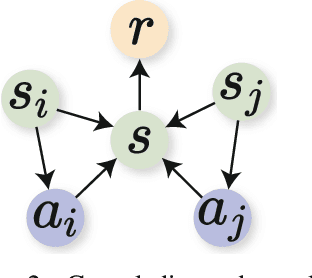
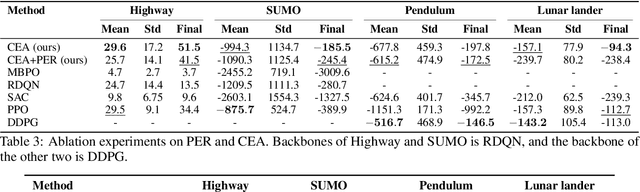
Reinforcement learning control algorithms face significant challenges due to out-of-distribution and inefficient exploration problems. While model-based reinforcement learning enhances the agent's reasoning and planning capabilities by constructing virtual environments, training such virtual environments can be very complex. In order to build an efficient inference model and enhance the representativeness of learning data, we propose the Counterfactual Experience Augmentation (CEA) algorithm. CEA leverages variational autoencoders to model the dynamic patterns of state transitions and introduces randomness to model non-stationarity. This approach focuses on expanding the learning data in the experience pool through counterfactual inference and performs exceptionally well in environments that follow the bisimulation assumption. Environments with bisimulation properties are usually represented by discrete observation and action spaces, we propose a sampling method based on maximum kernel density estimation entropy to extend CEA to various environments. By providing reward signals for counterfactual state transitions based on real information, CEA constructs a complete counterfactual experience to alleviate the out-of-distribution problem of the learning data, and outperforms general SOTA algorithms in environments with difference properties. Finally, we discuss the similarities, differences and properties of generated counterfactual experiences and real experiences. The code is available at https://github.com/Aegis1863/CEA.