 Add to Chrome
 Add to Firefox
 Add to Edge
Giving Faces Their Feelings Back: Explicit Emotion Control for Feedforward Single-Image 3D Head Avatars
Apr 16, 2026
We present a framework for explicit emotion control in feed-forward, single-image 3D head avatar reconstruction. Unlike existing pipelines where emotion is implicitly entangled with geometry or appearance, we treat emotion as a first-class control signal that can be manipulated independently and consistently across identities. Our method injects emotion into existing feed-forward architectures via a dual-path modulation mechanism without modifying their core design. Geometry modulation performs emotion-conditioned normalization in the original parametric space, disentangling emotional state from speech-driven articulation, while appearance modulation captures identity-aware, emotion-dependent visual cues beyond geometry. To enable learning under this setting, we construct a time-synchronized, emotion-consistent multi-identity dataset by transferring aligned emotional dynamics across identities. Integrated into multiple state-of-the-art backbones, our framework preserves reconstruction and reenactment fidelity while enabling controllable emotion transfer, disentangled manipulation, and smooth emotion interpolation, advancing expressive and scalable 3D head avatars.

Review of Cloud Service Composition for Intelligent Manufacturing
Aug 03, 2024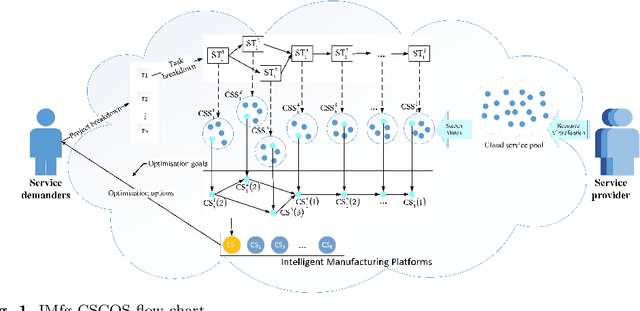
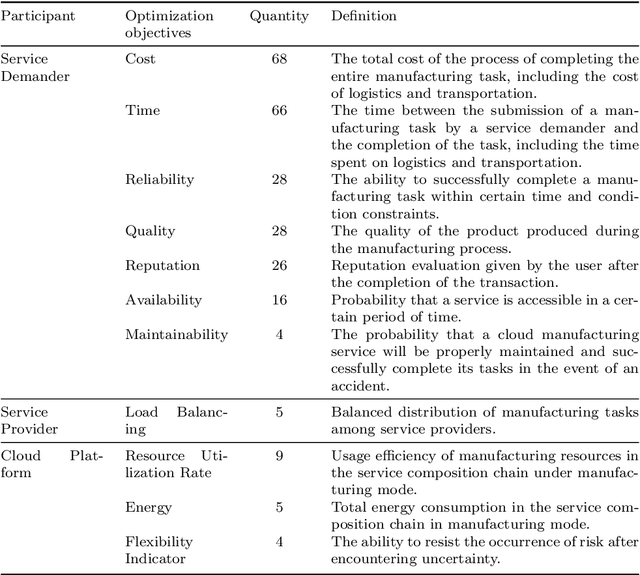
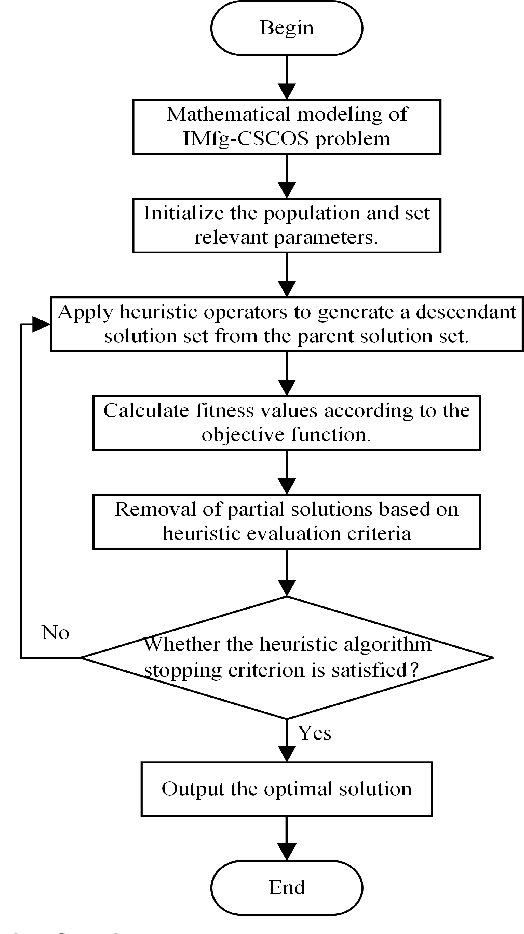
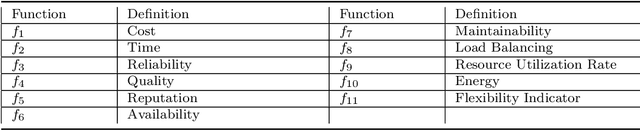
Intelligent manufacturing is a new model that uses advanced technologies such as the Internet of Things, big data, and artificial intelligence to improve the efficiency and quality of manufacturing production. As an important support to promote the transformation and upgrading of the manufacturing industry, cloud service optimization has received the attention of researchers. In recent years, remarkable research results have been achieved in this field. For the sustainability of intelligent manufacturing platforms, in this paper we summarize the process of cloud service optimization for intelligent manufacturing. Further, to address the problems of dispersed optimization indicators and nonuniform/unstandardized definitions in the existing research, 11 optimization indicators that take into account three-party participant subjects are defined from the urgent requirements of the sustainable development of intelligent manufacturing platforms. Next, service optimization algorithms are classified into two categories, heuristic and reinforcement learning. After comparing the two categories, the current key techniques of service optimization are targeted. Finally, research hotspots and future research trends of service optimization are summarized.