 Add to Chrome
 Add to Firefox
 Add to Edge
Arcane: An Assertion Reduction Framework through Semantic Clustering and MCTS-Guided Rule Exploring
May 11, 2026
Assertion-based Verification (ABV) is essential for ensuring that hardware designs conform to their intended specifications. However, existing automated assertion-generation approaches, such as LLM-based frameworks, often generate large numbers of redundant assertions, which significantly degrade simulation efficiency. To mitigate the simulation overhead caused by redundant assertions, this paper proposes Arcane, an efficient assertion reduction framework. It integrates a two-tier assertion clustering approach for accurate semantic classification of large assertion sets, and employs Monte Carlo Tree Search (MCTS) to explore optimal rule-application sequences for efficient assertion reduction. The experimental results on Assertionbench [20] show that Arcane achieves a reduction of up to 76.2% in the assertion count while fully preserving formal coverage and mutation-detection ability. Further simulation studies demonstrate a speedup of 2.6x to 6.1x speedup in simulation time. The proposed framework is released at https://anonymous.4open.science/r/Arcane1-0A6F/.

MacLight: Multi-scene Aggregation Convolutional Learning for Traffic Signal Control
Dec 24, 2024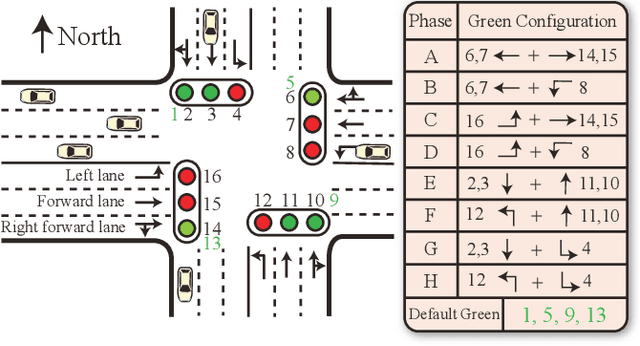
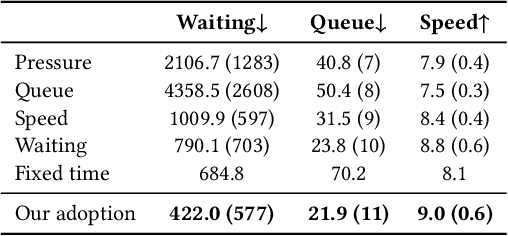
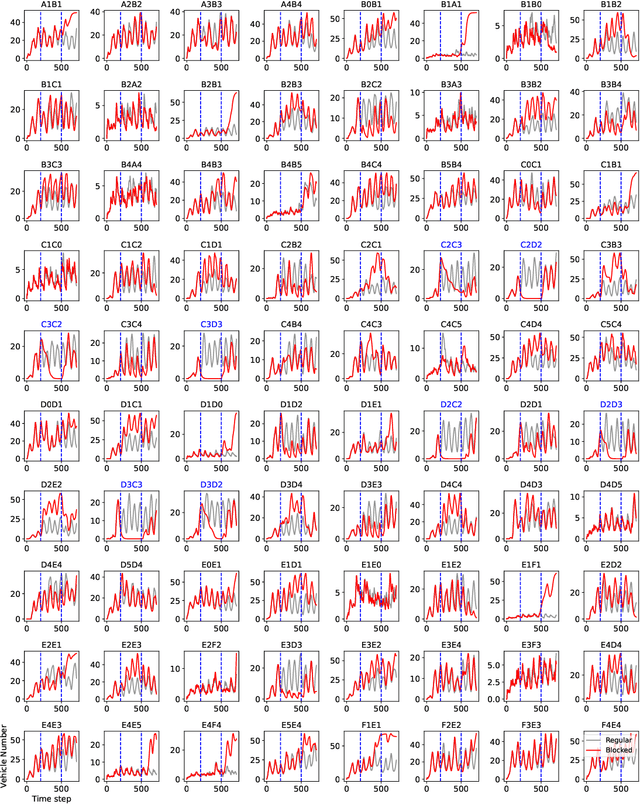
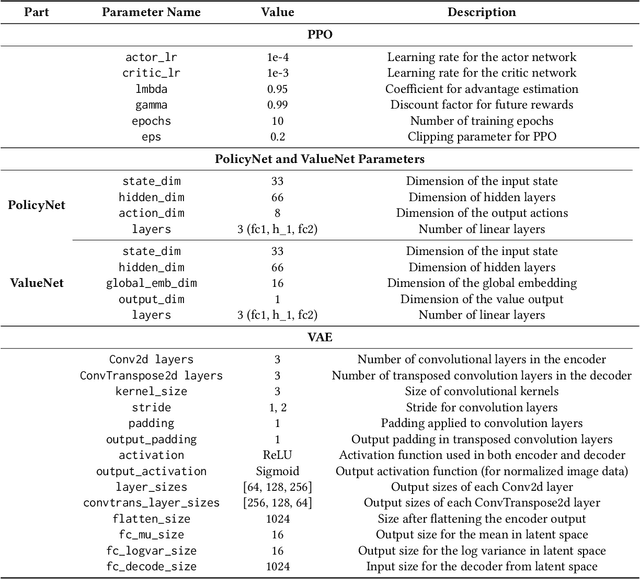
Reinforcement learning methods have proposed promising traffic signal control policy that can be trained on large road networks. Current SOTA methods model road networks as topological graph structures, incorporate graph attention into deep Q-learning, and merge local and global embeddings to improve policy. However, graph-based methods are difficult to parallelize, resulting in huge time overhead. Moreover, none of the current peer studies have deployed dynamic traffic systems for experiments, which is far from the actual situation. In this context, we propose Multi-Scene Aggregation Convolutional Learning for traffic signal control (MacLight), which offers faster training speeds and more stable performance. Our approach consists of two main components. The first is the global representation, where we utilize variational autoencoders to compactly compress and extract the global representation. The second component employs the proximal policy optimization algorithm as the backbone, allowing value evaluation to consider both local features and global embedding representations. This backbone model significantly reduces time overhead and ensures stability in policy updates. We validated our method across multiple traffic scenarios under both static and dynamic traffic systems. Experimental results demonstrate that, compared to general and domian SOTA methods, our approach achieves superior stability, optimized convergence levels and the highest time efficiency. The code is under https://github.com/Aegis1863/MacLight.