 Add to Chrome
 Add to Firefox
 Add to Edge
DataLadder: A Simulation-Enabled Interconversion Toolchain for the Embodied Data Pyramid
Jun 15, 2026
Generalist robot policies require trustworthy evaluation and robot-usable training data, but both are difficult to scale with physical robots alone. Real-robot trials and demonstrations remain the most faithful source of deployment signals, yet they are slow, costly, and hard to reproduce. We present DataLadder, a simulation-enabled interconversion toolchain for human-robot aligned model evaluation and data generation, denoted as Robot $\rightleftharpoons$ Simulation $\rightleftharpoons$ Human. On the one hand, the Robot $\rightarrow$ Simulation $\rightarrow$ Human pathway supports human-robot aligned model evaluation by reconstructing real-robot tabletop organization tasks as calibrated digital twins for scalable evaluation, while using human embodied feedback to inspect and refine the naturalness of simulated motions. On the other hand, the Human $\rightarrow$ Simulation $\rightarrow$ Robot pathway supports human-robot aligned data generation: it lifts ego-centric human demonstrations into simulation, checks them under robot physical constraints, and converts them into robot-centered trajectories, annotations, and visual observations. Together, these pathways use the JoySim simulator as both a scalable evaluation layer and a physical consistency filter for robot data generation. We further package the core reconstruction, simulation, rendering, and realism-augmentation modules as cloud services on JD Cloud, turning the system into reusable infrastructure for robot data generation and model evaluation.

Mixtac: A Novel Bio-Inspired Hybrid Tactile Sensor with Synergistic Event-Frame Perception
May 18, 2026Vision based and event based tactile sensors are important in robotic manipulation research. However, they suffer from a fundamental tradeoff: vision based sensors have low sampling rates, while event based sensors are prone to drift during long term static force estimation. To solve this challenge and achieve human level tactile perception, the novel hybrid event frame tactile sensor (Mixtac) is proposed in this paper by emulating the synergistic function of biological mechanoreceptors, which achieves normal force estimation. The prototype leverages events for high frequency force tracking and frames for long term accuracy. The Frame Guided Event Recurrent Network (FGER-Net) was proposed to fuse the two data streams. Frames were used by the net to correct event drift during training and guide high frequency predictions during inference. Experiments demonstrated an MAE of 0.04 N. This paper could bridge the sampling rate gap from 0 to 500 Hz in current vision based tactile sensors and pave the way for human level robotic manipulation.
EgoLive: A Large-Scale Egocentric Dataset from Real-World Human Tasks
Apr 26, 2026The advancement of robot learning is currently hindered by the scarcity of large-scale, high-quality datasets. While established data collection methods such as teleoperation and universal manipulation interfaces dominate current datasets, they suffer from inherent limitations in scalability and real-world deployability. Human egocentric video collection, by contrast, has emerged as a promising approach to enable scalable, natural and in-the-wild data collection. As such, we present EgoLive, a large-scale, high-quality egocentric dataset designed explicitly for robot manipulation learning. EgoLive establishes three distinctive technical advantages over existing egocentric datasets: first, it represents the largest open-source annotated egocentric dataset focused on real-world task-oriented human routines to date; second, it delivers leading data quality via a customized head-mounted capture device and comprehensive high-precision multi-modal annotations; third, all data is collected exclusively in unconstrained real-world scenarios and encompasses vertical field human working data, including home service, retail, and other practical work scenarios, providing superior diversity and ecological validity. With the introduction of EgoLive, we aim to provide the research community with a scalable, high-quality dataset that accelerates breakthroughs in generalizable robotic models and facilitates the real-world deployment of robot systems.
JoyAI-RA 0.1: A Foundation Model for Robotic Autonomy
Apr 22, 2026Robotic autonomy in open-world environments is fundamentally limited by insufficient data diversity and poor cross-embodiment generalization. Existing robotic datasets are often limited in scale and task coverage, while relatively large differences across robot embodiments impede effective behavior knowledge transfer. To address these challenges, we propose JoyAI-RA, a vision-language-action (VLA) embodied foundation model tailored for generalizable robotic manipulation. JoyAI-RA presents a multi-source multi-level pretraining framework that integrates web data, large-scale egocentric human manipulation videos, simulation-generated trajectories, and real-robot data. Through training on heterogeneous multi-source data with explicit action-space unification, JoyAI-RA effectively bridges embodiment gaps, particularly between human manipulation and robotic control, thereby enhancing cross-embodiment behavior learning. JoyAI-RA outperforms state-of-the-art methods in both simulation and real-world benchmarks, especially on diverse tasks with generalization demands.
Efficient Inference for Large Vision-Language Models: Bottlenecks, Techniques, and Prospects
Apr 07, 2026Large Vision-Language Models (LVLMs) enable sophisticated reasoning over images and videos, yet their inference is hindered by a systemic efficiency barrier known as visual token dominance. This overhead is driven by a multi-regime interplay between high-resolution feature extraction, quadratic attention scaling, and memory bandwidth constraints. We present a systematic taxonomy of efficiency techniques structured around the inference lifecycle, consisting of encoding, prefilling, and decoding. Unlike prior reviews focused on isolated optimizations, we analyze the end-to-end pipeline to reveal how upstream decisions dictate downstream bottlenecks, covering compute-bound visual encoding, the intensive prefilling of massive contexts, and the ''visual memory wall'' in bandwidth-bound decoding. By decoupling the efficiency landscape into the axes of shaping information density, managing long-context attention, and overcoming memory limits, this work provides a structured analysis of how isolated optimizations compose to navigate the trade-off between visual fidelity and system efficiency. The survey concludes by outlining four future frontiers supported by pilot empirical insights, including hybrid compression based on functional unit sensitivity, modality-aware decoding with relaxed verification, progressive state management for streaming continuity, and stage-disaggregated serving through hardware-algorithm co-design. The submitted software contains a snapshot of our literature repository, which is designed to be maintained as a living resource for the community.
EpicCBR: Item-Relation-Enhanced Dual-Scenario Contrastive Learning for Cold-Start Bundle Recommendation
Feb 12, 2026Bundle recommendation aims to recommend a set of items to users for overall consumption. Existing bundle recommendation models primarily depend on observed user-bundle interactions, limiting exploration of newly-emerged bundles that are constantly created. It pose a critical representation challenge for current bundle methods, as they usually treat each bundle as an independent instance, while neglecting to fully leverage the user-item (UI) and bundle-item (BI) relations over popular items. To alleviate it, in this paper we propose a multi-view contrastive learning framework for cold-start bundle recommendation, named EpicCBR. Specifically, it precisely mine and utilize the item relations to construct user profiles, identifying users likely to engage with bundles. Additionally, a popularity-based method that characterizes the features of new bundles through historical bundle information and user preferences is proposed. To build a framework that demonstrates robustness in both cold-start and warm-start scenarios, a multi-view graph contrastive learning framework capable of integrating these diverse scenarios is introduced to ensure the model's generalization capability. Extensive experiments conducted on three popular benchmarks showed that EpicCBR outperforms state-of-the-art by a large margin (up to 387%), sufficiently demonstrating the superiority of the proposed method in cold-start scenario. The code and dataset can be found in the GitHub repository: https://github.com/alexlovecoding/EpicCBR.
Object-Focus Actor for Data-efficient Robot Generalization Dexterous Manipulation
May 21, 2025Robot manipulation learning from human demonstrations offers a rapid means to acquire skills but often lacks generalization across diverse scenes and object placements. This limitation hinders real-world applications, particularly in complex tasks requiring dexterous manipulation. Vision-Language-Action (VLA) paradigm leverages large-scale data to enhance generalization. However, due to data scarcity, VLA's performance remains limited. In this work, we introduce Object-Focus Actor (OFA), a novel, data-efficient approach for generalized dexterous manipulation. OFA exploits the consistent end trajectories observed in dexterous manipulation tasks, allowing for efficient policy training. Our method employs a hierarchical pipeline: object perception and pose estimation, pre-manipulation pose arrival and OFA policy execution. This process ensures that the manipulation is focused and efficient, even in varied backgrounds and positional layout. Comprehensive real-world experiments across seven tasks demonstrate that OFA significantly outperforms baseline methods in both positional and background generalization tests. Notably, OFA achieves robust performance with only 10 demonstrations, highlighting its data efficiency.
Dexterous Hand Manipulation via Efficient Imitation-Bootstrapped Online Reinforcement Learning
Mar 06, 2025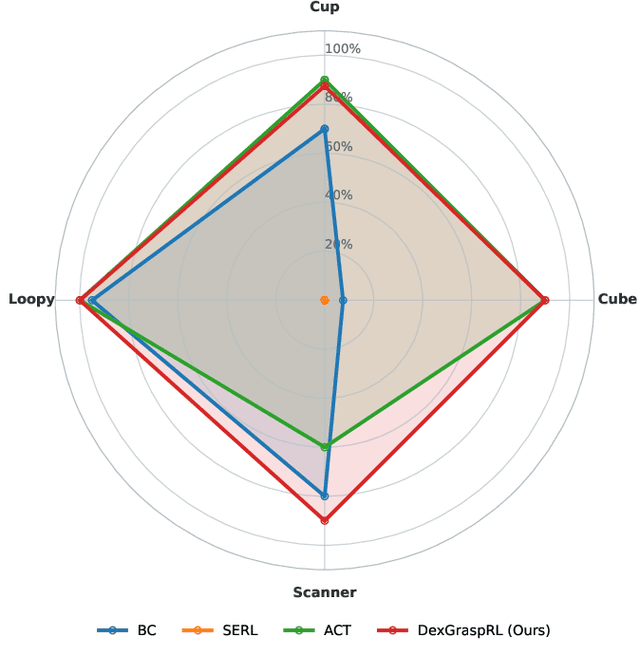
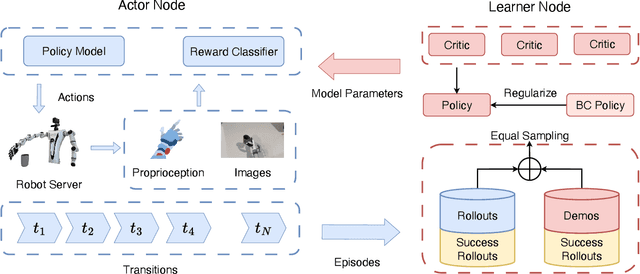
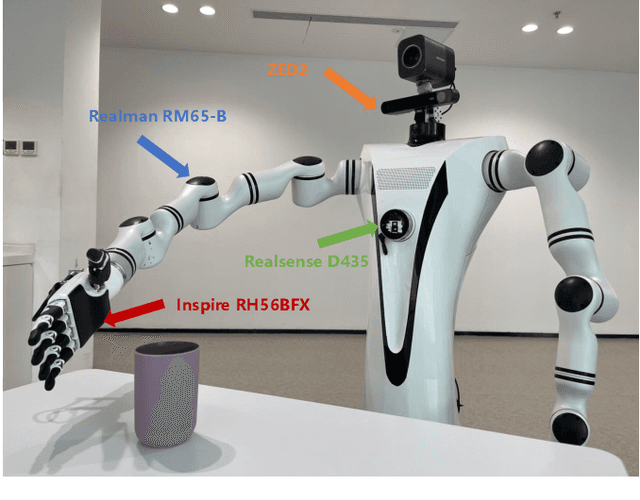
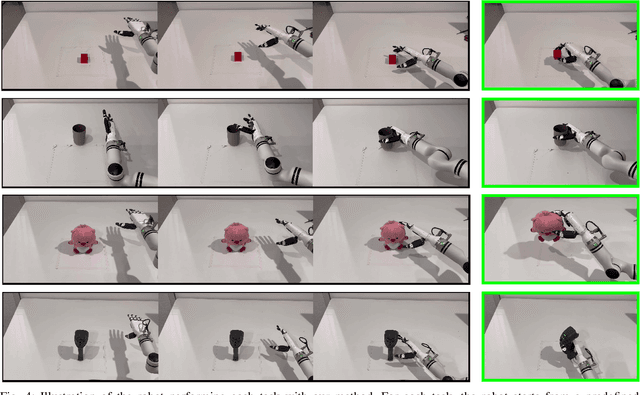
Dexterous hand manipulation in real-world scenarios presents considerable challenges due to its demands for both dexterity and precision. While imitation learning approaches have thoroughly examined these challenges, they still require a significant number of expert demonstrations and are limited by a constrained performance upper bound. In this paper, we propose a novel and efficient Imitation-Bootstrapped Online Reinforcement Learning (IBORL) method tailored for robotic dexterous hand manipulation in real-world environments. Specifically, we pretrain the policy using a limited set of expert demonstrations and subsequently finetune this policy through direct reinforcement learning in the real world. To address the catastrophic forgetting issues that arise from the distribution shift between expert demonstrations and real-world environments, we design a regularization term that balances the exploration of novel behaviors with the preservation of the pretrained policy. Our experiments with real-world tasks demonstrate that our method significantly outperforms existing approaches, achieving an almost 100% success rate and a 23% improvement in cycle time. Furthermore, by finetuning with online reinforcement learning, our method surpasses expert demonstrations and uncovers superior policies. Our code and empirical results are available in https://hggforget.github.io/iborl.github.io/.
Preferred-Action-Optimized Diffusion Policies for Offline Reinforcement Learning
May 29, 2024
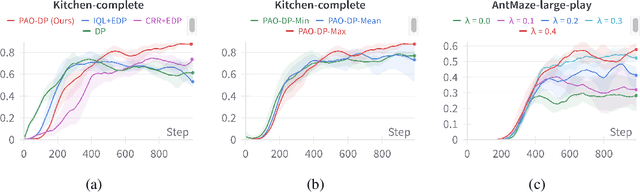


Offline reinforcement learning (RL) aims to learn optimal policies from previously collected datasets. Recently, due to their powerful representational capabilities, diffusion models have shown significant potential as policy models for offline RL issues. However, previous offline RL algorithms based on diffusion policies generally adopt weighted regression to improve the policy. This approach optimizes the policy only using the collected actions and is sensitive to Q-values, which limits the potential for further performance enhancement. To this end, we propose a novel preferred-action-optimized diffusion policy for offline RL. In particular, an expressive conditional diffusion model is utilized to represent the diverse distribution of a behavior policy. Meanwhile, based on the diffusion model, preferred actions within the same behavior distribution are automatically generated through the critic function. Moreover, an anti-noise preference optimization is designed to achieve policy improvement by using the preferred actions, which can adapt to noise-preferred actions for stable training. Extensive experiments demonstrate that the proposed method provides competitive or superior performance compared to previous state-of-the-art offline RL methods, particularly in sparse reward tasks such as Kitchen and AntMaze. Additionally, we empirically prove the effectiveness of anti-noise preference optimization.
Empowering Embodied Manipulation: A Bimanual-Mobile Robot Manipulation Dataset for Household Tasks
May 29, 2024


As Embodied AI advances, it increasingly enables robots to handle the complexity of household manipulation tasks more effectively. However, the application of robots in these settings remains limited due to the scarcity of bimanual-mobile robot manipulation datasets. Existing datasets either focus solely on simple grasping tasks using single-arm robots without mobility, or collect sensor data limited to a narrow scope of sensory inputs. As a result, these datasets often fail to encapsulate the intricate and dynamic nature of real-world tasks that bimanual-mobile robots are expected to perform. To address these limitations, we introduce BRMData, a Bimanual-mobile Robot Manipulation Dataset designed specifically for household applications. The dataset includes 10 diverse household tasks, ranging from simple single-arm manipulation to more complex dual-arm and mobile manipulations. It is collected using multi-view and depth-sensing data acquisition strategies. Human-robot interactions and multi-object manipulations are integrated into the task designs to closely simulate real-world household applications. Moreover, we present a Manipulation Efficiency Score (MES) metric to evaluate both the precision and efficiency of robot manipulation methods. BRMData aims to drive the development of versatile robot manipulation technologies, specifically focusing on advancing imitation learning methods from human demonstrations. The dataset is now open-sourced and available at https://embodiedrobot.github.io/, enhancing research and development efforts in the field of Embodied Manipulation.