 Add to Chrome
 Add to Firefox
 Add to Edge
NTIRE 2026 Low-light Enhancement: Twilight Cowboy Challenge
Aug 10, 2026
This paper presents a review of the NTIRE 2026 Low-light Enhancement: Twilight Cowboy Challenge. The objective of the competition was to merge a set of misaligned smartphone images in the raw domain, captured in low-light conditions, into a single, clean image. Introduced setup simultaneously addresses two problems of low-light photography: visual degradations such as high noise and mixed scene illuminants, and the geometric inconsistencies caused by hand movement during multi-frame capture. To advance research in low-light and nighttime computational photography, a challenging dataset was collected comprising 585 real-world scenes, spanning indoor low-light and outdoor nighttime conditions, for training and benchmarking participant solutions. The competition employed a three-stage evaluation protocol: automatic validation via the CodaBench platform in stages one and two, followed by blind assessment on a private test set for the final ranking. Ten teams surpassed the established baseline, achieving improvements of up to +6.49 dB in PSNR and +0.0101 in SSIM, thereby establishing new state-of-the-art performance for burst-based low-light image enhancement. These results demonstrate significant progress in handling real-world noise, motion, and illumination variability in the low-light setting. Comprehensive results, leaderboards, and additional information are publicly available at https://nightimaging.org.

BiCAA: Bidirectional Credit Assignment for Search-Augmented Agent
Aug 02, 2026Multi-step search is a fundamental capability for search agents, enabling them to iteratively acquire, refine, and integrate external evidence for complex reasoning QA. However, vanilla GRPO allocates rewards exclusively based on the model's final outputs, yielding outcome-only supervision with no supervisory signals for intermediate reasoning steps. Such sparse supervision easily causes training instability and redundant search behaviors on multi-step search tasks. To mitigate this limitation, we adopt process reward to deliver stepwise supervision signals. For this process reward, we propose two complementary criteria to judge each search step: whether the step yields new evidence to facilitate problem solving, and whether it forms an efficient, pivotal intermediate decision within the overall reasoning trajectory. Building on this insight, we propose BiCAA: a bidirectional credit assignment framework that delivers dense, distinguishing process rewards for search-augmented agents. BiCAA builds bidirectional process rewards by fusing two complementary signals: forward solvability gain and hindsight success criticality. The former quantifies step-wise improvements in answer plausibility, while the latter evaluates each step's necessity for final success via hindsight outcome-based criticality scoring. We modulate and aggregate the two signals and then fuse them with the outcome reward. Experiments on search-augmented QA benchmarks show that BiCAA stabilizes policy optimization, reduces redundant search behavior, and achieves competitive performance.
SPAE: Spectrally Guided Autoencoder for Pretrained Visual Latents
Aug 02, 2026Latents from vision foundation models (VFMs) are semantically rich and well suited for visual understanding. Recent representation autoencoder methods such as RAE have shown that they can provide promising latent spaces for image generation. However, VFM latents remain difficult to model directly: DiT-generated latents exhibit spectral mismatch with encoder latents, especially in high-frequency components. Our channel-wise spectral analysis further reveals that these high-frequency components are diffusely distributed across latent channels and entangled with semantic information, making the latent space difficult for DiT to model. To address these challenges, we propose SPAE, latent adaptation framework for generation. Specifically, SPAE employs a compact bottleneck to distill stable semantic information while suppressing high-frequency components, thereby improving the alignment between DiT-generated latents and encoder latents. In addition, we apply a channel-wise masking strategy to promote the decoupling of semantic information and high-frequency details across bottleneck channels. Experiments show that SPAE achieves a favorable balance among visual understanding, generation quality, and reconstruction fidelity.
The Second LoViF 2026 Challenge on Real-World All-in-One Image Restoration: Methods and Results
Jul 23, 2026This paper presents a review of the second LoViF Challenge on Real-World All-in-One Image Restoration. The challenge aims to advance unified image restoration under diverse real-world degradation conditions, including blur, low-light, haze, rain, and snow. It provides a common benchmark for evaluating the restoration accuracy, robustness, and generalization capability of models across multiple degradation categories within a unified framework. The competition attracted 158 registered participants, and 20 teams were included in the final ranking after their submitted results were successfully reproduced and verified. This report provides a comprehensive analysis of the submitted solutions and corresponding results, highlighting recent advances in real-world all-in-one image restoration. The summarized methods and empirical findings reveal effective design strategies and establish an updated benchmark for future research in real-world low-level vision.
NTIRE 2026 Challenge on Short-form UGC Video Restoration in the Wild with Generative Models: Datasets, Methods and Results
Apr 12, 2026This paper presents an overview of the NTIRE 2026 Challenge on Short-form UGC Video Restoration in the Wild with Generative Models. This challenge utilizes a new short-form UGC (S-UGC) video restoration benchmark, termed KwaiVIR, which is contributed by USTC and Kuaishou Technology. It contains both synthetically distorted videos and real-world short-form UGC videos in the wild. For this edition, the released data include 200 synthetic training videos, 48 wild training videos, 11 validation videos, and 20 testing videos. The primary goal of this challenge is to establish a strong and practical benchmark for restoring short-form UGC videos under complex real-world degradations, especially in the emerging paradigm of generative-model-based S-UGC video restoration. This challenge has two tracks: (i) the primary track is a subjective track, where the evaluation is based on a user study; (ii) the second track is an objective track. These two tracks enable a comprehensive assessment of restoration quality. In total, 95 teams have registered for this competition. And 12 teams submitted valid final solutions and fact sheets for the testing phase. The submitted methods achieved strong performance on the KwaiVIR benchmark, demonstrating encouraging progress in short-form UGC video restoration in the wild.
MM-UAVBench: How Well Do Multimodal Large Language Models See, Think, and Plan in Low-Altitude UAV Scenarios?
Dec 29, 2025While Multimodal Large Language Models (MLLMs) have exhibited remarkable general intelligence across diverse domains, their potential in low-altitude applications dominated by Unmanned Aerial Vehicles (UAVs) remains largely underexplored. Existing MLLM benchmarks rarely cover the unique challenges of low-altitude scenarios, while UAV-related evaluations mainly focus on specific tasks such as localization or navigation, without a unified evaluation of MLLMs'general intelligence. To bridge this gap, we present MM-UAVBench, a comprehensive benchmark that systematically evaluates MLLMs across three core capability dimensions-perception, cognition, and planning-in low-altitude UAV scenarios. MM-UAVBench comprises 19 sub-tasks with over 5.7K manually annotated questions, all derived from real-world UAV data collected from public datasets. Extensive experiments on 16 open-source and proprietary MLLMs reveal that current models struggle to adapt to the complex visual and cognitive demands of low-altitude scenarios. Our analyses further uncover critical bottlenecks such as spatial bias and multi-view understanding that hinder the effective deployment of MLLMs in UAV scenarios. We hope MM-UAVBench will foster future research on robust and reliable MLLMs for real-world UAV intelligence.
NTIRE 2024 Challenge on Night Photography Rendering
Jun 18, 2024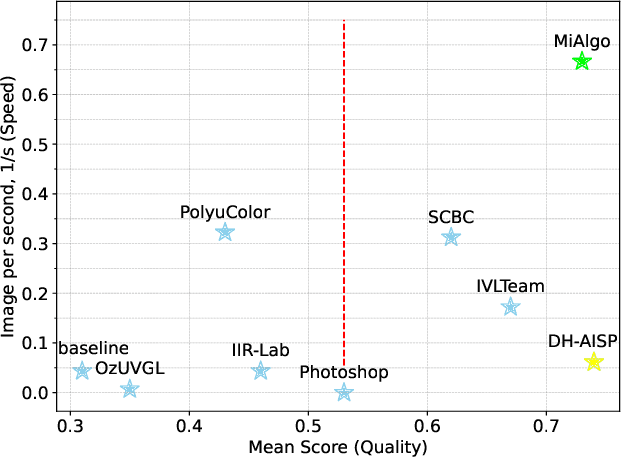
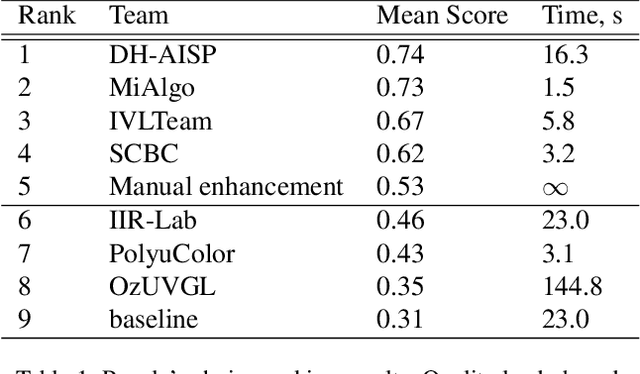
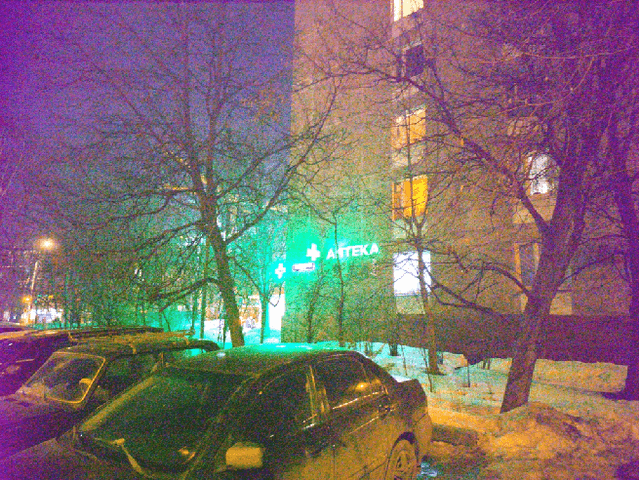
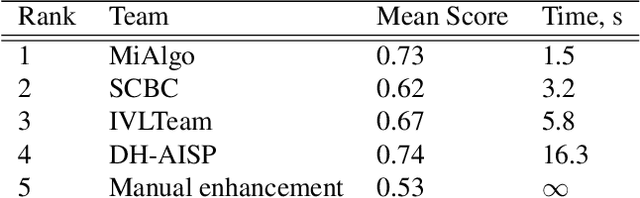
This paper presents a review of the NTIRE 2024 challenge on night photography rendering. The goal of the challenge was to find solutions that process raw camera images taken in nighttime conditions, and thereby produce a photo-quality output images in the standard RGB (sRGB) space. Unlike the previous year's competition, the challenge images were collected with a mobile phone and the speed of algorithms was also measured alongside the quality of their output. To evaluate the results, a sufficient number of viewers were asked to assess the visual quality of the proposed solutions, considering the subjective nature of the task. There were 2 nominations: quality and efficiency. Top 5 solutions in terms of output quality were sorted by evaluation time (see Fig. 1). The top ranking participants' solutions effectively represent the state-of-the-art in nighttime photography rendering. More results can be found at https://nightimaging.org.
Reversed Image Signal Processing and RAW Reconstruction. AIM 2022 Challenge Report
Oct 20, 2022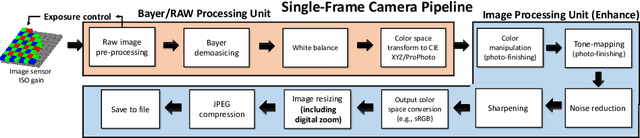
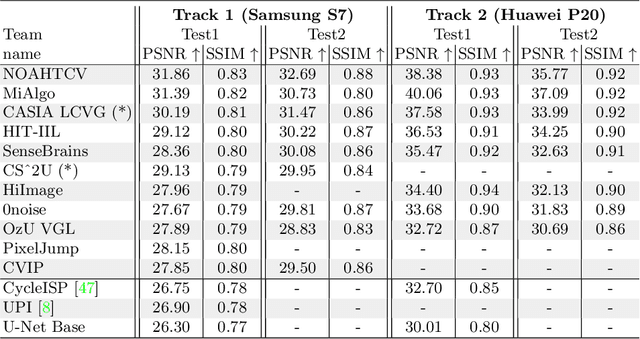
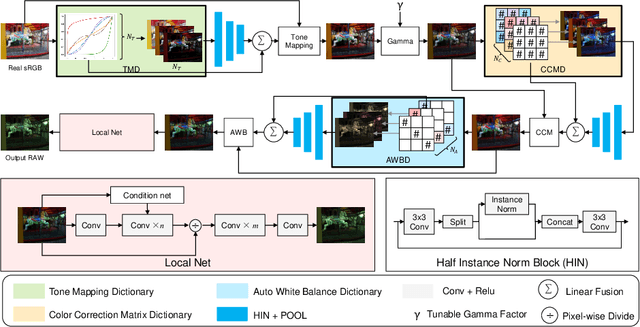
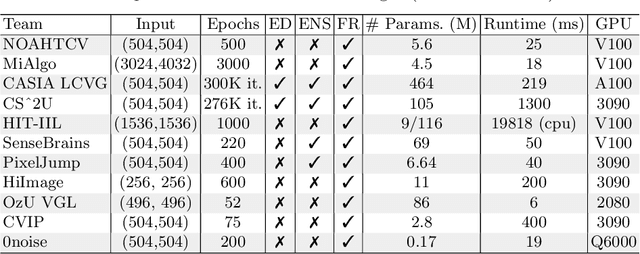
Cameras capture sensor RAW images and transform them into pleasant RGB images, suitable for the human eyes, using their integrated Image Signal Processor (ISP). Numerous low-level vision tasks operate in the RAW domain (e.g. image denoising, white balance) due to its linear relationship with the scene irradiance, wide-range of information at 12bits, and sensor designs. Despite this, RAW image datasets are scarce and more expensive to collect than the already large and public RGB datasets. This paper introduces the AIM 2022 Challenge on Reversed Image Signal Processing and RAW Reconstruction. We aim to recover raw sensor images from the corresponding RGBs without metadata and, by doing this, "reverse" the ISP transformation. The proposed methods and benchmark establish the state-of-the-art for this low-level vision inverse problem, and generating realistic raw sensor readings can potentially benefit other tasks such as denoising and super-resolution.
Fast Camera Image Denoising on Mobile GPUs with Deep Learning, Mobile AI 2021 Challenge: Report
May 17, 2021

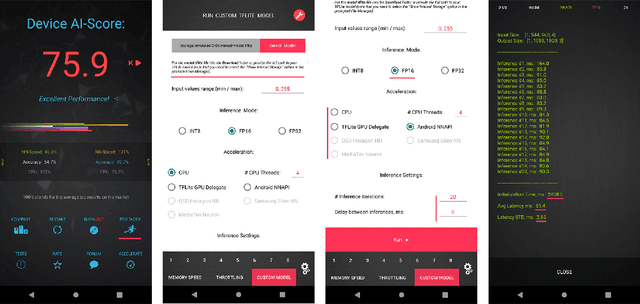
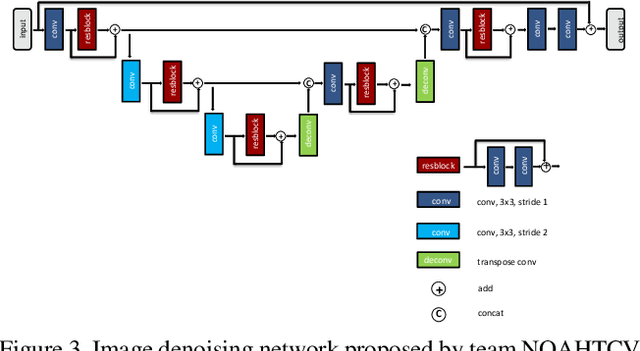
Image denoising is one of the most critical problems in mobile photo processing. While many solutions have been proposed for this task, they are usually working with synthetic data and are too computationally expensive to run on mobile devices. To address this problem, we introduce the first Mobile AI challenge, where the target is to develop an end-to-end deep learning-based image denoising solution that can demonstrate high efficiency on smartphone GPUs. For this, the participants were provided with a novel large-scale dataset consisting of noisy-clean image pairs captured in the wild. The runtime of all models was evaluated on the Samsung Exynos 2100 chipset with a powerful Mali GPU capable of accelerating floating-point and quantized neural networks. The proposed solutions are fully compatible with any mobile GPU and are capable of processing 480p resolution images under 40-80 ms while achieving high fidelity results. A detailed description of all models developed in the challenge is provided in this paper.
NTIRE 2021 Challenge on Quality Enhancement of Compressed Video: Methods and Results
May 02, 2021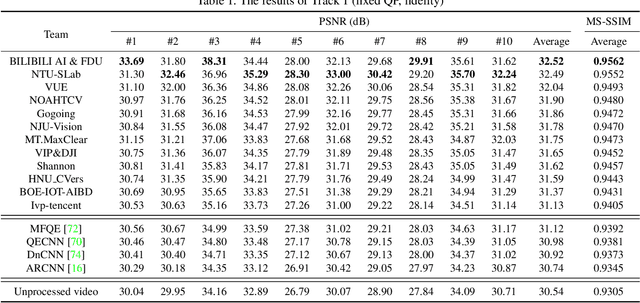
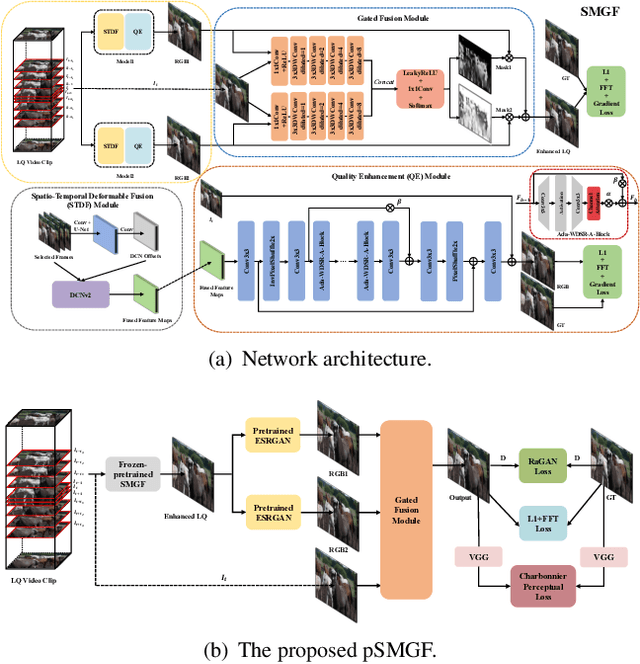
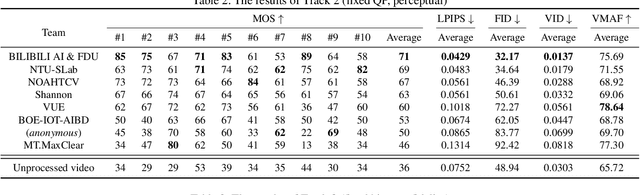
This paper reviews the first NTIRE challenge on quality enhancement of compressed video, with a focus on the proposed methods and results. In this challenge, the new Large-scale Diverse Video (LDV) dataset is employed. The challenge has three tracks. Tracks 1 and 2 aim at enhancing the videos compressed by HEVC at a fixed QP, while Track 3 is designed for enhancing the videos compressed by x265 at a fixed bit-rate. Besides, the quality enhancement of Tracks 1 and 3 targets at improving the fidelity (PSNR), and Track 2 targets at enhancing the perceptual quality. The three tracks totally attract 482 registrations. In the test phase, 12 teams, 8 teams and 11 teams submitted the final results of Tracks 1, 2 and 3, respectively. The proposed methods and solutions gauge the state-of-the-art of video quality enhancement. The homepage of the challenge: https://github.com/RenYang-home/NTIRE21_VEnh