 Add to Chrome
 Add to Firefox
 Add to Edge
MM-UAVBench: How Well Do Multimodal Large Language Models See, Think, and Plan in Low-Altitude UAV Scenarios?
Dec 29, 2025
While Multimodal Large Language Models (MLLMs) have exhibited remarkable general intelligence across diverse domains, their potential in low-altitude applications dominated by Unmanned Aerial Vehicles (UAVs) remains largely underexplored. Existing MLLM benchmarks rarely cover the unique challenges of low-altitude scenarios, while UAV-related evaluations mainly focus on specific tasks such as localization or navigation, without a unified evaluation of MLLMs'general intelligence. To bridge this gap, we present MM-UAVBench, a comprehensive benchmark that systematically evaluates MLLMs across three core capability dimensions-perception, cognition, and planning-in low-altitude UAV scenarios. MM-UAVBench comprises 19 sub-tasks with over 5.7K manually annotated questions, all derived from real-world UAV data collected from public datasets. Extensive experiments on 16 open-source and proprietary MLLMs reveal that current models struggle to adapt to the complex visual and cognitive demands of low-altitude scenarios. Our analyses further uncover critical bottlenecks such as spatial bias and multi-view understanding that hinder the effective deployment of MLLMs in UAV scenarios. We hope MM-UAVBench will foster future research on robust and reliable MLLMs for real-world UAV intelligence.

EMind: A Foundation Model for Multi-task Electromagnetic Signals Understanding
Aug 26, 2025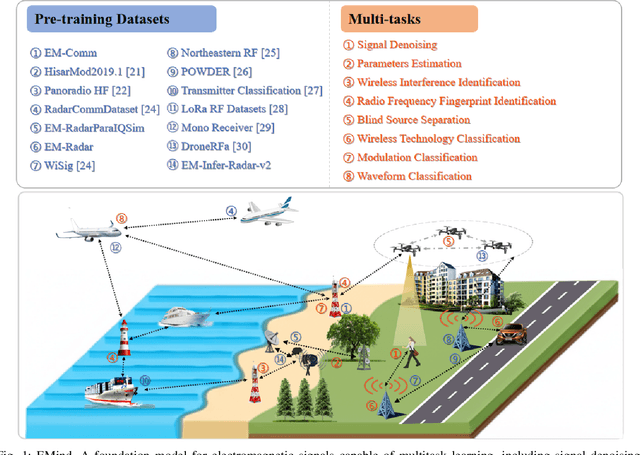
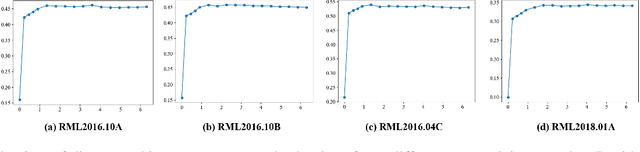
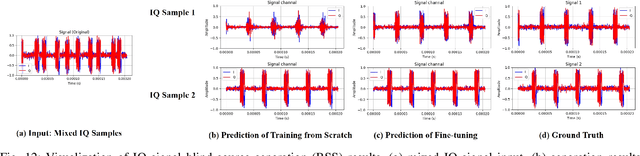
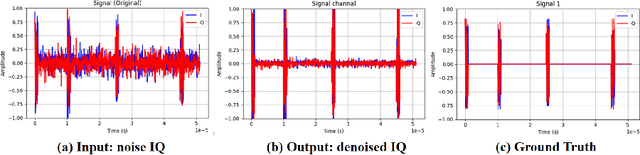
Deep understanding of electromagnetic signals is fundamental to dynamic spectrum management, intelligent transportation, autonomous driving and unmanned vehicle perception. The field faces challenges because electromagnetic signals differ greatly from text and images, showing high heterogeneity, strong background noise and complex joint time frequency structure, which prevents existing general models from direct use. Electromagnetic communication and sensing tasks are diverse, current methods lack cross task generalization and transfer efficiency, and the scarcity of large high quality datasets blocks the creation of a truly general multitask learning framework. To overcome these issue, we introduce EMind, an electromagnetic signals foundation model that bridges large scale pretraining and the unique nature of this modality. We build the first unified and largest standardized electromagnetic signal dataset covering multiple signal types and tasks. By exploiting the physical properties of electromagnetic signals, we devise a length adaptive multi-signal packing method and a hardware-aware training strategy that enable efficient use and representation learning from heterogeneous multi-source signals. Experiments show that EMind achieves strong performance and broad generalization across many downstream tasks, moving decisively from task specific models to a unified framework for electromagnetic intelligence. The code is available at: https://github.com/GabrielleTse/EMind.