 Add to Chrome
 Add to Firefox
 Add to Edge
NTIRE 2026 Low-light Enhancement: Twilight Cowboy Challenge
Aug 10, 2026
This paper presents a review of the NTIRE 2026 Low-light Enhancement: Twilight Cowboy Challenge. The objective of the competition was to merge a set of misaligned smartphone images in the raw domain, captured in low-light conditions, into a single, clean image. Introduced setup simultaneously addresses two problems of low-light photography: visual degradations such as high noise and mixed scene illuminants, and the geometric inconsistencies caused by hand movement during multi-frame capture. To advance research in low-light and nighttime computational photography, a challenging dataset was collected comprising 585 real-world scenes, spanning indoor low-light and outdoor nighttime conditions, for training and benchmarking participant solutions. The competition employed a three-stage evaluation protocol: automatic validation via the CodaBench platform in stages one and two, followed by blind assessment on a private test set for the final ranking. Ten teams surpassed the established baseline, achieving improvements of up to +6.49 dB in PSNR and +0.0101 in SSIM, thereby establishing new state-of-the-art performance for burst-based low-light image enhancement. These results demonstrate significant progress in handling real-world noise, motion, and illumination variability in the low-light setting. Comprehensive results, leaderboards, and additional information are publicly available at https://nightimaging.org.

Enhancing the Reliability of Medical AI through Expert-guided Uncertainty Modeling
Apr 02, 2026Artificial intelligence (AI) systems accelerate medical workflows and improve diagnostic accuracy in healthcare, serving as second-opinion systems. However, the unpredictability of AI errors poses a significant challenge, particularly in healthcare contexts, where mistakes can have severe consequences. A widely adopted safeguard is to pair predictions with uncertainty estimation, enabling human experts to focus on high-risk cases while streamlining routine verification. Current uncertainty estimation methods, however, remain limited, particularly in quantifying aleatoric uncertainty, which arises from data ambiguity and noise. To address this, we propose a novel approach that leverages disagreement in expert responses to generate targets for training machine learning models. These targets are used in conjunction with standard data labels to estimate two components of uncertainty separately, as given by the law of total variance, via a two-ensemble approach, as well as its lightweight variant. We validate our method on binary image classification, binary and multi-class image segmentation, and multiple-choice question answering. Our experiments demonstrate that incorporating expert knowledge can enhance uncertainty estimation quality by $9\%$ to $50\%$ depending on the task, making this source of information invaluable for the construction of risk-aware AI systems in healthcare applications.
Expert-aware uncertainty estimation for quality control of neural-based blood typing
Jul 15, 2024In medical diagnostics, accurate uncertainty estimation for neural-based models is essential for complementing second-opinion systems. Despite neural network ensembles' proficiency in this problem, a gap persists between actual uncertainties and predicted estimates. A major difficulty here is the lack of labels on the hardness of examples: a typical dataset includes only ground truth target labels, making the uncertainty estimation problem almost unsupervised. Our novel approach narrows this gap by integrating expert assessments of case complexity into the neural network's learning process, utilizing both definitive target labels and supplementary complexity ratings. We validate our methodology for blood typing, leveraging a new dataset "BloodyWell" unique in augmenting labeled reaction images with complexity scores from six medical specialists. Experiments demonstrate enhancement of our approach in uncertainty prediction, achieving a 2.5-fold improvement with expert labels and a 35% increase in performance with estimates of neural-based expert consensus.
NTIRE 2024 Challenge on Night Photography Rendering
Jun 18, 2024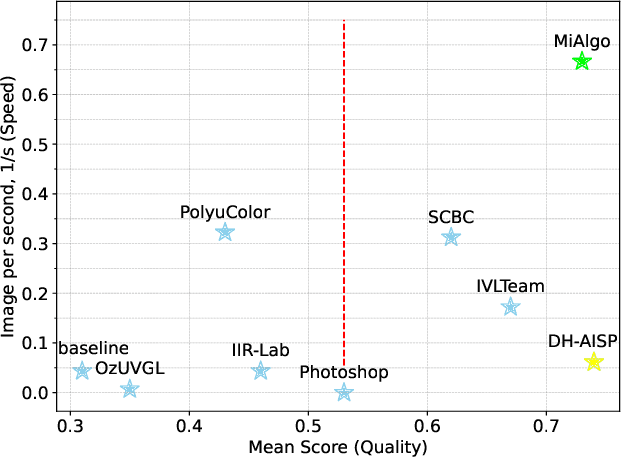
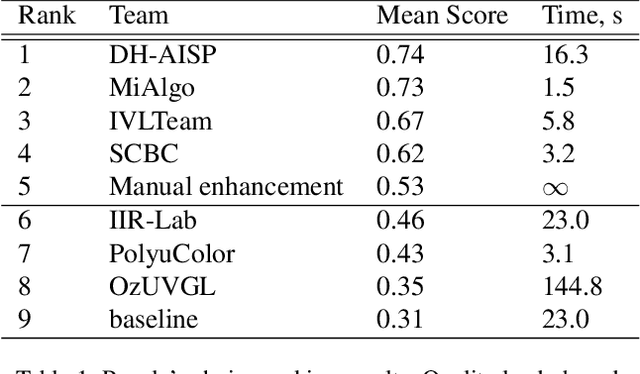
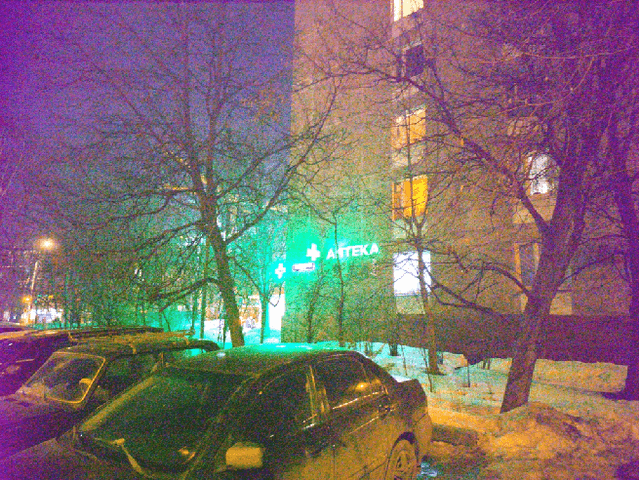
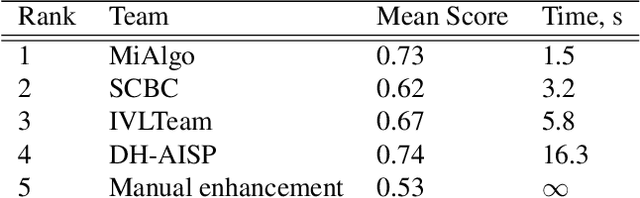
This paper presents a review of the NTIRE 2024 challenge on night photography rendering. The goal of the challenge was to find solutions that process raw camera images taken in nighttime conditions, and thereby produce a photo-quality output images in the standard RGB (sRGB) space. Unlike the previous year's competition, the challenge images were collected with a mobile phone and the speed of algorithms was also measured alongside the quality of their output. To evaluate the results, a sufficient number of viewers were asked to assess the visual quality of the proposed solutions, considering the subjective nature of the task. There were 2 nominations: quality and efficiency. Top 5 solutions in terms of output quality were sorted by evaluation time (see Fig. 1). The top ranking participants' solutions effectively represent the state-of-the-art in nighttime photography rendering. More results can be found at https://nightimaging.org.