 Add to Chrome
 Add to Firefox
 Add to Edge
NTIRE 2026 Low-light Enhancement: Twilight Cowboy Challenge
Aug 10, 2026
This paper presents a review of the NTIRE 2026 Low-light Enhancement: Twilight Cowboy Challenge. The objective of the competition was to merge a set of misaligned smartphone images in the raw domain, captured in low-light conditions, into a single, clean image. Introduced setup simultaneously addresses two problems of low-light photography: visual degradations such as high noise and mixed scene illuminants, and the geometric inconsistencies caused by hand movement during multi-frame capture. To advance research in low-light and nighttime computational photography, a challenging dataset was collected comprising 585 real-world scenes, spanning indoor low-light and outdoor nighttime conditions, for training and benchmarking participant solutions. The competition employed a three-stage evaluation protocol: automatic validation via the CodaBench platform in stages one and two, followed by blind assessment on a private test set for the final ranking. Ten teams surpassed the established baseline, achieving improvements of up to +6.49 dB in PSNR and +0.0101 in SSIM, thereby establishing new state-of-the-art performance for burst-based low-light image enhancement. These results demonstrate significant progress in handling real-world noise, motion, and illumination variability in the low-light setting. Comprehensive results, leaderboards, and additional information are publicly available at https://nightimaging.org.

NTIRE 2024 Challenge on Night Photography Rendering
Jun 18, 2024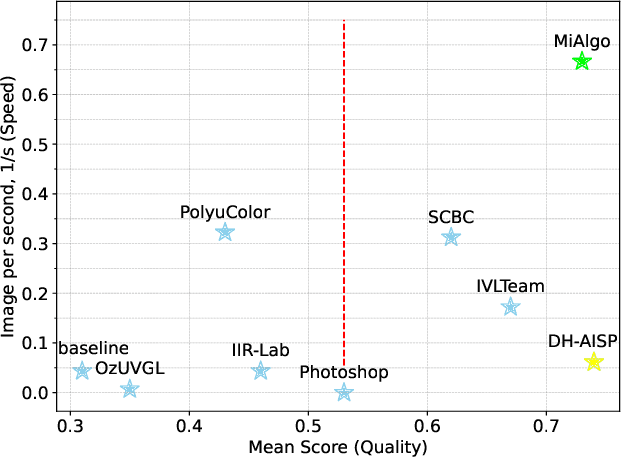
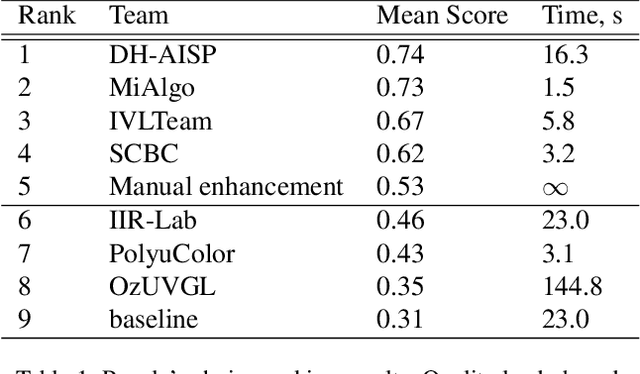
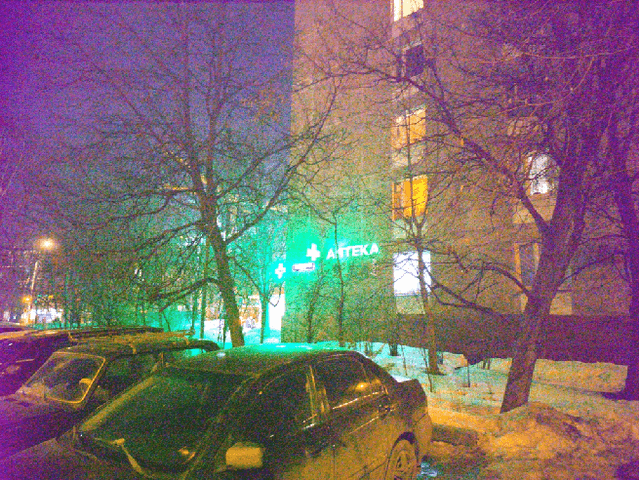
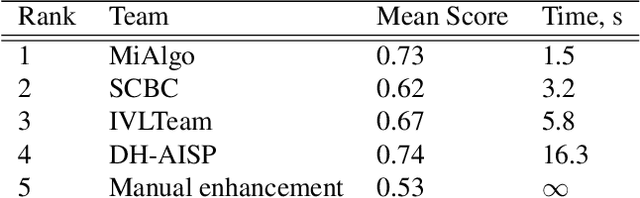
This paper presents a review of the NTIRE 2024 challenge on night photography rendering. The goal of the challenge was to find solutions that process raw camera images taken in nighttime conditions, and thereby produce a photo-quality output images in the standard RGB (sRGB) space. Unlike the previous year's competition, the challenge images were collected with a mobile phone and the speed of algorithms was also measured alongside the quality of their output. To evaluate the results, a sufficient number of viewers were asked to assess the visual quality of the proposed solutions, considering the subjective nature of the task. There were 2 nominations: quality and efficiency. Top 5 solutions in terms of output quality were sorted by evaluation time (see Fig. 1). The top ranking participants' solutions effectively represent the state-of-the-art in nighttime photography rendering. More results can be found at https://nightimaging.org.