 Add to Chrome
 Add to Firefox
 Add to Edge
NVILA: Efficient Frontier Visual Language Models
Dec 05, 2024


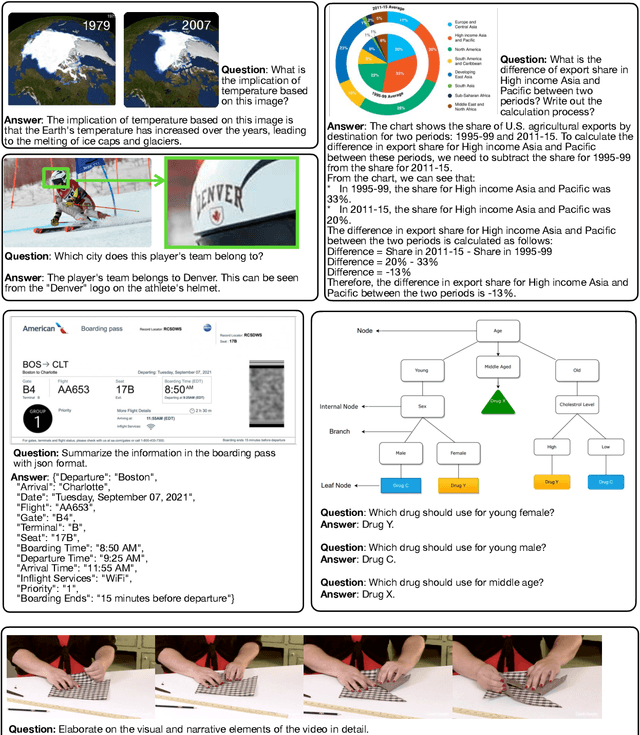

Visual language models (VLMs) have made significant advances in accuracy in recent years. However, their efficiency has received much less attention. This paper introduces NVILA, a family of open VLMs designed to optimize both efficiency and accuracy. Building on top of VILA, we improve its model architecture by first scaling up the spatial and temporal resolutions, and then compressing visual tokens. This "scale-then-compress" approach enables NVILA to efficiently process high-resolution images and long videos. We also conduct a systematic investigation to enhance the efficiency of NVILA throughout its entire lifecycle, from training and fine-tuning to deployment. NVILA matches or surpasses the accuracy of many leading open and proprietary VLMs across a wide range of image and video benchmarks. At the same time, it reduces training costs by 4.5X, fine-tuning memory usage by 3.4X, pre-filling latency by 1.6-2.2X, and decoding latency by 1.2-2.8X. We will soon make our code and models available to facilitate reproducibility.

Instruct or Interact? Exploring and Eliciting LLMs' Capability in Code Snippet Adaptation Through Prompt Engineering
Nov 23, 2024
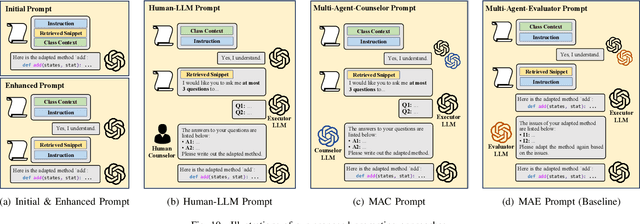
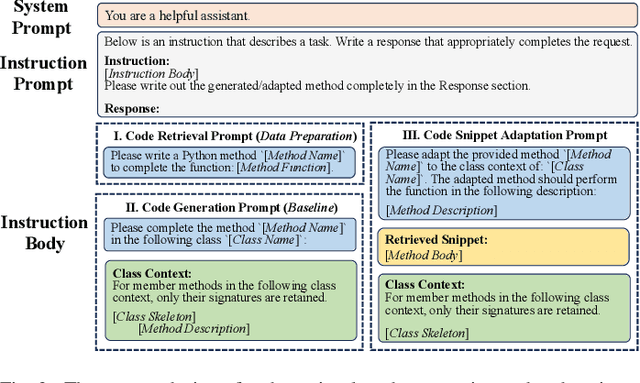
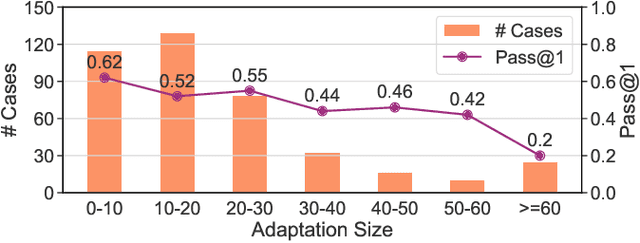
Code snippet adaptation is a fundamental activity in the software development process. Unlike code generation, code snippet adaptation is not a "free creation", which requires developers to tailor a given code snippet in order to fit specific requirements and the code context. Recently, large language models (LLMs) have confirmed their effectiveness in the code generation task with promising results. However, their performance on adaptation, a reuse-oriented and context-dependent code change prediction task, is still unclear. To bridge this gap, we conduct an empirical study to investigate the performance and issues of LLMs on the adaptation task. We first evaluate the adaptation performances of three popular LLMs and compare them to the code generation task. Our result indicates that their adaptation ability is weaker than generation, with a nearly 15% decrease on pass@1 and more context-related errors. By manually inspecting 200 cases, we further investigate the causes of LLMs' sub-optimal performance, which can be classified into three categories, i.e., Unclear Requirement, Requirement Misalignment and Context Misapplication. Based on the above empirical research, we propose an interactive prompting approach to eliciting LLMs' adaptation ability. Experimental result reveals that our approach greatly improve LLMs' adaptation performance. The best-performing Human-LLM interaction successfully solves 159 out of the 202 identified defects and improves the pass@1 and pass@5 by over 40% compared to the initial instruction-based prompt. Considering human efforts, we suggest multi-agent interaction as a trade-off, which can achieve comparable performance with excellent generalization ability. We deem that our approach could provide methodological assistance for autonomous code snippet reuse and adaptation with LLMs.
Reassessing Layer Pruning in LLMs: New Insights and Methods
Nov 23, 2024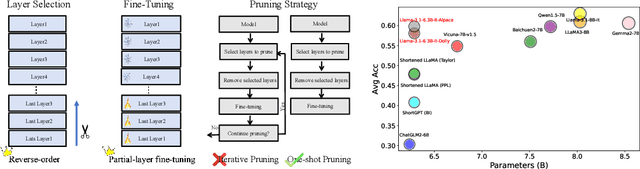
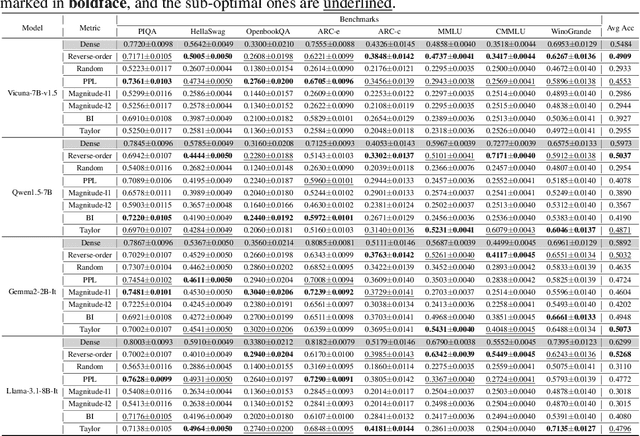
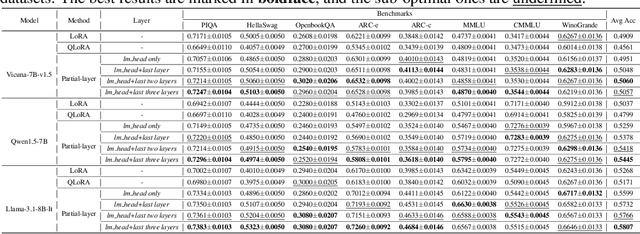
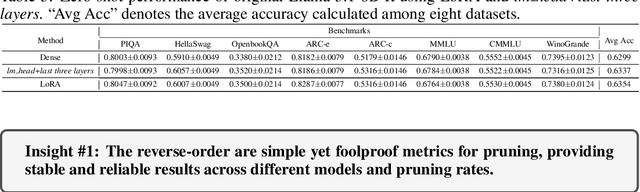
Although large language models (LLMs) have achieved remarkable success across various domains, their considerable scale necessitates substantial computational resources, posing significant challenges for deployment in resource-constrained environments. Layer pruning, as a simple yet effective compression method, removes layers of a model directly, reducing computational overhead. However, what are the best practices for layer pruning in LLMs? Are sophisticated layer selection metrics truly effective? Does the LoRA (Low-Rank Approximation) family, widely regarded as a leading method for pruned model fine-tuning, truly meet expectations when applied to post-pruning fine-tuning? To answer these questions, we dedicate thousands of GPU hours to benchmarking layer pruning in LLMs and gaining insights across multiple dimensions. Our results demonstrate that a simple approach, i.e., pruning the final 25\% of layers followed by fine-tuning the \texttt{lm\_head} and the remaining last three layer, yields remarkably strong performance. Following this guide, we prune Llama-3.1-8B-It and obtain a model that outperforms many popular LLMs of similar size, such as ChatGLM2-6B, Vicuna-7B-v1.5, Qwen1.5-7B and Baichuan2-7B. We release the optimal model weights on Huggingface, and the code is available on GitHub.
VILA-M3: Enhancing Vision-Language Models with Medical Expert Knowledge
Nov 19, 2024

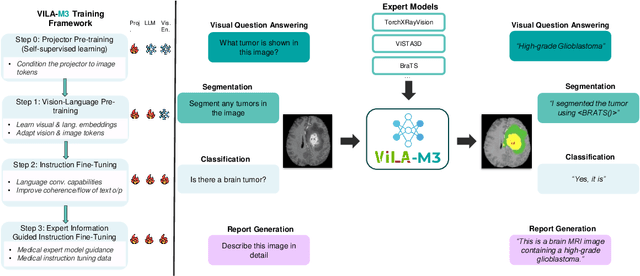

Generalist vision language models (VLMs) have made significant strides in computer vision, but they fall short in specialized fields like healthcare, where expert knowledge is essential. In traditional computer vision tasks, creative or approximate answers may be acceptable, but in healthcare, precision is paramount.Current large multimodal models like Gemini and GPT-4o are insufficient for medical tasks due to their reliance on memorized internet knowledge rather than the nuanced expertise required in healthcare. VLMs are usually trained in three stages: vision pre-training, vision-language pre-training, and instruction fine-tuning (IFT). IFT has been typically applied using a mixture of generic and healthcare data. In contrast, we propose that for medical VLMs, a fourth stage of specialized IFT is necessary, which focuses on medical data and includes information from domain expert models. Domain expert models developed for medical use are crucial because they are specifically trained for certain clinical tasks, e.g. to detect tumors and classify abnormalities through segmentation and classification, which learn fine-grained features of medical data$-$features that are often too intricate for a VLM to capture effectively especially in radiology. This paper introduces a new framework, VILA-M3, for medical VLMs that utilizes domain knowledge via expert models. Through our experiments, we show an improved state-of-the-art (SOTA) performance with an average improvement of ~9% over the prior SOTA model Med-Gemini and ~6% over models trained on the specific tasks. Our approach emphasizes the importance of domain expertise in creating precise, reliable VLMs for medical applications.
RedTest: Towards Measuring Redundancy in Deep Neural Networks Effectively
Nov 15, 2024
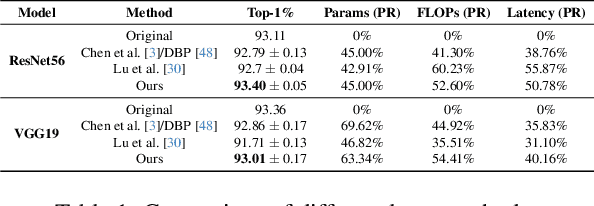
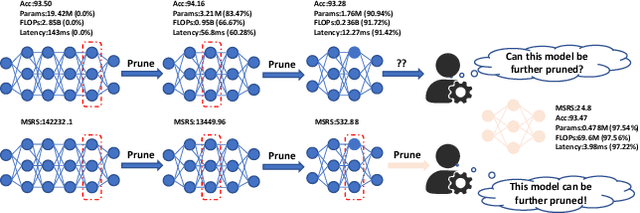
Deep learning has revolutionized computing in many real-world applications, arguably due to its remarkable performance and extreme convenience as an end-to-end solution. However, deep learning models can be costly to train and to use, especially for those large-scale models, making it necessary to optimize the original overly complicated models into smaller ones in scenarios with limited resources such as mobile applications or simply for resource saving. The key question in such model optimization is, how can we effectively identify and measure the redundancy in a deep learning model structure. While several common metrics exist in the popular model optimization techniques to measure the performance of models after optimization, they are not able to quantitatively inform the degree of remaining redundancy. To address the problem, we present a novel testing approach, i.e., RedTest, which proposes a novel testing metric called Model Structural Redundancy Score (MSRS) to quantitatively measure the degree of redundancy in a deep learning model structure. We first show that MSRS is effective in both revealing and assessing the redundancy issues in many state-of-the-art models, which urgently calls for model optimization. Then, we utilize MSRS to assist deep learning model developers in two practical application scenarios: 1) in Neural Architecture Search, we design a novel redundancy-aware algorithm to guide the search for the optimal model structure and demonstrate its effectiveness by comparing it to existing standard NAS practice; 2) in the pruning of large-scale pre-trained models, we prune the redundant layers of pre-trained models with the guidance of layer similarity to derive less redundant ones of much smaller size. Extensive experimental results demonstrate that removing such redundancy has a negligible effect on the model utility.
Multilingual Pretraining Using a Large Corpus Machine-Translated from a Single Source Language
Oct 31, 2024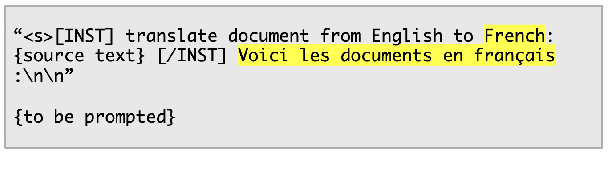
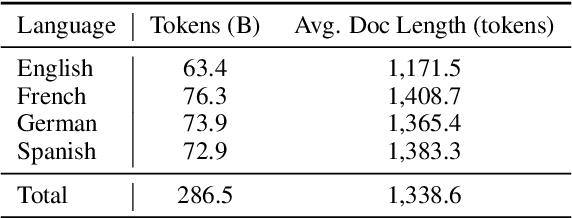
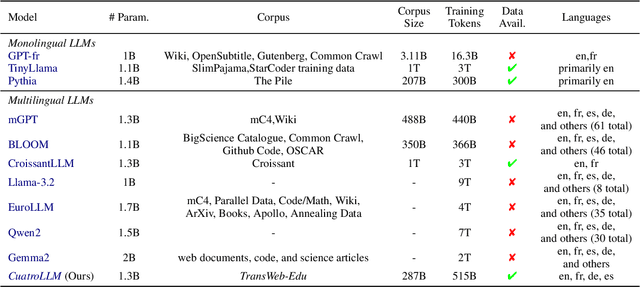
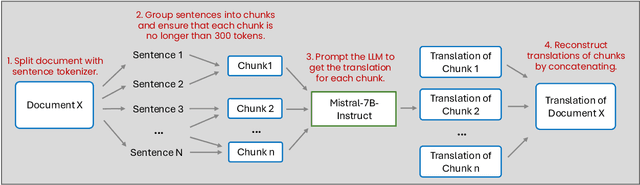
English, as a very high-resource language, enables the pretraining of high-quality large language models (LLMs). The same cannot be said for most other languages, as leading LLMs still underperform for non-English languages, likely due to a gap in the quality and diversity of the available multilingual pretraining corpora. In this work, we find that machine-translated text from a single high-quality source language can contribute significantly to the pretraining of multilingual LLMs. We translate FineWeb-Edu, a high-quality English web dataset, into French, German, and Spanish, resulting in a final 300B-token dataset, which we call TransWeb-Edu, and pretrain a 1.3B-parameter model, CuatroLLM, from scratch on this dataset. Across five non-English reasoning tasks, we show that CuatroLLM matches or outperforms state-of-the-art multilingual models trained using closed data, such as Llama3.2 and Gemma2, despite using an order of magnitude less data, such as about 6% of the tokens used for Llama3.2's training. We further demonstrate that with additional domain-specific pretraining, amounting to less than 1% of TransWeb-Edu, CuatroLLM surpasses the state of the art in multilingual reasoning. To promote reproducibility, we release our corpus, models, and training pipeline under open licenses at hf.co/britllm/CuatroLLM.
COAT: Compressing Optimizer states and Activation for Memory-Efficient FP8 Training
Oct 25, 2024


FP8 training has emerged as a promising method for improving training efficiency. Existing frameworks accelerate training by applying FP8 computation to linear layers while leaving optimizer states and activations in higher precision, which fails to fully optimize memory usage. This paper introduces COAT (Compressing Optimizer States and Activations for FP8 Training), a novel FP8 training framework designed to significantly reduce memory footprint when training large models. COAT addresses current limitations through two key innovations: (1) Dynamic Range Expansion, which aligns optimizer state distributions more closely with the FP8 representation range, thereby reducing quantization error, and (2) Mixed-Granularity Activation Quantization, which optimizes activation memory using a combination of per-tensor and per-group quantization strategies. Experiments demonstrate that COAT effectively reduces end-to-end training memory footprint by 1.54x compared to BF16 while achieving nearly lossless performance across various tasks, such as Large Language Model pretraining and fine-tuning and Vision Language Model training. COAT also achieves a 1.43x end-to-end training speedup compared to BF16, performing on par with or surpassing TransformerEngine's speedup. COAT enables efficient full-parameter training of large models on fewer GPUs, and facilitates doubling the batch size in distributed training settings, providing a practical solution for scaling large-scale model training. The code is available at https://github.com/NVlabs/COAT.
SANA: Efficient High-Resolution Image Synthesis with Linear Diffusion Transformers
Oct 15, 2024
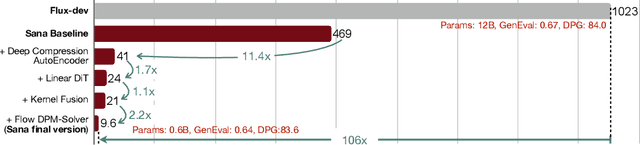
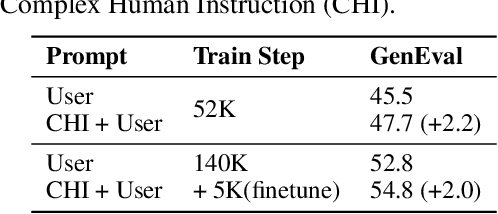
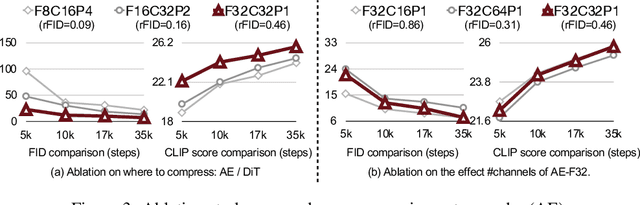
We introduce Sana, a text-to-image framework that can efficiently generate images up to 4096$\times$4096 resolution. Sana can synthesize high-resolution, high-quality images with strong text-image alignment at a remarkably fast speed, deployable on laptop GPU. Core designs include: (1) Deep compression autoencoder: unlike traditional AEs, which compress images only 8$\times$, we trained an AE that can compress images 32$\times$, effectively reducing the number of latent tokens. (2) Linear DiT: we replace all vanilla attention in DiT with linear attention, which is more efficient at high resolutions without sacrificing quality. (3) Decoder-only text encoder: we replaced T5 with modern decoder-only small LLM as the text encoder and designed complex human instruction with in-context learning to enhance the image-text alignment. (4) Efficient training and sampling: we propose Flow-DPM-Solver to reduce sampling steps, with efficient caption labeling and selection to accelerate convergence. As a result, Sana-0.6B is very competitive with modern giant diffusion model (e.g. Flux-12B), being 20 times smaller and 100+ times faster in measured throughput. Moreover, Sana-0.6B can be deployed on a 16GB laptop GPU, taking less than 1 second to generate a 1024$\times$1024 resolution image. Sana enables content creation at low cost. Code and model will be publicly released.
ECGN: A Cluster-Aware Approach to Graph Neural Networks for Imbalanced Classification
Oct 15, 2024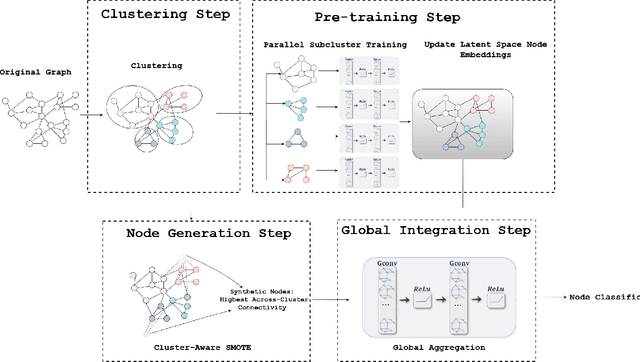

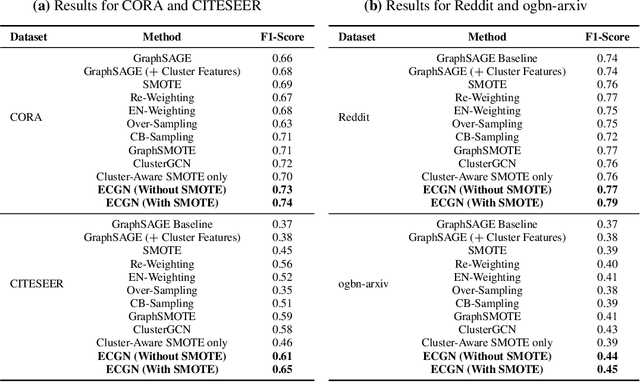
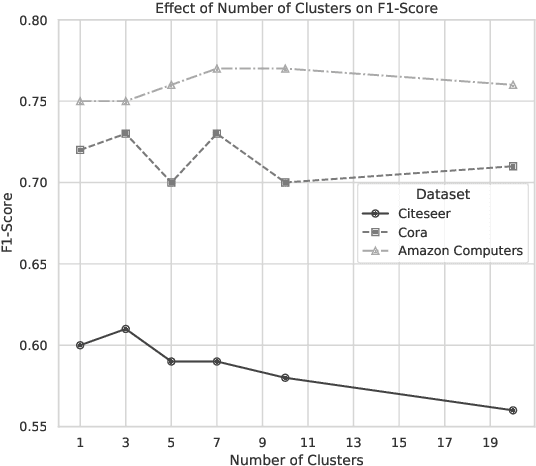
Classifying nodes in a graph is a common problem. The ideal classifier must adapt to any imbalances in the class distribution. It must also use information in the clustering structure of real-world graphs. Existing Graph Neural Networks (GNNs) have not addressed both problems together. We propose the Enhanced Cluster-aware Graph Network (ECGN), a novel method that addresses these issues by integrating cluster-specific training with synthetic node generation. Unlike traditional GNNs that apply the same node update process for all nodes, ECGN learns different aggregations for different clusters. We also use the clusters to generate new minority-class nodes in a way that helps clarify the inter-class decision boundary. By combining cluster-aware embeddings with a global integration step, ECGN enhances the quality of the resulting node embeddings. Our method works with any underlying GNN and any cluster generation technique. Experimental results show that ECGN consistently outperforms its closest competitors by up to 11% on some widely studied benchmark datasets.
SGLP: A Similarity Guided Fast Layer Partition Pruning for Compressing Large Deep Models
Oct 14, 2024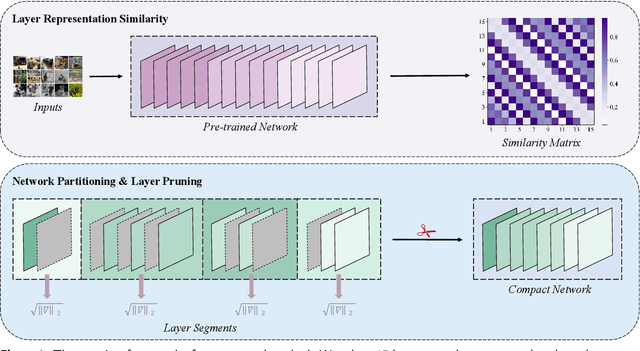
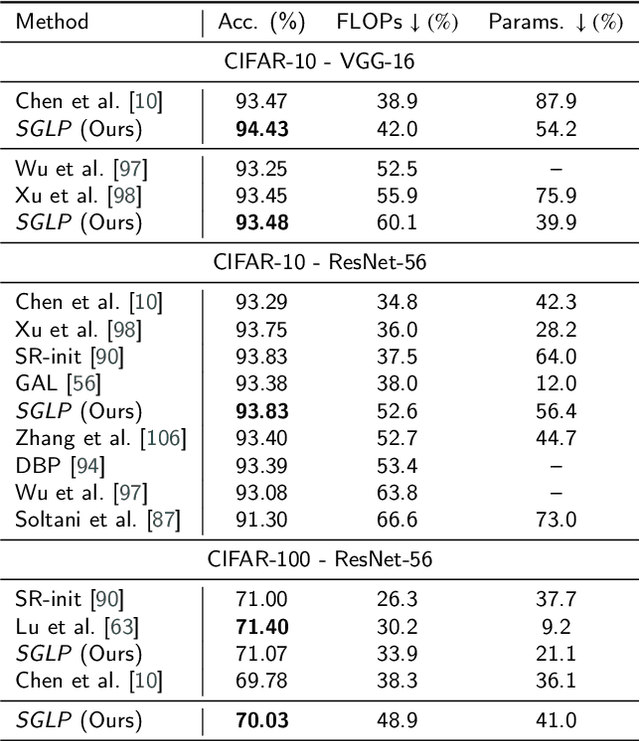
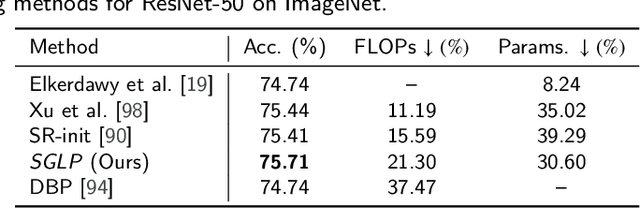
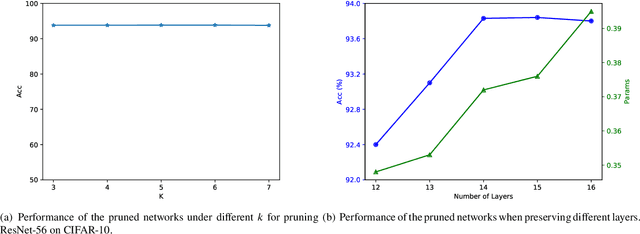
The deployment of Deep Neural Network (DNN)-based networks on resource-constrained devices remains a significant challenge due to their high computational and parameter requirements. To solve this problem, layer pruning has emerged as a potent approach to reduce network size and improve computational efficiency. However, existing layer pruning methods mostly overlook the intrinsic connections and inter-dependencies between different layers within complicated deep neural networks. This oversight can result in pruned models that do not preserve the essential characteristics of the pre-trained network as effectively as desired. To address this limitations, we propose a Similarity Guided fast Layer Partition pruning for compressing large deep models (SGLP), which focuses on pruning layers from network segments partitioned via representation similarity. Specifically, our presented method first leverages Centered Kernel Alignment (CKA) to indicate the internal representations among the layers of the pre-trained network, which provides us with a potent basis for layer pruning. Based on similarity matrix derived from CKA, we employ Fisher Optimal Segmentation to partition the network into multiple segments, which provides a basis for removing the layers in a segment-wise manner. In addition, our method innovatively adopts GradNorm for segment-wise layer importance evaluation, eliminating the need for extensive fine-tuning, and finally prunes the unimportant layers to obtain a compact network. Experimental results in image classification and for large language models (LLMs) demonstrate that our proposed SGLP outperforms the state-of-the-art methods in both accuracy and computational efficiency, presenting a more effective solution for deploying DNNs on resource-limited platforms. Our codes are available at https://github.com/itsnotacie/information-fusion-SGLP.