 Add to Chrome
 Add to Firefox
 Add to Edge
Lagrangian Relaxation Score-based Generation for Mixed Integer linear Programming
Mar 25, 2026
Predict-and-search (PaS) methods have shown promise for accelerating mixed-integer linear programming (MILP) solving. However, existing approaches typically assume variable independence and rely on deterministic single-point predictions, which limits solution diversityand often necessitates extensive downstream search for high-quality solutions. In this paper, we propose \textbf{SRG}, a generative framework based on Lagrangian relaxation-guided stochastic differential equations (SDEs), with theoretical guarantees on solution quality. SRG leverages convolutional kernels to capture inter-variable dependencies while integrating Lagrangian relaxation to guide the sampling process toward feasible and near-optimal regions. Rather than producing a single estimate, SRG generates diverse, high-quality solution candidates that collectively define compact and effective trust-region subproblems for standard MILP solvers. Across multiple public benchmarks, SRG consistently outperforms existing machine learning baselines in solution quality. Moreover, SRG demonstrates strong zero-shot transferability: on unseen cross-scale/problem instances, it achieves competitive optimality with state-of-the-art exact solvers while significantly reducing computational overhead through faster search and superior solution quality.

HTMuon: Improving Muon via Heavy-Tailed Spectral Correction
Mar 10, 2026Muon has recently shown promising results in LLM training. In this work, we study how to further improve Muon. We argue that Muon's orthogonalized update rule suppresses the emergence of heavy-tailed weight spectra and over-emphasizes the training along noise-dominated directions. Motivated by the Heavy-Tailed Self-Regularization (HT-SR) theory, we propose HTMuon. HTMuon preserves Muon's ability to capture parameter interdependencies while producing heavier-tailed updates and inducing heavier-tailed weight spectra. Experiments on LLM pretraining and image classification show that HTMuon consistently improves performance over state-of-the-art baselines and can also serve as a plug-in on top of existing Muon variants. For example, on LLaMA pretraining on the C4 dataset, HTMuon reduces perplexity by up to $0.98$ compared to Muon. We further theoretically show that HTMuon corresponds to steepest descent under the Schatten-$q$ norm constraint and provide convergence analysis in smooth non-convex settings. The implementation of HTMuon is available at https://github.com/TDCSZ327/HTmuon.
Reassessing Layer Pruning in LLMs: New Insights and Methods
Nov 23, 2024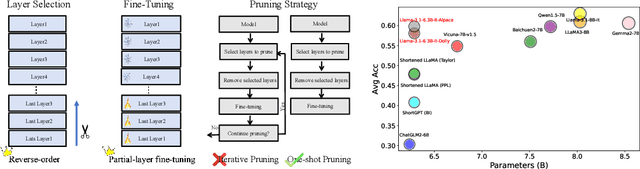
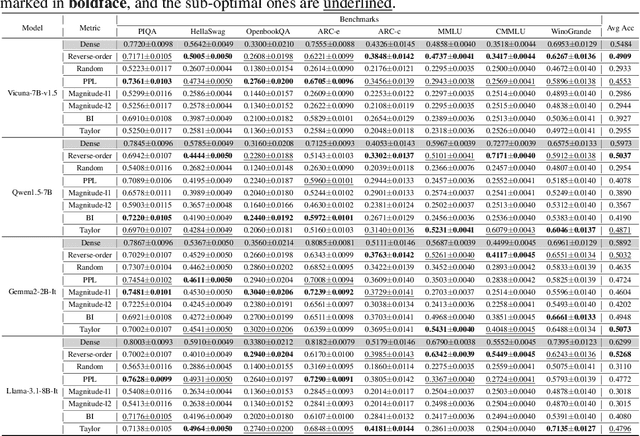
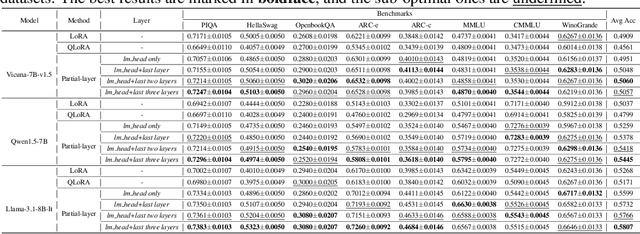
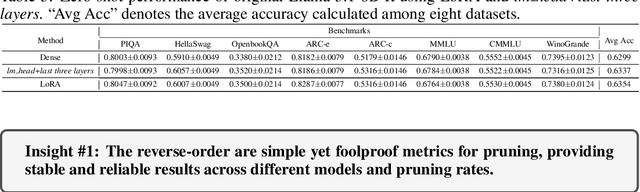
Although large language models (LLMs) have achieved remarkable success across various domains, their considerable scale necessitates substantial computational resources, posing significant challenges for deployment in resource-constrained environments. Layer pruning, as a simple yet effective compression method, removes layers of a model directly, reducing computational overhead. However, what are the best practices for layer pruning in LLMs? Are sophisticated layer selection metrics truly effective? Does the LoRA (Low-Rank Approximation) family, widely regarded as a leading method for pruned model fine-tuning, truly meet expectations when applied to post-pruning fine-tuning? To answer these questions, we dedicate thousands of GPU hours to benchmarking layer pruning in LLMs and gaining insights across multiple dimensions. Our results demonstrate that a simple approach, i.e., pruning the final 25\% of layers followed by fine-tuning the \texttt{lm\_head} and the remaining last three layer, yields remarkably strong performance. Following this guide, we prune Llama-3.1-8B-It and obtain a model that outperforms many popular LLMs of similar size, such as ChatGLM2-6B, Vicuna-7B-v1.5, Qwen1.5-7B and Baichuan2-7B. We release the optimal model weights on Huggingface, and the code is available on GitHub.