 Add to Chrome
 Add to Firefox
 Add to Edge
Learning to Query History: Nonstationary Classification via Learned Retrieval
Apr 08, 2026
Nonstationarity is ubiquitous in practical classification settings, leading deployed models to perform poorly even when they generalize well to holdout sets available at training time. We address this by reframing nonstationary classification as time series prediction: rather than predicting from the current input alone, we condition the classifier on a sequence of historical labeled examples that extends beyond the training cutoff. To scale to large sequences, we introduce a learned discrete retrieval mechanism that samples relevant historical examples via input-dependent queries, trained end-to-end with the classifier using a score-based gradient estimator. This enables the full corpus of historical data to remain on an arbitrary filesystem during training and deployment. Experiments on synthetic benchmarks and Amazon Reviews '23 (electronics category) show improved robustness to distribution shift compared to standard classifiers, with VRAM scaling predictably as the length of the historical data sequence increases.

ECGN: A Cluster-Aware Approach to Graph Neural Networks for Imbalanced Classification
Oct 15, 2024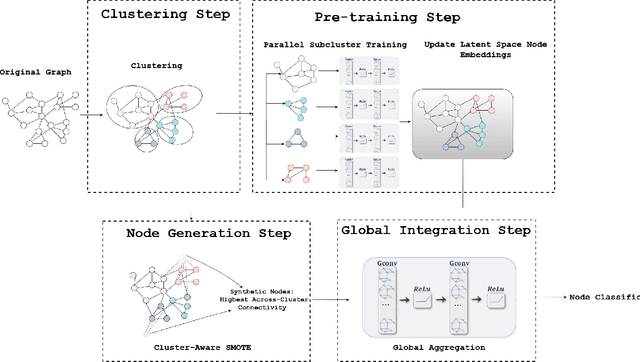

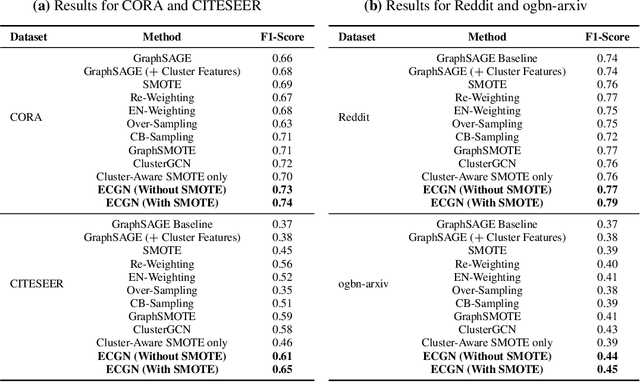
Classifying nodes in a graph is a common problem. The ideal classifier must adapt to any imbalances in the class distribution. It must also use information in the clustering structure of real-world graphs. Existing Graph Neural Networks (GNNs) have not addressed both problems together. We propose the Enhanced Cluster-aware Graph Network (ECGN), a novel method that addresses these issues by integrating cluster-specific training with synthetic node generation. Unlike traditional GNNs that apply the same node update process for all nodes, ECGN learns different aggregations for different clusters. We also use the clusters to generate new minority-class nodes in a way that helps clarify the inter-class decision boundary. By combining cluster-aware embeddings with a global integration step, ECGN enhances the quality of the resulting node embeddings. Our method works with any underlying GNN and any cluster generation technique. Experimental results show that ECGN consistently outperforms its closest competitors by up to 11% on some widely studied benchmark datasets.