 Add to Chrome
 Add to Firefox
 Add to Edge
M3imic: Learning a Versatile Whole-Body Controller for Multimodal Motion Mimicking
Jun 03, 2026
Building a general-purpose whole-body controller is essential for enabling diverse motion capabilities in humanoid robots across a wide range of downstream tasks, including locomotion and loco-manipulation. Different tasks rely on distinct motion reference modalities: locomotion primarily depends on coordinated robot joint trajectories, whereas manipulation requires precise end-effector trajectory tracking. Existing methods often overlook the representational mismatch between dense robot joint angles and sparse end-effector poses. To address this, we propose Multi-Modal Mimic (M3imic), a versatile multi-modal whole-body control framework that unifies heterogeneous motion reference modalities, including robot joint angles, human pose trajectories, and end-effector poses, using modality-specific encoders to map them into a shared latent space. Leveraging large-scale reinforcement learning in the simulator, we train a single policy that achieves sim-to-real transfer across multiple motion reference modalities without modality-specific retraining. Extensive simulation and real-world experiments on the Unitree G1 robot are conducted to evaluate the proposed framework. In simulation, the policy achieves a peak success rate of 98.42\% on an unseen test dataset, demonstrating its exceptional generalization capability. The code is available at https://github.com/Renforce-Dynamics/MultiModalWBC

Towards Event-Aware Forecasting in DeFi: Insights from On-chain Automated Market Maker Protocols
Apr 22, 2026Automated Market Makers (AMMs), as a core infrastructure of decentralized finance (DeFi), uniquely drive on-chain asset pricing through a deterministic reserve ratio mechanism. Unlike traditional markets, AMM price dynamics is triggered largely by on-chain events (e.g., swap) that change the reserve ratio, rather than by continuous responses to off-chain information. This makes event-level analysis crucial for understanding price formation mechanisms in AMMs. However, existing research generally neglects the micro-structural dynamics at the AMMs level, lacking both a comprehensive dataset covering multiple protocols with fine-grained event classification and an effective framework for event-aware modeling. To fill this gap, we construct a dataset containing 8.9 million on-chain event records from four representative AMMs protocols: Pendle, Uniswap v3, Aave and Morpho, with precise annotations of transaction type and block height timestamps. Furthermore, we propose an Uncertainty Weighted Mean Squared Error (UWM) loss function, which incorporates the block interval regression term into the traditional Time-Point Process (TPP) objective function by weighting the uncertainty with homoscedasticity. Extensive experiments on eight advanced TPP architectures demonstrate that this loss function reduces the time prediction error by an average of 56.41\% while maintaining the accuracy of event type prediction, establishing a robust benchmark for event-aware prediction in the AMMs ecosystem. This work provides the necessary data foundation and methodological framework for modeling the discreteness and event-driven characteristics of on-chain price discovery. All datasets and source code are publicly available. https://github.com/yosen-king/Deep-AMM-Events
Fundus-R1: Training a Fundus-Reading MLLM with Knowledge-Aware Reasoning on Public Data
Apr 09, 2026Fundus imaging such as CFP, OCT and UWF is crucial for the early detection of retinal anomalies and diseases. Fundus image understanding, due to its knowledge-intensive nature, poses a challenging vision-language task. An emerging approach to addressing the task is to post-train a generic multimodal large language model (MLLM), either by supervised finetuning (SFT) or by reinforcement learning with verifiable rewards (RLVR), on a considerable amount of in-house samples paired with high-quality clinical reports. However, these valuable samples are not publicly accessible, which not only hinders reproducibility but also practically limits research to few players. To overcome the barrier, we make a novel attempt to train a reasoning-enhanced fundus-reading MLLM, which we term Fundus-R1, using exclusively public datasets, wherein over 94\% of the data are annotated with only image-level labels. Our technical contributions are two-fold. First, we propose a RAG-based method for composing image-specific, knowledge-aware reasoning traces. Such auto-generated traces link visual findings identified by a generic MLLM to the image labels in terms of ophthalmic knowledge. Second, we enhance RLVR with a process reward that encourages self-consistency of the generated reasoning trace in each rollout. Extensive experiments on three fundus-reading benchmarks, i.e., FunBench, Omni-Fundus and GMAI-Fundus, show that Fundus-R1 clearly outperforms multiple baselines, including its generic counterpart (Qwen2.5-VL) and a stronger edition post-trained without using the generated traces. This work paves the way for training powerful fundus-reading MLLMs with publicly available data.
GigaWorld-Policy: An Efficient Action-Centered World--Action Model
Mar 18, 2026World-Action Models (WAM) initialized from pre-trained video generation backbones have demonstrated remarkable potential for robot policy learning. However, existing approaches face two critical bottlenecks that hinder performance and deployment. First, jointly reasoning over future visual dynamics and corresponding actions incurs substantial inference overhead. Second, joint modeling often entangles visual and motion representations, making motion prediction accuracy heavily dependent on the quality of future video forecasts. To address these issues, we introduce GigaWorld-Policy, an action-centered WAM that learns 2D pixel-action dynamics while enabling efficient action decoding, with optional video generation. Specifically, we formulate policy training into two coupled components: the model predicts future action sequences conditioned on the current observation, and simultaneously generates future videos conditioned on the predicted actions and the same observation. The policy is supervised by both action prediction and video generation, providing richer learning signals and encouraging physically plausible actions through visual-dynamics constraints. With a causal design that prevents future-video tokens from influencing action tokens, explicit future-video generation is optional at inference time, allowing faster action prediction during deployment. To support this paradigm, we curate a diverse, large-scale robot dataset to pre-train an action-centered video generation model, which is then adapted as the backbone for robot policy learning. Experimental results on real-world robotic platforms show that GigaWorld-Policy runs 9x faster than the leading WAM baseline, Motus, while improving task success rates by 7%. Moreover, compared with pi-0.5, GigaWorld-Policy improves performance by 95% on RoboTwin 2.0.
SAVE: Speech-Aware Video Representation Learning for Video-Text Retrieval
Mar 11, 2026For video-text retrieval, the use of CLIP has been a de facto choice. Since CLIP provides only image and text encoders, this consensus has led to a biased paradigm that entirely ignores the sound track of videos. While several attempts have been made to reintroduce audio -- typically by incorporating an audio encoder and fusing its output with visual features -- these methods face two challenges: ineffective representation of speech content and suboptimal vision-audio fusion. To address these issues jointly, we propose SAVE, a Speech Aware Video rEpresentation learning method. SAVE improves upon AVIGATE, a SOTA audiovisual method, with a dedicated speech branch for more effective speech embedding. Furthermore, we introduce soft-ALBEF for early vision-audio alignment that facilitates fusion. Extensive experiments on five benchmarks show that SAVE compares favorably against the SOTA, outperforming AVIGATE by +4.1% on MSRVTT-9k, +1.9% on MSRVTT-7k, +2.5% on VATEX, +9.8% on Charades, and +2.1% on LSMDC, in light of the SumR metric.
Scaling Beyond Masked Diffusion Language Models
Feb 16, 2026Diffusion language models are a promising alternative to autoregressive models due to their potential for faster generation. Among discrete diffusion approaches, Masked diffusion currently dominates, largely driven by strong perplexity on language modeling benchmarks. In this work, we present the first scaling law study of uniform-state and interpolating discrete diffusion methods. We also show that Masked diffusion models can be made approximately 12% more FLOPs-efficient when trained with a simple cross-entropy objective. We find that perplexity is informative within a diffusion family but can be misleading across families, where models with worse likelihood scaling may be preferable due to faster and more practical sampling, as reflected by the speed-quality Pareto frontier. These results challenge the view that Masked diffusion is categorically the future of diffusion language modeling and that perplexity alone suffices for cross-algorithm comparison. Scaling all methods to 1.7B parameters, we show that uniform-state diffusion remains competitive on likelihood-based benchmarks and outperforms autoregressive and Masked diffusion models on GSM8K, despite worse validation perplexity. We provide the code, model checkpoints, and video tutorials on the project page: http://s-sahoo.github.io/scaling-dllms
GigaBrain-0.5M*: a VLA That Learns From World Model-Based Reinforcement Learning
Feb 12, 2026Vision-language-action (VLA) models that directly predict multi-step action chunks from current observations face inherent limitations due to constrained scene understanding and weak future anticipation capabilities. In contrast, video world models pre-trained on web-scale video corpora exhibit robust spatiotemporal reasoning and accurate future prediction, making them a natural foundation for enhancing VLA learning. Therefore, we propose \textit{GigaBrain-0.5M*}, a VLA model trained via world model-based reinforcement learning. Built upon \textit{GigaBrain-0.5}, which is pre-trained on over 10,000 hours of robotic manipulation data, whose intermediate version currently ranks first on the international RoboChallenge benchmark. \textit{GigaBrain-0.5M*} further integrates world model-based reinforcement learning via \textit{RAMP} (Reinforcement leArning via world Model-conditioned Policy) to enable robust cross-task adaptation. Empirical results demonstrate that \textit{RAMP} achieves substantial performance gains over the RECAP baseline, yielding improvements of approximately 30\% on challenging tasks including \texttt{Laundry Folding}, \texttt{Box Packing}, and \texttt{Espresso Preparation}. Critically, \textit{GigaBrain-0.5M$^*$} exhibits reliable long-horizon execution, consistently accomplishing complex manipulation tasks without failure as validated by real-world deployment videos on our \href{https://gigabrain05m.github.io}{project page}.
Tackling the Inherent Difficulty of Noise Filtering in RAG
Jan 06, 2026Retrieval-Augmented Generation (RAG) has become a widely adopted approach to enhance Large Language Models (LLMs) by incorporating external knowledge and reducing hallucinations. However, noisy or irrelevant documents are often introduced during RAG, potentially degrading performance and even causing hallucinated outputs. While various methods have been proposed to filter out such noise, we argue that identifying irrelevant information from retrieved content is inherently difficult and limited number of transformer layers can hardly solve this. Consequently, retrievers fail to filter out irrelevant documents entirely. Therefore, LLMs must be robust against such noise, but we demonstrate that standard fine-tuning approaches are often ineffective in enabling the model to selectively utilize relevant information while ignoring irrelevant content due to the structural constraints of attention patterns. To address this, we propose a novel fine-tuning method designed to enhance the model's ability to distinguish between relevant and irrelevant information within retrieved documents. Extensive experiments across multiple benchmarks show that our approach significantly improves the robustness and performance of LLMs.
Deep Deterministic Nonlinear ICA via Total Correlation Minimization with Matrix-Based Entropy Functional
Dec 31, 2025Blind source separation, particularly through independent component analysis (ICA), is widely utilized across various signal processing domains for disentangling underlying components from observed mixed signals, owing to its fully data-driven nature that minimizes reliance on prior assumptions. However, conventional ICA methods rely on an assumption of linear mixing, limiting their ability to capture complex nonlinear relationships and to maintain robustness in noisy environments. In this work, we present deep deterministic nonlinear independent component analysis (DDICA), a novel deep neural network-based framework designed to address these limitations. DDICA leverages a matrix-based entropy function to directly optimize the independence criterion via stochastic gradient descent, bypassing the need for variational approximations or adversarial schemes. This results in a streamlined training process and improved resilience to noise. We validated the effectiveness and generalizability of DDICA across a range of applications, including simulated signal mixtures, hyperspectral image unmixing, modeling of primary visual receptive fields, and resting-state functional magnetic resonance imaging (fMRI) data analysis. Experimental results demonstrate that DDICA effectively separates independent components with high accuracy across a range of applications. These findings suggest that DDICA offers a robust and versatile solution for blind source separation in diverse signal processing tasks.
Efficient-DLM: From Autoregressive to Diffusion Language Models, and Beyond in Speed
Dec 16, 2025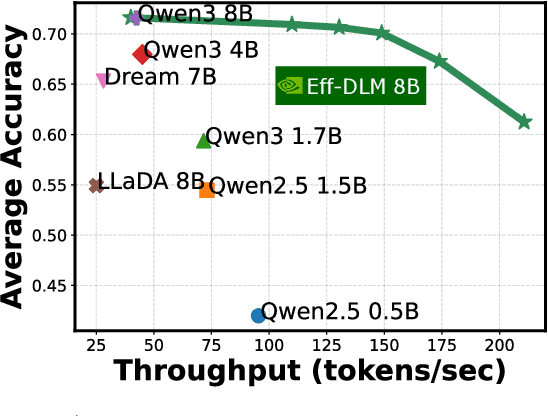
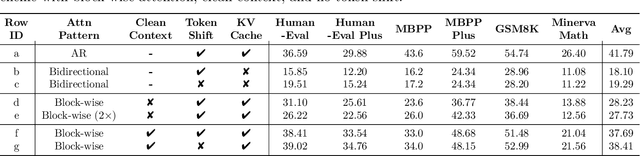
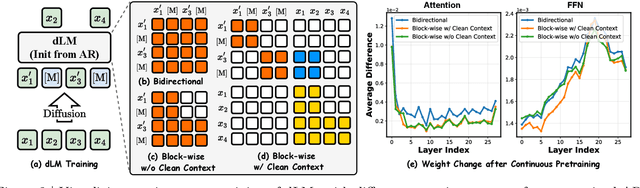
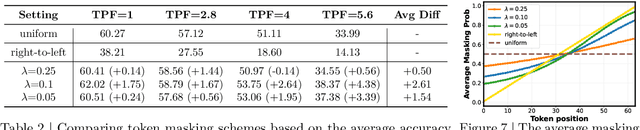
Diffusion language models (dLMs) have emerged as a promising paradigm that enables parallel, non-autoregressive generation, but their learning efficiency lags behind that of autoregressive (AR) language models when trained from scratch. To this end, we study AR-to-dLM conversion to transform pretrained AR models into efficient dLMs that excel in speed while preserving AR models' task accuracy. We achieve this by identifying limitations in the attention patterns and objectives of existing AR-to-dLM methods and then proposing principles and methodologies for more effective AR-to-dLM conversion. Specifically, we first systematically compare different attention patterns and find that maintaining pretrained AR weight distributions is critical for effective AR-to-dLM conversion. As such, we introduce a continuous pretraining scheme with a block-wise attention pattern, which remains causal across blocks while enabling bidirectional modeling within each block. We find that this approach can better preserve pretrained AR models' weight distributions than fully bidirectional modeling, in addition to its known benefit of enabling KV caching, and leads to a win-win in accuracy and efficiency. Second, to mitigate the training-test gap in mask token distributions (uniform vs. highly left-to-right), we propose a position-dependent token masking strategy that assigns higher masking probabilities to later tokens during training to better mimic test-time behavior. Leveraging this framework, we conduct extensive studies of dLMs' attention patterns, training dynamics, and other design choices, providing actionable insights into scalable AR-to-dLM conversion. These studies lead to the Efficient-DLM family, which outperforms state-of-the-art AR models and dLMs, e.g., our Efficient-DLM 8B achieves +5.4%/+2.7% higher accuracy with 4.5x/2.7x higher throughput compared to Dream 7B and Qwen3 4B, respectively.