 Add to Chrome
 Add to Firefox
 Add to Edge
PReD: An LLM-based Foundation Multimodal Model for Electromagnetic Perception, Recognition, and Decision
Apr 01, 2026
Multimodal Large Language Models have demonstrated powerful cross-modal understanding and reasoning capabilities in general domains. However, in the electromagnetic (EM) domain, they still face challenges such as data scarcity and insufficient integration of domain knowledge. This paper proposes PReD, the first foundation model for the EM domain that covers the intelligent closed-loop of "perception, recognition, decision-making." We constructed a high-quality multitask EM dataset, PReD-1.3M, and an evaluation benchmark, PReD-Bench. The dataset encompasses multi-perspective representations such as raw time-domain waveform, frequency-domain spectrograms, and constellation diagrams, covering typical features of communication and radar signals. It supports a range of core tasks, including signal detection, modulation recognition, parameter estimation, protocol recognition, radio frequency fingerprint recognition, and anti-jamming decision-making. PReD adopts a multi-stage training strategy that unifies multiple tasks for EM signals. It achieves closed-loop optimization from end-to-end signal understanding to language-driven reasoning and decision-making, significantly enhancing EM domain expertise while maintaining general multimodal capabilities. Experimental results show that PReD achieves state-of-the-art performance on PReD-Bench constructed from both open-source and self-collected signal datasets. These results collectively validate the feasibility and potential of vision-aligned foundation models in advancing the understanding and reasoning of EM signals.

Cheers: Decoupling Patch Details from Semantic Representations Enables Unified Multimodal Comprehension and Generation
Mar 13, 2026A recent cutting-edge topic in multimodal modeling is to unify visual comprehension and generation within a single model. However, the two tasks demand mismatched decoding regimes and visual representations, making it non-trivial to jointly optimize within a shared feature space. In this work, we present Cheers, a unified multimodal model that decouples patch-level details from semantic representations, thereby stabilizing semantics for multimodal understanding and improving fidelity for image generation via gated detail residuals. Cheers includes three key components: (i) a unified vision tokenizer that encodes and compresses image latent states into semantic tokens for efficient LLM conditioning, (ii) an LLM-based Transformer that unifies autoregressive decoding for text generation and diffusion decoding for image generation, and (iii) a cascaded flow matching head that decodes visual semantics first and then injects semantically gated detail residuals from the vision tokenizer to refine high-frequency content. Experiments on popular benchmarks demonstrate that Cheers matches or surpasses advanced UMMs in both visual understanding and generation. Cheers also achieves 4x token compression, enabling more efficient high-resolution image encoding and generation. Notably, Cheers outperforms the Tar-1.5B on the popular benchmarks GenEval and MMBench, while requiring only 20% of the training cost, indicating effective and efficient (i.e., 4x token compression) unified multimodal modeling. We will release all code and data for future research.
MERLIN: Building Low-SNR Robust Multimodal LLMs for Electromagnetic Signals
Mar 09, 2026The paradigm of Multimodal Large Language Models (MLLMs) offers a promising blueprint for advancing the electromagnetic (EM) domain. However, prevailing approaches often deviate from the native MLLM paradigm, instead using task-specific or pipelined architectures that lead to fundamental limitations in model performance and generalization. Fully realizing the MLLM potential in EM domain requires overcoming three main challenges: (1) Data. The scarcity of high-quality datasets with paired EM signals and descriptive text annotations used for MLLMs pre-training; (2) Benchmark. The absence of comprehensive benchmarks to systematically evaluate and compare the performance of models on EM signal-to-text tasks; (3) Model. A critical fragility in low Signal-to-Noise Ratio (SNR) environments, where critical signal features can be obscured, leading to significant performance degradation. To address these challenges, we introduce a tripartite contribution to establish a foundation for MLLMs in the EM domain. First, to overcome data scarcity, we construct and release EM-100k, a large-scale dataset comprising over 100,000 EM signal-text pairs. Second, to enable rigorous and standardized evaluation, we propose EM-Bench, the most comprehensive benchmark featuring diverse downstream tasks spanning from perception to reasoning. Finally, to tackle the core modeling challenge, we present MERLIN, a novel training framework designed not only to align low-level signal representations with high-level semantic text, but also to explicitly enhance model robustness and performance in challenging low-SNR environments. Comprehensive experiments validate our method, showing that MERLIN is state-of-the-art in the EM-Bench and exhibits remarkable robustness in low-SNR settings.
MiniCPM-SALA: Hybridizing Sparse and Linear Attention for Efficient Long-Context Modeling
Feb 12, 2026The evolution of large language models (LLMs) towards applications with ultra-long contexts faces challenges posed by the high computational and memory costs of the Transformer architecture. While existing sparse and linear attention mechanisms attempt to mitigate these issues, they typically involve a trade-off between memory efficiency and model performance. This paper introduces MiniCPM-SALA, a 9B-parameter hybrid architecture that integrates the high-fidelity long-context modeling of sparse attention (InfLLM-V2) with the global efficiency of linear attention (Lightning Attention). By employing a layer selection algorithm to integrate these mechanisms in a 1:3 ratio and utilizing a hybrid positional encoding (HyPE), the model maintains efficiency and performance for long-context tasks. Furthermore, we introduce a cost-effective continual training framework that transforms pre-trained Transformer-based models into hybrid models, which reduces training costs by approximately 75% compared to training from scratch. Extensive experiments show that MiniCPM-SALA maintains general capabilities comparable to full-attention models while offering improved efficiency. On a single NVIDIA A6000D GPU, the model achieves up to 3.5x the inference speed of the full-attention model at the sequence length of 256K tokens and supports context lengths of up to 1M tokens, a scale where traditional full-attention 8B models fail because of memory constraints.
EMind: A Foundation Model for Multi-task Electromagnetic Signals Understanding
Aug 26, 2025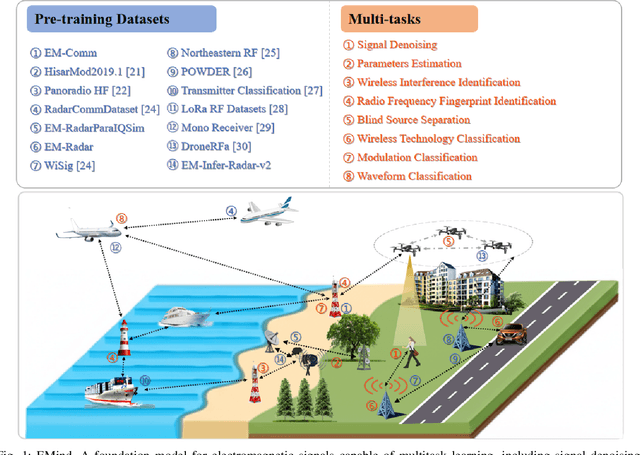
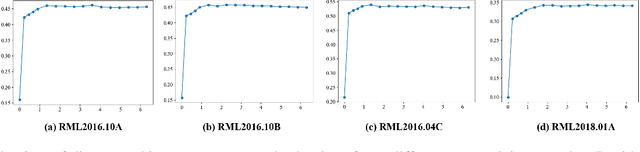
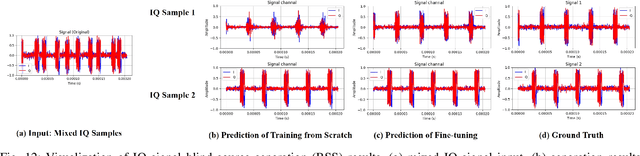
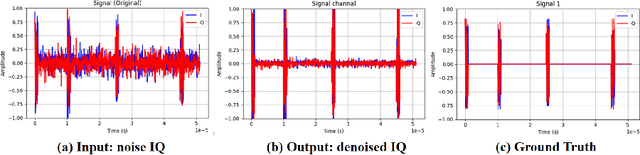
Deep understanding of electromagnetic signals is fundamental to dynamic spectrum management, intelligent transportation, autonomous driving and unmanned vehicle perception. The field faces challenges because electromagnetic signals differ greatly from text and images, showing high heterogeneity, strong background noise and complex joint time frequency structure, which prevents existing general models from direct use. Electromagnetic communication and sensing tasks are diverse, current methods lack cross task generalization and transfer efficiency, and the scarcity of large high quality datasets blocks the creation of a truly general multitask learning framework. To overcome these issue, we introduce EMind, an electromagnetic signals foundation model that bridges large scale pretraining and the unique nature of this modality. We build the first unified and largest standardized electromagnetic signal dataset covering multiple signal types and tasks. By exploiting the physical properties of electromagnetic signals, we devise a length adaptive multi-signal packing method and a hardware-aware training strategy that enable efficient use and representation learning from heterogeneous multi-source signals. Experiments show that EMind achieves strong performance and broad generalization across many downstream tasks, moving decisively from task specific models to a unified framework for electromagnetic intelligence. The code is available at: https://github.com/GabrielleTse/EMind.
RIS-MAE: A Self-Supervised Modulation Classification Method Based on Raw IQ Signals and Masked Autoencoder
Aug 01, 2025Automatic modulation classification (AMC) is a basic technology in intelligent wireless communication systems. It is important for tasks such as spectrum monitoring, cognitive radio, and secure communications. In recent years, deep learning methods have made great progress in AMC. However, mainstream methods still face two key problems. First, they often use time-frequency images instead of raw signals. This causes loss of key modulation features and reduces adaptability to different communication conditions. Second, most methods rely on supervised learning. This needs a large amount of labeled data, which is hard to get in real-world environments. To solve these problems, we propose a self-supervised learning framework called RIS-MAE. RIS-MAE uses masked autoencoders to learn signal features from unlabeled data. It takes raw IQ sequences as input. By applying random masking and reconstruction, it captures important time-domain features such as amplitude, phase, etc. This helps the model learn useful and transferable representations. RIS-MAE is tested on four datasets. The results show that it performs better than existing methods in few-shot and cross-domain tasks. Notably, it achieves high classification accuracy on previously unseen datasets with only a small number of fine-tuning samples, confirming its generalization ability and potential for real-world deployment.
RoMA: Scaling up Mamba-based Foundation Models for Remote Sensing
Mar 13, 2025Recent advances in self-supervised learning for Vision Transformers (ViTs) have fueled breakthroughs in remote sensing (RS) foundation models. However, the quadratic complexity of self-attention poses a significant barrier to scalability, particularly for large models and high-resolution images. While the linear-complexity Mamba architecture offers a promising alternative, existing RS applications of Mamba remain limited to supervised tasks on small, domain-specific datasets. To address these challenges, we propose RoMA, a framework that enables scalable self-supervised pretraining of Mamba-based RS foundation models using large-scale, diverse, unlabeled data. RoMA enhances scalability for high-resolution images through a tailored auto-regressive learning strategy, incorporating two key innovations: 1) a rotation-aware pretraining mechanism combining adaptive cropping with angular embeddings to handle sparsely distributed objects with arbitrary orientations, and 2) multi-scale token prediction objectives that address the extreme variations in object scales inherent to RS imagery. Systematic empirical studies validate that Mamba adheres to RS data and parameter scaling laws, with performance scaling reliably as model and data size increase. Furthermore, experiments across scene classification, object detection, and semantic segmentation tasks demonstrate that RoMA-pretrained Mamba models consistently outperform ViT-based counterparts in both accuracy and computational efficiency. The source code and pretrained models will be released at https://github.com/MiliLab/RoMA.