 Add to Chrome
 Add to Firefox
 Add to Edge
Radio-FM: A Foundation Model for Radio Signal Representation Learning and Its Applications
Aug 06, 2026
Applying foundation models to the radio frequency (RF) domain presents unique challenges due to the intrinsic physical complexity of raw I/Q signals and the extreme heterogeneity of spectral data. In this paper, we present Radio-FM, a scalable family of foundation models designed for universal radio signal representation learning. Unlike standard architectures, Radio-FM employs dual-channel processing specifically optimized for I/Q independence while capturing cross-channel interactions through a lightweight attention mechanism. To scale pretraining across heterogeneous multi-source corpora with highly variable sequence lengths, we propose a token-budgeted dynamic batching strategy coupled with channel-independent masked reconstruction. We pretrain Radio-FM on a diverse collection of 15 datasets spanning modulation, radar, and communication domains, and rigorously evaluate it on 15 downstream benchmarks. Experimental results show Radio-FM achieves state-of-the-art performance on 13 of 15 benchmarks, consistently improving across modulation, radar, emitter identification, wireless technology recognition, and wireless interference identification. Notably, it exhibits superior few-shot transferability, significantly outperforming existing baselines in data-scarce regimes, validating its potential as a general-purpose backbone for radio signal understanding.

Mixture-of-Experts Transformer for Automatic Modulation Recognition
Jun 08, 2026Automatic Modulation Recognition (AMR) is a key enabling technology for cognitive radio and intelligent spectrum management in next-generation wireless systems. However, current deep learning-based AMR methods predominantly rely on static multi-scale fusion strategies, which lack the flexibility to adapt to the highly dynamic temporal variations of modulation signals. To address this limitation, we propose MoEformer, an adaptive Multi-Scale Mixture-of-Experts Transformer network that directly processes I/Q signals to preserve their temporal and phase structures. Specifically, MoEformer constructs multi scale expert views through temporal resampling, employs an input-dependent gating mechanism for dynamic expert fusion, and integrates Rotary Position Embeddings (RoPE) within Transformer encoders to capture both local and global tem poral dependencies. Comprehensive evaluations on three widely adopted benchmarks (RadioML2016.10a, RadioML2016.10b, and RadioML2018.01A) demonstrate that MoEformer outperforms the competitive baselines, achieving superior average recognition accuracies of 63.74%, 66.24%, and 64.22%, respectively. In addition, the proposed method strikes an optimal trade-off between recognition performance and model complexity.
MERLIN: Building Low-SNR Robust Multimodal LLMs for Electromagnetic Signals
Mar 09, 2026The paradigm of Multimodal Large Language Models (MLLMs) offers a promising blueprint for advancing the electromagnetic (EM) domain. However, prevailing approaches often deviate from the native MLLM paradigm, instead using task-specific or pipelined architectures that lead to fundamental limitations in model performance and generalization. Fully realizing the MLLM potential in EM domain requires overcoming three main challenges: (1) Data. The scarcity of high-quality datasets with paired EM signals and descriptive text annotations used for MLLMs pre-training; (2) Benchmark. The absence of comprehensive benchmarks to systematically evaluate and compare the performance of models on EM signal-to-text tasks; (3) Model. A critical fragility in low Signal-to-Noise Ratio (SNR) environments, where critical signal features can be obscured, leading to significant performance degradation. To address these challenges, we introduce a tripartite contribution to establish a foundation for MLLMs in the EM domain. First, to overcome data scarcity, we construct and release EM-100k, a large-scale dataset comprising over 100,000 EM signal-text pairs. Second, to enable rigorous and standardized evaluation, we propose EM-Bench, the most comprehensive benchmark featuring diverse downstream tasks spanning from perception to reasoning. Finally, to tackle the core modeling challenge, we present MERLIN, a novel training framework designed not only to align low-level signal representations with high-level semantic text, but also to explicitly enhance model robustness and performance in challenging low-SNR environments. Comprehensive experiments validate our method, showing that MERLIN is state-of-the-art in the EM-Bench and exhibits remarkable robustness in low-SNR settings.
EMind: A Foundation Model for Multi-task Electromagnetic Signals Understanding
Aug 26, 2025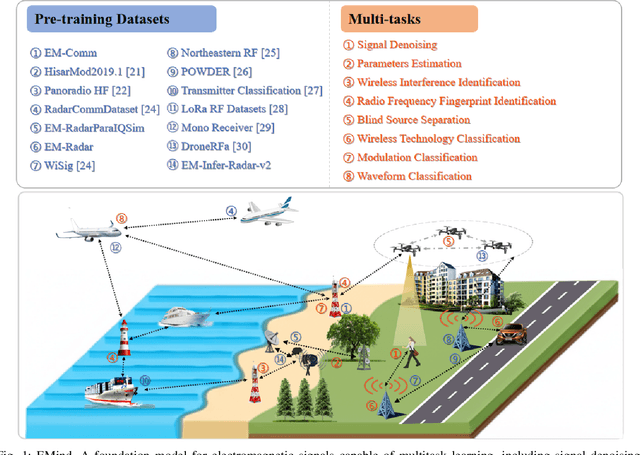
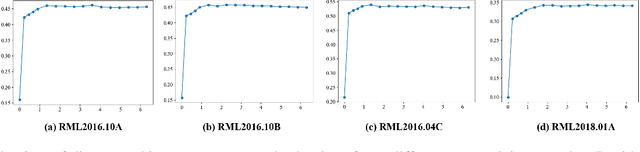
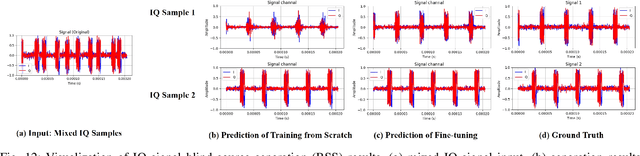
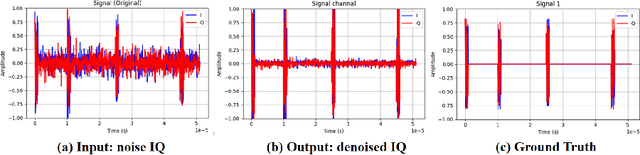
Deep understanding of electromagnetic signals is fundamental to dynamic spectrum management, intelligent transportation, autonomous driving and unmanned vehicle perception. The field faces challenges because electromagnetic signals differ greatly from text and images, showing high heterogeneity, strong background noise and complex joint time frequency structure, which prevents existing general models from direct use. Electromagnetic communication and sensing tasks are diverse, current methods lack cross task generalization and transfer efficiency, and the scarcity of large high quality datasets blocks the creation of a truly general multitask learning framework. To overcome these issue, we introduce EMind, an electromagnetic signals foundation model that bridges large scale pretraining and the unique nature of this modality. We build the first unified and largest standardized electromagnetic signal dataset covering multiple signal types and tasks. By exploiting the physical properties of electromagnetic signals, we devise a length adaptive multi-signal packing method and a hardware-aware training strategy that enable efficient use and representation learning from heterogeneous multi-source signals. Experiments show that EMind achieves strong performance and broad generalization across many downstream tasks, moving decisively from task specific models to a unified framework for electromagnetic intelligence. The code is available at: https://github.com/GabrielleTse/EMind.
RIS-MAE: A Self-Supervised Modulation Classification Method Based on Raw IQ Signals and Masked Autoencoder
Aug 01, 2025Automatic modulation classification (AMC) is a basic technology in intelligent wireless communication systems. It is important for tasks such as spectrum monitoring, cognitive radio, and secure communications. In recent years, deep learning methods have made great progress in AMC. However, mainstream methods still face two key problems. First, they often use time-frequency images instead of raw signals. This causes loss of key modulation features and reduces adaptability to different communication conditions. Second, most methods rely on supervised learning. This needs a large amount of labeled data, which is hard to get in real-world environments. To solve these problems, we propose a self-supervised learning framework called RIS-MAE. RIS-MAE uses masked autoencoders to learn signal features from unlabeled data. It takes raw IQ sequences as input. By applying random masking and reconstruction, it captures important time-domain features such as amplitude, phase, etc. This helps the model learn useful and transferable representations. RIS-MAE is tested on four datasets. The results show that it performs better than existing methods in few-shot and cross-domain tasks. Notably, it achieves high classification accuracy on previously unseen datasets with only a small number of fine-tuning samples, confirming its generalization ability and potential for real-world deployment.