 Add to Chrome
 Add to Firefox
 Add to Edge
MiniCPM-SALA: Hybridizing Sparse and Linear Attention for Efficient Long-Context Modeling
Feb 12, 2026
The evolution of large language models (LLMs) towards applications with ultra-long contexts faces challenges posed by the high computational and memory costs of the Transformer architecture. While existing sparse and linear attention mechanisms attempt to mitigate these issues, they typically involve a trade-off between memory efficiency and model performance. This paper introduces MiniCPM-SALA, a 9B-parameter hybrid architecture that integrates the high-fidelity long-context modeling of sparse attention (InfLLM-V2) with the global efficiency of linear attention (Lightning Attention). By employing a layer selection algorithm to integrate these mechanisms in a 1:3 ratio and utilizing a hybrid positional encoding (HyPE), the model maintains efficiency and performance for long-context tasks. Furthermore, we introduce a cost-effective continual training framework that transforms pre-trained Transformer-based models into hybrid models, which reduces training costs by approximately 75% compared to training from scratch. Extensive experiments show that MiniCPM-SALA maintains general capabilities comparable to full-attention models while offering improved efficiency. On a single NVIDIA A6000D GPU, the model achieves up to 3.5x the inference speed of the full-attention model at the sequence length of 256K tokens and supports context lengths of up to 1M tokens, a scale where traditional full-attention 8B models fail because of memory constraints.

UltraEval-Audio: A Unified Framework for Comprehensive Evaluation of Audio Foundation Models
Jan 04, 2026The development of audio foundation models has accelerated rapidly since the emergence of GPT-4o. However, the lack of comprehensive evaluation has become a critical bottleneck for further progress in the field, particularly in audio generation. Current audio evaluation faces three major challenges: (1) audio evaluation lacks a unified framework, with datasets and code scattered across various sources, hindering fair and efficient cross-model comparison;(2) audio codecs, as a key component of audio foundation models, lack a widely accepted and holistic evaluation methodology; (3) existing speech benchmarks are heavily reliant on English, making it challenging to objectively assess models' performance on Chinese. To address the first issue, we introduce UltraEval-Audio, a unified evaluation framework for audio foundation models, specifically designed for both audio understanding and generation tasks. UltraEval-Audio features a modular architecture, supporting 10 languages and 14 core task categories, while seamlessly integrating 24 mainstream models and 36 authoritative benchmarks. To enhance research efficiency, the framework provides a one-command evaluation feature, accompanied by real-time public leaderboards. For the second challenge, UltraEval-Audio adopts a novel comprehensive evaluation scheme for audio codecs, evaluating performance across three key dimensions: semantic accuracy, timbre fidelity, and acoustic quality. To address the third issue, we propose two new Chinese benchmarks, SpeechCMMLU and SpeechHSK, designed to assess Chinese knowledge proficiency and language fluency. We wish that UltraEval-Audio will provide both academia and industry with a transparent, efficient, and fair platform for comparison of audio models. Our code, benchmarks, and leaderboards are available at https://github.com/OpenBMB/UltraEval-Audio.
MiniCPM4: Ultra-Efficient LLMs on End Devices
Jun 09, 2025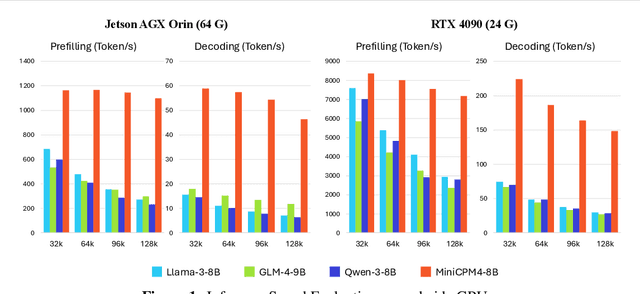

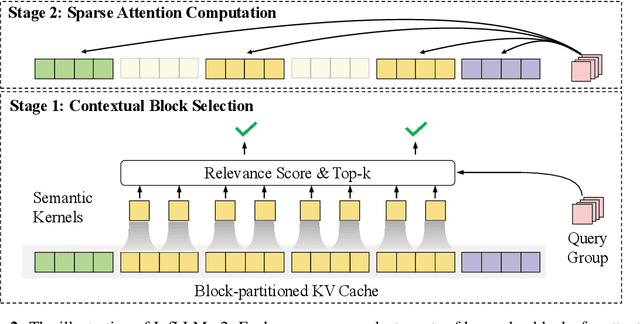
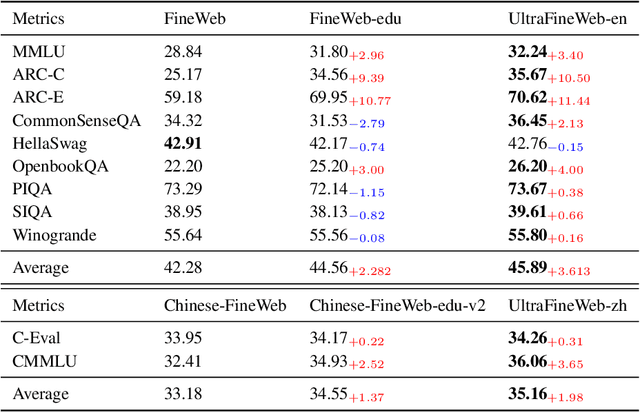
This paper introduces MiniCPM4, a highly efficient large language model (LLM) designed explicitly for end-side devices. We achieve this efficiency through systematic innovation in four key dimensions: model architecture, training data, training algorithms, and inference systems. Specifically, in terms of model architecture, we propose InfLLM v2, a trainable sparse attention mechanism that accelerates both prefilling and decoding phases for long-context processing. Regarding training data, we propose UltraClean, an efficient and accurate pre-training data filtering and generation strategy, and UltraChat v2, a comprehensive supervised fine-tuning dataset. These datasets enable satisfactory model performance to be achieved using just 8 trillion training tokens. Regarding training algorithms, we propose ModelTunnel v2 for efficient pre-training strategy search, and improve existing post-training methods by introducing chunk-wise rollout for load-balanced reinforcement learning and data-efficient tenary LLM, BitCPM. Regarding inference systems, we propose CPM.cu that integrates sparse attention, model quantization, and speculative sampling to achieve efficient prefilling and decoding. To meet diverse on-device requirements, MiniCPM4 is available in two versions, with 0.5B and 8B parameters, respectively. Sufficient evaluation results show that MiniCPM4 outperforms open-source models of similar size across multiple benchmarks, highlighting both its efficiency and effectiveness. Notably, MiniCPM4-8B demonstrates significant speed improvements over Qwen3-8B when processing long sequences. Through further adaptation, MiniCPM4 successfully powers diverse applications, including trustworthy survey generation and tool use with model context protocol, clearly showcasing its broad usability.