 Add to Chrome
 Add to Firefox
 Add to Edge
PReD: An LLM-based Foundation Multimodal Model for Electromagnetic Perception, Recognition, and Decision
Apr 01, 2026
Multimodal Large Language Models have demonstrated powerful cross-modal understanding and reasoning capabilities in general domains. However, in the electromagnetic (EM) domain, they still face challenges such as data scarcity and insufficient integration of domain knowledge. This paper proposes PReD, the first foundation model for the EM domain that covers the intelligent closed-loop of "perception, recognition, decision-making." We constructed a high-quality multitask EM dataset, PReD-1.3M, and an evaluation benchmark, PReD-Bench. The dataset encompasses multi-perspective representations such as raw time-domain waveform, frequency-domain spectrograms, and constellation diagrams, covering typical features of communication and radar signals. It supports a range of core tasks, including signal detection, modulation recognition, parameter estimation, protocol recognition, radio frequency fingerprint recognition, and anti-jamming decision-making. PReD adopts a multi-stage training strategy that unifies multiple tasks for EM signals. It achieves closed-loop optimization from end-to-end signal understanding to language-driven reasoning and decision-making, significantly enhancing EM domain expertise while maintaining general multimodal capabilities. Experimental results show that PReD achieves state-of-the-art performance on PReD-Bench constructed from both open-source and self-collected signal datasets. These results collectively validate the feasibility and potential of vision-aligned foundation models in advancing the understanding and reasoning of EM signals.

Asynchronous and Segmented Bidirectional Encoding for NMT
Feb 19, 2024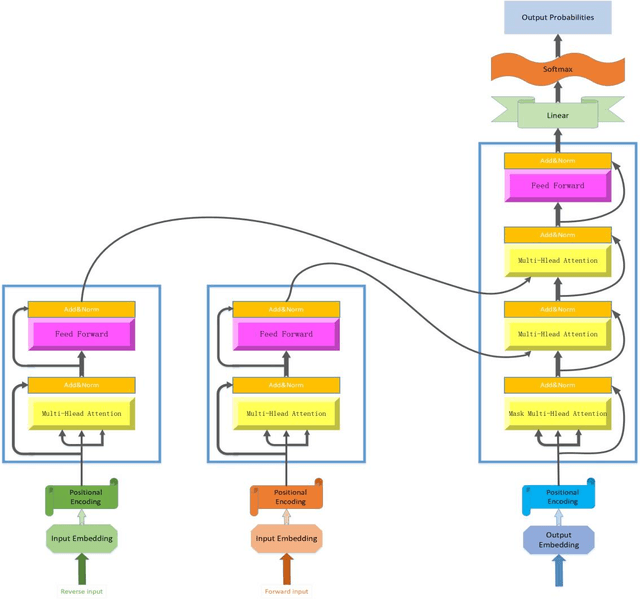

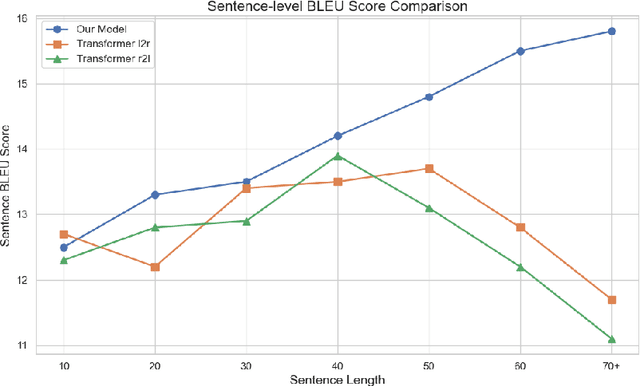
With the rapid advancement of Neural Machine Translation (NMT), enhancing translation efficiency and quality has become a focal point of research. Despite the commendable performance of general models such as the Transformer in various aspects, they still fall short in processing long sentences and fully leveraging bidirectional contextual information. This paper introduces an improved model based on the Transformer, implementing an asynchronous and segmented bidirectional decoding strategy aimed at elevating translation efficiency and accuracy. Compared to traditional unidirectional translations from left-to-right or right-to-left, our method demonstrates heightened efficiency and improved translation quality, particularly in handling long sentences. Experimental results on the IWSLT2017 dataset confirm the effectiveness of our approach in accelerating translation and increasing accuracy, especially surpassing traditional unidirectional strategies in long sentence translation. Furthermore, this study analyzes the impact of sentence length on decoding outcomes and explores the model's performance in various scenarios. The findings of this research not only provide an effective encoding strategy for the NMT field but also pave new avenues and directions for future studies.