 Add to Chrome
 Add to Firefox
 Add to Edge
VeriAgent: A Tool-Integrated Multi-Agent System with Evolving Memory for PPA-Aware RTL Code Generation
Mar 18, 2026
LLMs have recently demonstrated strong capabilities in automatic RTL code generation, achieving high syntactic and functional correctness. However, most methods focus on functional correctness while overlooking critical physical design objectives, including Power, Performance, and Area. In this work, we propose a PPA-aware, tool-integrated multi-agent framework for high-quality verilog code generation. Our framework explicitly incorporates EDA tools into a closed-loop workflow composed of a \textit{Programmer Agent}, a \textit{Correctness Agent}, and a \textit{PPA Agent}, enabling joint optimization of functional correctness and physical metrics. To support continuous improvement without model retraining, we introduce an \textit{Evolved Memory Mechanism} that externalizes optimization experience into structured memory nodes. A dedicated memory manager dynamically maintains the memory pool and allows the system to refine strategies based on historical execution trajectories. Extensive experiments demonstrate that our approach achieves strong functional correctness while delivering significant improvements in PPA metrics. By integrating tool-driven feedback with structured and evolvable memory, our framework transforms RTL generation from one-shot reasoning into a continual, feedback-driven optimization process, providing a scalable pathway for deploying LLMs in real-world hardware design flows.

MERLIN: Building Low-SNR Robust Multimodal LLMs for Electromagnetic Signals
Mar 09, 2026The paradigm of Multimodal Large Language Models (MLLMs) offers a promising blueprint for advancing the electromagnetic (EM) domain. However, prevailing approaches often deviate from the native MLLM paradigm, instead using task-specific or pipelined architectures that lead to fundamental limitations in model performance and generalization. Fully realizing the MLLM potential in EM domain requires overcoming three main challenges: (1) Data. The scarcity of high-quality datasets with paired EM signals and descriptive text annotations used for MLLMs pre-training; (2) Benchmark. The absence of comprehensive benchmarks to systematically evaluate and compare the performance of models on EM signal-to-text tasks; (3) Model. A critical fragility in low Signal-to-Noise Ratio (SNR) environments, where critical signal features can be obscured, leading to significant performance degradation. To address these challenges, we introduce a tripartite contribution to establish a foundation for MLLMs in the EM domain. First, to overcome data scarcity, we construct and release EM-100k, a large-scale dataset comprising over 100,000 EM signal-text pairs. Second, to enable rigorous and standardized evaluation, we propose EM-Bench, the most comprehensive benchmark featuring diverse downstream tasks spanning from perception to reasoning. Finally, to tackle the core modeling challenge, we present MERLIN, a novel training framework designed not only to align low-level signal representations with high-level semantic text, but also to explicitly enhance model robustness and performance in challenging low-SNR environments. Comprehensive experiments validate our method, showing that MERLIN is state-of-the-art in the EM-Bench and exhibits remarkable robustness in low-SNR settings.
PBWR: Parametric Building Wireframe Reconstruction from Aerial LiDAR Point Clouds
Nov 18, 2023

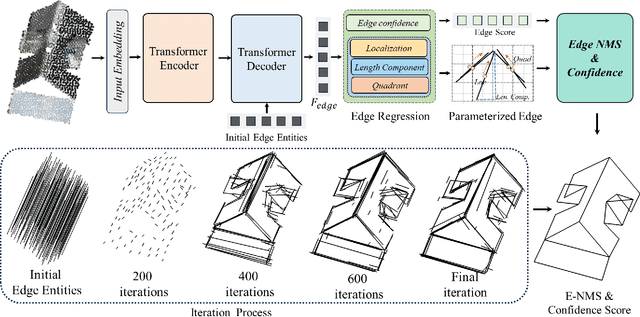

In this paper, we present an end-to-end 3D building wireframe reconstruction method to regress edges directly from aerial LiDAR point clouds.Our method, named Parametric Building Wireframe Reconstruction (PBWR), takes aerial LiDAR point clouds and initial edge entities as input, and fully uses self-attention mechanism of transformers to regress edge parameters without any intermediate steps such as corner prediction. We propose an edge non-maximum suppression (E-NMS) module based on edge similarityto remove redundant edges. Additionally, a dedicated edge loss function is utilized to guide the PBWR in regressing edges parameters, where simple use of edge distance loss isn't suitable. In our experiments, we demonstrate state-of-the-art results on the Building3D dataset, achieving an improvement of approximately 36% in entry-level dataset edge accuracy and around 42% improvement in the Tallinn dataset.
Graph Convolutional Networks for Simulating Multi-phase Flow and Transport in Porous Media
Jul 10, 2023Numerical simulation of multi-phase fluid dynamics in porous media is critical for many subsurface applications. Data-driven surrogate modeling provides computationally inexpensive alternatives to high-fidelity numerical simulators. While the commonly used convolutional neural networks (CNNs) are powerful in approximating partial differential equation solutions, it remains challenging for CNNs to handle irregular and unstructured simulation meshes. However, subsurface simulation models often involve unstructured meshes with complex mesh geometries, which limits the application of CNNs. To address this challenge, here we construct surrogate models based on Graph Convolutional Networks (GCNs) to approximate the spatial-temporal solutions of multi-phase flow and transport processes. We propose a new GCN architecture suited to the hyperbolic character of the coupled PDE system, to better capture the saturation dynamics. Results of 2D heterogeneous test cases show that our surrogates predict the evolutions of the pressure and saturation states with high accuracy, and the predicted rollouts remain stable for multiple timesteps. Moreover, the GCN-based models generalize well to irregular domain geometries and unstructured meshes that are unseen in the training dataset.