 Add to Chrome
 Add to Firefox
 Add to Edge
MaineCoon: Pursuing A Real-Time Audio-Visual Social World Model
Jun 16, 2026
As an increasing majority of global video content is consumed on social platforms for interactive social purposes, video generation models built for social worlds are important but largely overlooked by previous studies. In this work, we define the position of social world models and build a prototype model as the first step towards this goal. While previous world models successfully simulate physical environments or gaming world exploration, they remain fundamentally detached from human-centric social dynamics. To bridge this gap as the first step to social world models, we present MaineCoon, the first real-time audio-visual autoregressive model that has 22B parameters and is capable of real-time streaming generation and sub-second interaction, with a record-breaking frame rate of up to 47.5 FPS, on a single GPU. To the best of our knowledge, MaineCoon is also the first real-time audio-visual generation model specifically optimized for social-interactive applications. To enable efficient and stable training, we introduce several novel techniques into MaineCoon, including self-resampling, cross-modal representation alignment, domain-aware preference optimization, and reinforced online-policy distillation (ROPD). We also design the first agentic streaming inference framework that supports thousand-second-scale or even longer generation while mitigating drift with agentic cache management and prompt planing. These innovations significantly accelerate training while optimizing real-time inference performance. We believe this work not only sets a new state-of-the-art (SOTA) performance benchmark for high-quality, low-latency, and long-horizon audio-visual autoregressive models, but also points out the paradigm shift desired for next-generation AI-native social platforms.

PReD: An LLM-based Foundation Multimodal Model for Electromagnetic Perception, Recognition, and Decision
Apr 01, 2026Multimodal Large Language Models have demonstrated powerful cross-modal understanding and reasoning capabilities in general domains. However, in the electromagnetic (EM) domain, they still face challenges such as data scarcity and insufficient integration of domain knowledge. This paper proposes PReD, the first foundation model for the EM domain that covers the intelligent closed-loop of "perception, recognition, decision-making." We constructed a high-quality multitask EM dataset, PReD-1.3M, and an evaluation benchmark, PReD-Bench. The dataset encompasses multi-perspective representations such as raw time-domain waveform, frequency-domain spectrograms, and constellation diagrams, covering typical features of communication and radar signals. It supports a range of core tasks, including signal detection, modulation recognition, parameter estimation, protocol recognition, radio frequency fingerprint recognition, and anti-jamming decision-making. PReD adopts a multi-stage training strategy that unifies multiple tasks for EM signals. It achieves closed-loop optimization from end-to-end signal understanding to language-driven reasoning and decision-making, significantly enhancing EM domain expertise while maintaining general multimodal capabilities. Experimental results show that PReD achieves state-of-the-art performance on PReD-Bench constructed from both open-source and self-collected signal datasets. These results collectively validate the feasibility and potential of vision-aligned foundation models in advancing the understanding and reasoning of EM signals.
MERLIN: Building Low-SNR Robust Multimodal LLMs for Electromagnetic Signals
Mar 09, 2026The paradigm of Multimodal Large Language Models (MLLMs) offers a promising blueprint for advancing the electromagnetic (EM) domain. However, prevailing approaches often deviate from the native MLLM paradigm, instead using task-specific or pipelined architectures that lead to fundamental limitations in model performance and generalization. Fully realizing the MLLM potential in EM domain requires overcoming three main challenges: (1) Data. The scarcity of high-quality datasets with paired EM signals and descriptive text annotations used for MLLMs pre-training; (2) Benchmark. The absence of comprehensive benchmarks to systematically evaluate and compare the performance of models on EM signal-to-text tasks; (3) Model. A critical fragility in low Signal-to-Noise Ratio (SNR) environments, where critical signal features can be obscured, leading to significant performance degradation. To address these challenges, we introduce a tripartite contribution to establish a foundation for MLLMs in the EM domain. First, to overcome data scarcity, we construct and release EM-100k, a large-scale dataset comprising over 100,000 EM signal-text pairs. Second, to enable rigorous and standardized evaluation, we propose EM-Bench, the most comprehensive benchmark featuring diverse downstream tasks spanning from perception to reasoning. Finally, to tackle the core modeling challenge, we present MERLIN, a novel training framework designed not only to align low-level signal representations with high-level semantic text, but also to explicitly enhance model robustness and performance in challenging low-SNR environments. Comprehensive experiments validate our method, showing that MERLIN is state-of-the-art in the EM-Bench and exhibits remarkable robustness in low-SNR settings.
Gazing at Rewards: Eye Movements as a Lens into Human and AI Decision-Making in Hybrid Visual Foraging
Nov 14, 2024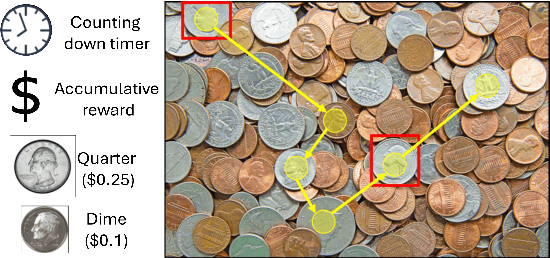


Imagine searching a collection of coins for quarters ($0.25$), dimes ($0.10$), nickels ($0.05$), and pennies ($0.01$)-a hybrid foraging task where observers look for multiple instances of multiple target types. In such tasks, how do target values and their prevalence influence foraging and eye movement behaviors (e.g., should you prioritize rare quarters or common nickels)? To explore this, we conducted human psychophysics experiments, revealing that humans are proficient reward foragers. Their eye fixations are drawn to regions with higher average rewards, fixation durations are longer on more valuable targets, and their cumulative rewards exceed chance, approaching the upper bound of optimal foragers. To probe these decision-making processes of humans, we developed a transformer-based Visual Forager (VF) model trained via reinforcement learning. Our VF model takes a series of targets, their corresponding values, and the search image as inputs, processes the images using foveated vision, and produces a sequence of eye movements along with decisions on whether to collect each fixated item. Our model outperforms all baselines, achieves cumulative rewards comparable to those of humans, and approximates human foraging behavior in eye movements and foraging biases within time-limited environments. Furthermore, stress tests on out-of-distribution tasks with novel targets, unseen values, and varying set sizes demonstrate the VF model's effective generalization. Our work offers valuable insights into the relationship between eye movements and decision-making, with our model serving as a powerful tool for further exploration of this connection. All data, code, and models will be made publicly available.
DreamFactory: Pioneering Multi-Scene Long Video Generation with a Multi-Agent Framework
Aug 21, 2024Current video generation models excel at creating short, realistic clips, but struggle with longer, multi-scene videos. We introduce \texttt{DreamFactory}, an LLM-based framework that tackles this challenge. \texttt{DreamFactory} leverages multi-agent collaboration principles and a Key Frames Iteration Design Method to ensure consistency and style across long videos. It utilizes Chain of Thought (COT) to address uncertainties inherent in large language models. \texttt{DreamFactory} generates long, stylistically coherent, and complex videos. Evaluating these long-form videos presents a challenge. We propose novel metrics such as Cross-Scene Face Distance Score and Cross-Scene Style Consistency Score. To further research in this area, we contribute the Multi-Scene Videos Dataset containing over 150 human-rated videos.