 Add to Chrome
 Add to Firefox
 Add to Edge
PReD: An LLM-based Foundation Multimodal Model for Electromagnetic Perception, Recognition, and Decision
Apr 01, 2026
Multimodal Large Language Models have demonstrated powerful cross-modal understanding and reasoning capabilities in general domains. However, in the electromagnetic (EM) domain, they still face challenges such as data scarcity and insufficient integration of domain knowledge. This paper proposes PReD, the first foundation model for the EM domain that covers the intelligent closed-loop of "perception, recognition, decision-making." We constructed a high-quality multitask EM dataset, PReD-1.3M, and an evaluation benchmark, PReD-Bench. The dataset encompasses multi-perspective representations such as raw time-domain waveform, frequency-domain spectrograms, and constellation diagrams, covering typical features of communication and radar signals. It supports a range of core tasks, including signal detection, modulation recognition, parameter estimation, protocol recognition, radio frequency fingerprint recognition, and anti-jamming decision-making. PReD adopts a multi-stage training strategy that unifies multiple tasks for EM signals. It achieves closed-loop optimization from end-to-end signal understanding to language-driven reasoning and decision-making, significantly enhancing EM domain expertise while maintaining general multimodal capabilities. Experimental results show that PReD achieves state-of-the-art performance on PReD-Bench constructed from both open-source and self-collected signal datasets. These results collectively validate the feasibility and potential of vision-aligned foundation models in advancing the understanding and reasoning of EM signals.

Cheers: Decoupling Patch Details from Semantic Representations Enables Unified Multimodal Comprehension and Generation
Mar 13, 2026A recent cutting-edge topic in multimodal modeling is to unify visual comprehension and generation within a single model. However, the two tasks demand mismatched decoding regimes and visual representations, making it non-trivial to jointly optimize within a shared feature space. In this work, we present Cheers, a unified multimodal model that decouples patch-level details from semantic representations, thereby stabilizing semantics for multimodal understanding and improving fidelity for image generation via gated detail residuals. Cheers includes three key components: (i) a unified vision tokenizer that encodes and compresses image latent states into semantic tokens for efficient LLM conditioning, (ii) an LLM-based Transformer that unifies autoregressive decoding for text generation and diffusion decoding for image generation, and (iii) a cascaded flow matching head that decodes visual semantics first and then injects semantically gated detail residuals from the vision tokenizer to refine high-frequency content. Experiments on popular benchmarks demonstrate that Cheers matches or surpasses advanced UMMs in both visual understanding and generation. Cheers also achieves 4x token compression, enabling more efficient high-resolution image encoding and generation. Notably, Cheers outperforms the Tar-1.5B on the popular benchmarks GenEval and MMBench, while requiring only 20% of the training cost, indicating effective and efficient (i.e., 4x token compression) unified multimodal modeling. We will release all code and data for future research.
Boosting Single-domain Generalized Object Detection via Vision-Language Knowledge Interaction
Apr 27, 2025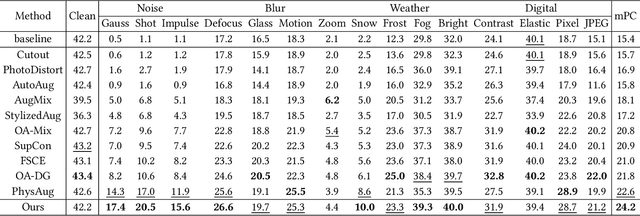
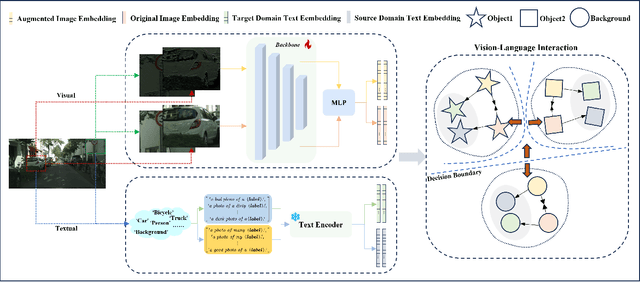
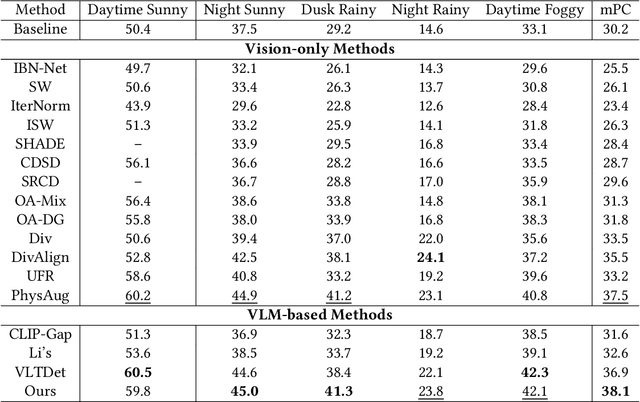
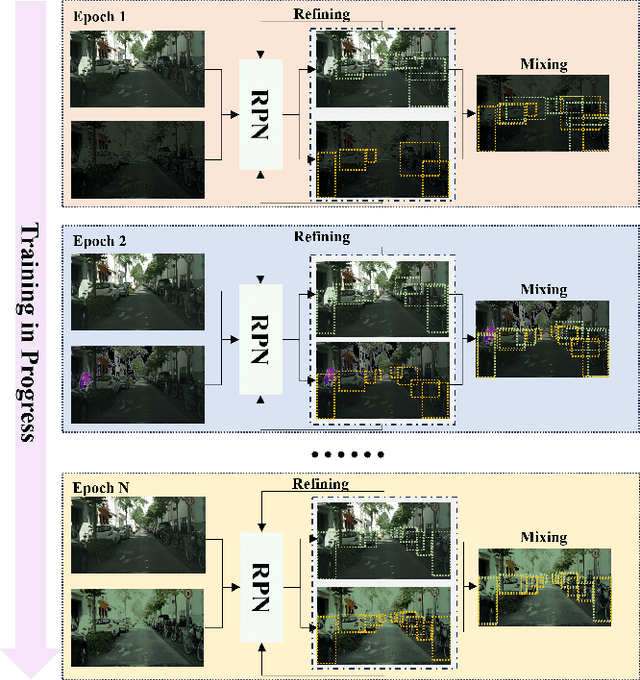
Single-Domain Generalized Object Detection~(S-DGOD) aims to train an object detector on a single source domain while generalizing well to diverse unseen target domains, making it suitable for multimedia applications that involve various domain shifts, such as intelligent video surveillance and VR/AR technologies. With the success of large-scale Vision-Language Models, recent S-DGOD approaches exploit pre-trained vision-language knowledge to guide invariant feature learning across visual domains. However, the utilized knowledge remains at a coarse-grained level~(e.g., the textual description of adverse weather paired with the image) and serves as an implicit regularization for guidance, struggling to learn accurate region- and object-level features in varying domains. In this work, we propose a new cross-modal feature learning method, which can capture generalized and discriminative regional features for S-DGOD tasks. The core of our method is the mechanism of Cross-modal and Region-aware Feature Interaction, which simultaneously learns both inter-modal and intra-modal regional invariance through dynamic interactions between fine-grained textual and visual features. Moreover, we design a simple but effective strategy called Cross-domain Proposal Refining and Mixing, which aligns the position of region proposals across multiple domains and diversifies them, enhancing the localization ability of detectors in unseen scenarios. Our method achieves new state-of-the-art results on S-DGOD benchmark datasets, with improvements of +8.8\%~mPC on Cityscapes-C and +7.9\%~mPC on DWD over baselines, demonstrating its efficacy.
Object Gaussian for Monocular 6D Pose Estimation from Sparse Views
Sep 04, 2024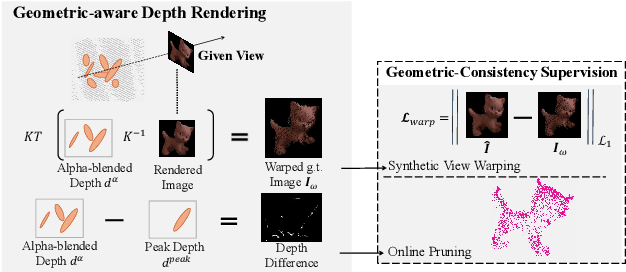
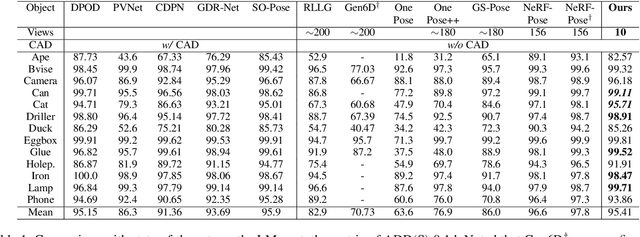
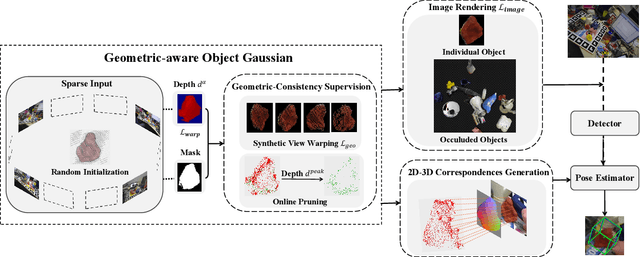
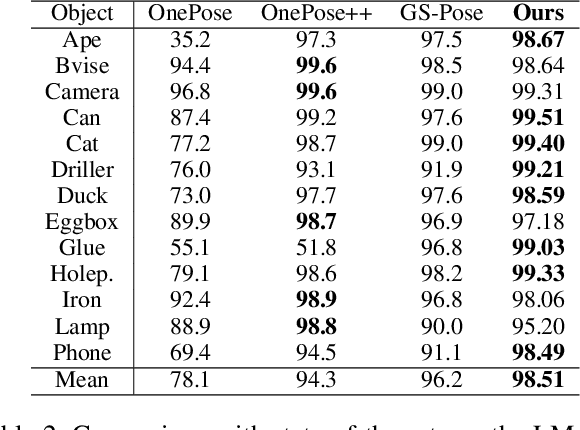
Monocular object pose estimation, as a pivotal task in computer vision and robotics, heavily depends on accurate 2D-3D correspondences, which often demand costly CAD models that may not be readily available. Object 3D reconstruction methods offer an alternative, among which recent advancements in 3D Gaussian Splatting (3DGS) afford a compelling potential. Yet its performance still suffers and tends to overfit with fewer input views. Embracing this challenge, we introduce SGPose, a novel framework for sparse view object pose estimation using Gaussian-based methods. Given as few as ten views, SGPose generates a geometric-aware representation by starting with a random cuboid initialization, eschewing reliance on Structure-from-Motion (SfM) pipeline-derived geometry as required by traditional 3DGS methods. SGPose removes the dependence on CAD models by regressing dense 2D-3D correspondences between images and the reconstructed model from sparse input and random initialization, while the geometric-consistent depth supervision and online synthetic view warping are key to the success. Experiments on typical benchmarks, especially on the Occlusion LM-O dataset, demonstrate that SGPose outperforms existing methods even under sparse view constraints, under-scoring its potential in real-world applications.