 Add to Chrome
 Add to Firefox
 Add to Edge
Zooming from Context to Cue: Hierarchical Preference Optimization for Multi-Image MLLMs
May 28, 2025
Multi-modal Large Language Models (MLLMs) excel at single-image tasks but struggle with multi-image understanding due to cross-modal misalignment, leading to hallucinations (context omission, conflation, and misinterpretation). Existing methods using Direct Preference Optimization (DPO) constrain optimization to a solitary image reference within the input sequence, neglecting holistic context modeling. We propose Context-to-Cue Direct Preference Optimization (CcDPO), a multi-level preference optimization framework that enhances per-image perception in multi-image settings by zooming into visual clues -- from sequential context to local details. It features: (i) Context-Level Optimization : Re-evaluates cognitive biases underlying MLLMs' multi-image context comprehension and integrates a spectrum of low-cost global sequence preferences for bias mitigation. (ii) Needle-Level Optimization : Directs attention to fine-grained visual details through region-targeted visual prompts and multimodal preference supervision. To support scalable optimization, we also construct MultiScope-42k, an automatically generated dataset with high-quality multi-level preference pairs. Experiments show that CcDPO significantly reduces hallucinations and yields consistent performance gains across general single- and multi-image tasks.

IKMo: Image-Keyframed Motion Generation with Trajectory-Pose Conditioned Motion Diffusion Model
May 27, 2025Existing human motion generation methods with trajectory and pose inputs operate global processing on both modalities, leading to suboptimal outputs. In this paper, we propose IKMo, an image-keyframed motion generation method based on the diffusion model with trajectory and pose being decoupled. The trajectory and pose inputs go through a two-stage conditioning framework. In the first stage, the dedicated optimization module is applied to refine inputs. In the second stage, trajectory and pose are encoded via a Trajectory Encoder and a Pose Encoder in parallel. Then, motion with high spatial and semantic fidelity is guided by a motion ControlNet, which processes the fused trajectory and pose data. Experiment results based on HumanML3D and KIT-ML datasets demonstrate that the proposed method outperforms state-of-the-art on all metrics under trajectory-keyframe constraints. In addition, MLLM-based agents are implemented to pre-process model inputs. Given texts and keyframe images from users, the agents extract motion descriptions, keyframe poses, and trajectories as the optimized inputs into the motion generation model. We conducts a user study with 10 participants. The experiment results prove that the MLLM-based agents pre-processing makes generated motion more in line with users' expectation. We believe that the proposed method improves both the fidelity and controllability of motion generation by the diffusion model.
MMMR: Benchmarking Massive Multi-Modal Reasoning Tasks
May 22, 2025Recent advances in Multi-Modal Large Language Models (MLLMs) have enabled unified processing of language, vision, and structured inputs, opening the door to complex tasks such as logical deduction, spatial reasoning, and scientific analysis. Despite their promise, the reasoning capabilities of MLLMs, particularly those augmented with intermediate thinking traces (MLLMs-T), remain poorly understood and lack standardized evaluation benchmarks. Existing work focuses primarily on perception or final answer correctness, offering limited insight into how models reason or fail across modalities. To address this gap, we introduce the MMMR, a new benchmark designed to rigorously evaluate multi-modal reasoning with explicit thinking. The MMMR comprises 1) a high-difficulty dataset of 1,083 questions spanning six diverse reasoning types with symbolic depth and multi-hop demands and 2) a modular Reasoning Trace Evaluation Pipeline (RTEP) for assessing reasoning quality beyond accuracy through metrics like relevance, consistency, and structured error annotations. Empirical results show that MLLMs-T overall outperform non-thinking counterparts, but even top models like Claude-3.7-Sonnet and Gemini-2.5 Pro suffer from reasoning pathologies such as inconsistency and overthinking. This benchmark reveals persistent gaps between accuracy and reasoning quality and provides an actionable evaluation pipeline for future model development. Overall, the MMMR offers a scalable foundation for evaluating, comparing, and improving the next generation of multi-modal reasoning systems.
Confidence-Regulated Generative Diffusion Models for Reliable AI Agent Migration in Vehicular Metaverses
May 19, 2025Vehicular metaverses are an emerging paradigm that merges intelligent transportation systems with virtual spaces, leveraging advanced digital twin and Artificial Intelligence (AI) technologies to seamlessly integrate vehicles, users, and digital environments. In this paradigm, vehicular AI agents are endowed with environment perception, decision-making, and action execution capabilities, enabling real-time processing and analysis of multi-modal data to provide users with customized interactive services. Since vehicular AI agents require substantial resources for real-time decision-making, given vehicle mobility and network dynamics conditions, the AI agents are deployed in RoadSide Units (RSUs) with sufficient resources and dynamically migrated among them. However, AI agent migration requires frequent data exchanges, which may expose vehicular metaverses to potential cyber attacks. To this end, we propose a reliable vehicular AI agent migration framework, achieving reliable dynamic migration and efficient resource scheduling through cooperation between vehicles and RSUs. Additionally, we design a trust evaluation model based on the theory of planned behavior to dynamically quantify the reputation of RSUs, thereby better accommodating the personalized trust preferences of users. We then model the vehicular AI agent migration process as a partially observable markov decision process and develop a Confidence-regulated Generative Diffusion Model (CGDM) to efficiently generate AI agent migration decisions. Numerical results demonstrate that the CGDM algorithm significantly outperforms baseline methods in reducing system latency and enhancing robustness against cyber attacks.
ZeroSearch: Incentivize the Search Capability of LLMs without Searching
May 07, 2025Effective information searching is essential for enhancing the reasoning and generation capabilities of large language models (LLMs). Recent research has explored using reinforcement learning (RL) to improve LLMs' search capabilities by interacting with live search engines in real-world environments. While these approaches show promising results, they face two major challenges: (1) Uncontrolled Document Quality: The quality of documents returned by search engines is often unpredictable, introducing noise and instability into the training process. (2) Prohibitively High API Costs: RL training requires frequent rollouts, potentially involving hundreds of thousands of search requests, which incur substantial API expenses and severely constrain scalability. To address these challenges, we introduce ZeroSearch, a reinforcement learning framework that incentivizes the search capabilities of LLMs without interacting with real search engines. Our approach begins with lightweight supervised fine-tuning to transform the LLM into a retrieval module capable of generating both relevant and noisy documents in response to a query. During RL training, we employ a curriculum-based rollout strategy that incrementally degrades the quality of generated documents, progressively eliciting the model's reasoning ability by exposing it to increasingly challenging retrieval scenarios. Extensive experiments demonstrate that ZeroSearch effectively incentivizes the search capabilities of LLMs using a 3B LLM as the retrieval module. Remarkably, a 7B retrieval module achieves comparable performance to the real search engine, while a 14B retrieval module even surpasses it. Furthermore, it generalizes well across both base and instruction-tuned models of various parameter sizes and is compatible with a wide range of RL algorithms.
Temporal Attention Evolutional Graph Convolutional Network for Multivariate Time Series Forecasting
May 01, 2025Multivariate time series forecasting enables the prediction of future states by leveraging historical data, thereby facilitating decision-making processes. Each data node in a multivariate time series encompasses a sequence of multiple dimensions. These nodes exhibit interdependent relationships, forming a graph structure. While existing prediction methods often assume a fixed graph structure, many real-world scenarios involve dynamic graph structures. Moreover, interactions among time series observed at different time scales vary significantly. To enhance prediction accuracy by capturing precise temporal and spatial features, this paper introduces the Temporal Attention Evolutional Graph Convolutional Network (TAEGCN). This novel method not only integrates causal temporal convolution and a multi-head self-attention mechanism to learn temporal features of nodes, but also construct the dynamic graph structure based on these temporal features to keep the consistency of the changing in spatial feature with temporal series. TAEGCN adeptly captures temporal causal relationships and hidden spatial dependencies within the data. Furthermore, TAEGCN incorporates a unified neural network that seamlessly integrates these components to generate final predictions. Experimental results conducted on two public transportation network datasets, METR-LA and PEMS-BAY, demonstrate the superior performance of the proposed model.
SmallGS: Gaussian Splatting-based Camera Pose Estimation for Small-Baseline Videos
Apr 22, 2025Dynamic videos with small baseline motions are ubiquitous in daily life, especially on social media. However, these videos present a challenge to existing pose estimation frameworks due to ambiguous features, drift accumulation, and insufficient triangulation constraints. Gaussian splatting, which maintains an explicit representation for scenes, provides a reliable novel view rasterization when the viewpoint change is small. Inspired by this, we propose SmallGS, a camera pose estimation framework that is specifically designed for small-baseline videos. SmallGS optimizes sequential camera poses using Gaussian splatting, which reconstructs the scene from the first frame in each video segment to provide a stable reference for the rest. The temporal consistency of Gaussian splatting within limited viewpoint differences reduced the requirement of sufficient depth variations in traditional camera pose estimation. We further incorporate pretrained robust visual features, e.g. DINOv2, into Gaussian splatting, where high-dimensional feature map rendering enhances the robustness of camera pose estimation. By freezing the Gaussian splatting and optimizing camera viewpoints based on rasterized features, SmallGS effectively learns camera poses without requiring explicit feature correspondences or strong parallax motion. We verify the effectiveness of SmallGS in small-baseline videos in TUM-Dynamics sequences, which achieves impressive accuracy in camera pose estimation compared to MonST3R and DORID-SLAM for small-baseline videos in dynamic scenes. Our project page is at: https://yuxinyao620.github.io/SmallGS
FairSteer: Inference Time Debiasing for LLMs with Dynamic Activation Steering
Apr 20, 2025Large language models (LLMs) are prone to capturing biases from training corpus, leading to potential negative social impacts. Existing prompt-based debiasing methods exhibit instability due to their sensitivity to prompt changes, while fine-tuning-based techniques incur substantial computational overhead and catastrophic forgetting. In this paper, we propose FairSteer, a novel inference-time debiasing framework without requiring customized prompt design or model retraining. Motivated by the linear representation hypothesis, our preliminary investigation demonstrates that fairness-related features can be encoded into separable directions in the hidden activation space. FairSteer operates in three steps: biased activation detection, debiasing steering vector (DSV) computation, and dynamic activation steering. Specifically, it first trains a lightweight linear classifier to detect bias signatures in activations, and then computes DSVs as intervention directions derived from small contrastive prompt pairs. Subsequently, it performs debiasing by adjusting activations with DSVs in the inference stage. Comprehensive evaluation with six LLMs demonstrates the superiority of FairSteer across question-answering, counterfactual input evaluation and open-ended text generation tasks. Code will be released.
OmniV-Med: Scaling Medical Vision-Language Model for Universal Visual Understanding
Apr 20, 2025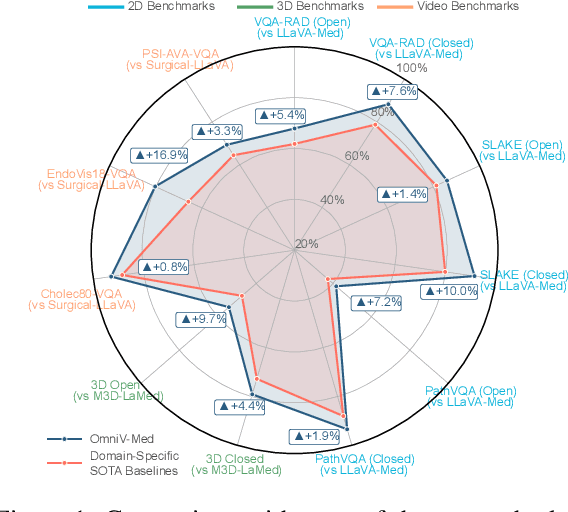
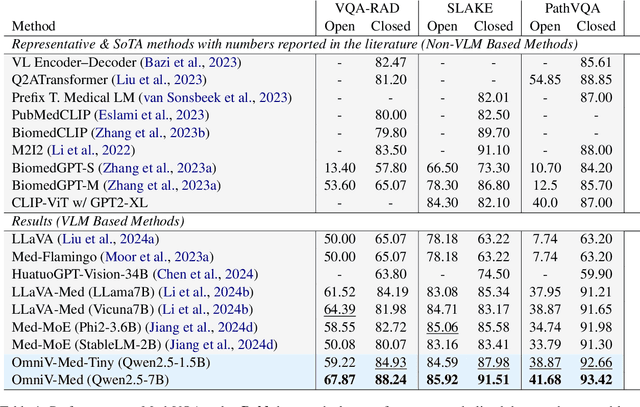
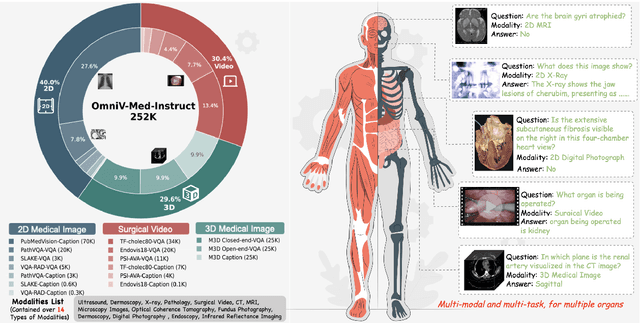
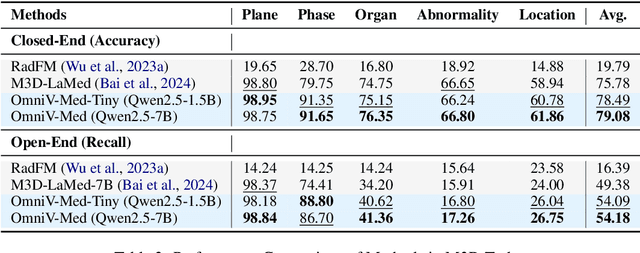
The practical deployment of medical vision-language models (Med-VLMs) necessitates seamless integration of textual data with diverse visual modalities, including 2D/3D images and videos, yet existing models typically employ separate encoders for different modalities. To address this limitation, we present OmniV-Med, a unified framework for multimodal medical understanding. Our technical contributions are threefold: First, we construct OmniV-Med-Instruct, a comprehensive multimodal medical dataset containing 252K instructional samples spanning 14 medical image modalities and 11 clinical tasks. Second, we devise a rotary position-adaptive encoder that processes multi-resolution 2D/3D images and videos within a unified architecture, diverging from conventional modality-specific encoders. Third, we introduce a medical-aware token pruning mechanism that exploits spatial-temporal redundancy in volumetric data (e.g., consecutive CT slices) and medical videos, effectively reducing 60\% of visual tokens without performance degradation. Empirical evaluations demonstrate that OmniV-Med-7B achieves state-of-the-art performance on 7 benchmarks spanning 2D/3D medical imaging and video understanding tasks. Notably, our lightweight variant (OmniV-Med-1.5B) attains comparable performance while requiring only 8 RTX3090 GPUs for training and supporting efficient long-video inference. Data, code and model will be released.
ProtPainter: Draw or Drag Protein via Topology-guided Diffusion
Apr 19, 2025Recent advances in protein backbone generation have achieved promising results under structural, functional, or physical constraints. However, existing methods lack the flexibility for precise topology control, limiting navigation of the backbone space. We present ProtPainter, a diffusion-based approach for generating protein backbones conditioned on 3D curves. ProtPainter follows a two-stage process: curve-based sketching and sketch-guided backbone generation. For the first stage, we propose CurveEncoder, which predicts secondary structure annotations from a curve to parametrize sketch generation. For the second stage, the sketch guides the generative process in Denoising Diffusion Probabilistic Modeling (DDPM) to generate backbones. During this process, we further introduce a fusion scheduling scheme, Helix-Gating, to control the scaling factors. To evaluate, we propose the first benchmark for topology-conditioned protein generation, introducing Protein Restoration Task and a new metric, self-consistency Topology Fitness (scTF). Experiments demonstrate ProtPainter's ability to generate topology-fit (scTF > 0.8) and designable (scTM > 0.5) backbones, with drawing and dragging tasks showcasing its flexibility and versatility.