 Add to Chrome
 Add to Firefox
 Add to Edge
MinerU.Chem: A High-Precision System for Optical Chemical Structure and Reaction Recognition
Aug 05, 2026
In organic chemistry papers and patents, molecular structures, reaction schemes, and experimental conditions are often presented as molecular structure depictions, reaction diagrams, and complex tables or figures. Such information is difficult for general-purpose document parsing systems to directly convert into machine-readable data. This limits data production for organic chemistry knowledge base construction and for AI for Chemistry tasks such as reaction prediction, retrosynthesis, condition recommendation, molecular property prediction, and drug molecule design. This report introduces MinerU-Chem, a document parsing system for organic chemistry literature integrated into the MinerU online platform. Built on top of MinerU's general document parsing pipeline, MinerU-Chem adds five chemistry-specific modules: chemistry relevance filtering, molecular structure detection, molecule identifier extraction, molecular structure recognition, and reaction scheme parsing. Together, these modules convert organic-chemistry-related image regions in documents into a Molecule Summary List and a Reaction Summary List. For molecular structure recognition, MinerU-Chem uses CARBON (Complex Atomic Representation and Bonding Object Notation) as its core representation. CARBON enables recognition results to preserve both the visual layout of the original image and complex chemical semantics, while supporting the export of standard downstream formats such as MolFile and SMILES. On the SMILES-evaluable subset of MolRecBench-Wild (N=2,392), MinerU-Chem's molecular structure recognition module achieves a SMILES exact-match accuracy of 93.02%, outperforming the best evaluated comparison system, GPT-5.6-Sol (74.87%), by 18.15 percentage points. The system has been integrated into the MinerU online platform and is available at https://mineru.net/OpenSourceTools/Extractor .

Creation-MMBench: Assessing Context-Aware Creative Intelligence in MLLM
Mar 19, 2025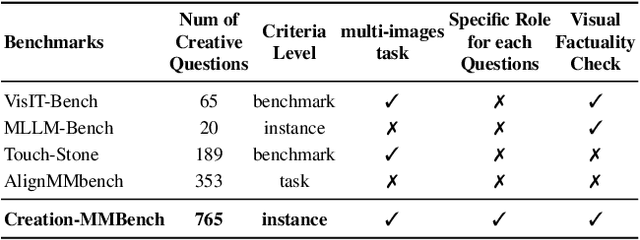
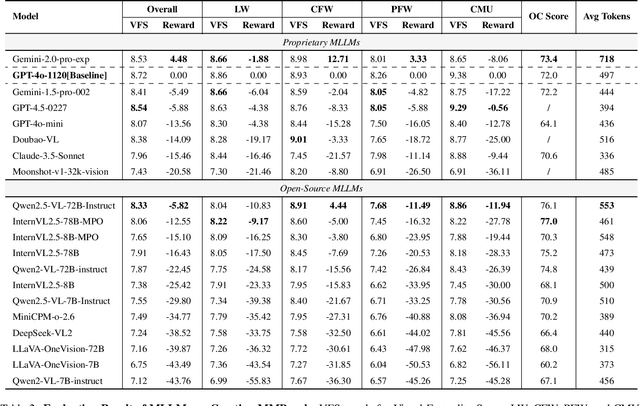
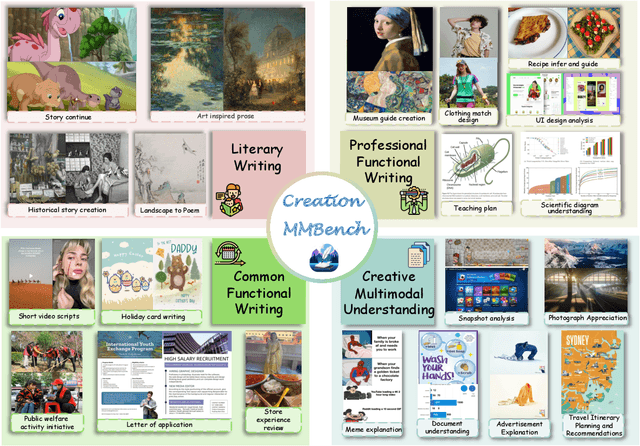
Creativity is a fundamental aspect of intelligence, involving the ability to generate novel and appropriate solutions across diverse contexts. While Large Language Models (LLMs) have been extensively evaluated for their creative capabilities, the assessment of Multimodal Large Language Models (MLLMs) in this domain remains largely unexplored. To address this gap, we introduce Creation-MMBench, a multimodal benchmark specifically designed to evaluate the creative capabilities of MLLMs in real-world, image-based tasks. The benchmark comprises 765 test cases spanning 51 fine-grained tasks. To ensure rigorous evaluation, we define instance-specific evaluation criteria for each test case, guiding the assessment of both general response quality and factual consistency with visual inputs. Experimental results reveal that current open-source MLLMs significantly underperform compared to proprietary models in creative tasks. Furthermore, our analysis demonstrates that visual fine-tuning can negatively impact the base LLM's creative abilities. Creation-MMBench provides valuable insights for advancing MLLM creativity and establishes a foundation for future improvements in multimodal generative intelligence. Full data and evaluation code is released on https://github.com/open-compass/Creation-MMBench.
SPHERE: A Hierarchical Evaluation on Spatial Perception and Reasoning for Vision-Language Models
Dec 17, 2024Current vision-language models may incorporate single-dimensional spatial cues, such as depth, object boundary, and basic spatial directions (e.g. left, right, front, back), yet often lack the multi-dimensional spatial reasoning necessary for human-like understanding and real-world applications. To address this gap, we develop SPHERE (Spatial Perception and Hierarchical Evaluation of REasoning), a hierarchical evaluation framework with a new human-annotated dataset to pinpoint model strengths and weaknesses, advancing from single-skill tasks to multi-skill tasks, and ultimately to complex reasoning tasks that require the integration of multiple spatial and visual cues with logical reasoning. Benchmark evaluation of state-of-the-art open-source models reveal significant shortcomings, especially in the abilities to understand distance and proximity, to reason from both allocentric and egocentric viewpoints, and to perform complex reasoning in a physical context. This work underscores the need for more advanced approaches to spatial understanding and reasoning, paving the way for improvements in vision-language models and their alignment with human-like spatial capabilities. The dataset will be open-sourced upon publication.