 Add to Chrome
 Add to Firefox
 Add to Edge
SAW-INT4: System-Aware 4-Bit KV-Cache Quantization for Real-World LLM Serving
Apr 21, 2026
KV-cache memory is a major bottleneck in real-world LLM serving, where systems must simultaneously support latency-sensitive small-batch requests and high-throughput concurrent workloads. Although many KV-cache compression methods improve offline accuracy or compression ratio, they often violate practical serving constraints such as paged memory layouts, regular memory access, and fused attention execution, limiting their effectiveness in deployment. In this work, we identify the minimal set of 4-bit KV-cache quantization methods that remain viable under these constraints. Our central finding is that a simple design--token-wise INT4 quantization with block-diagonal Hadamard rotation--consistently achieves the best accuracy-efficiency trade-off. Across multiple models and benchmarks, this approach recovers nearly all of the accuracy lost by naive INT4, while more complex methods such as vector quantization and Hessian-aware quantization provide only marginal additional gains once serving compatibility is taken into account. To make this practical, we implement a fused rotation-quantization kernel that integrates directly into paged KV-cache layouts and introduces zero measurable end-to-end overhead, matching plain INT4 throughput across concurrency levels. Our results show that effective KV-cache compression is fundamentally a systems co-design problem: under real serving constraints, lightweight block-diagonal Hadamard rotation is a viable method that delivers near-lossless accuracy without sacrificing serving efficiency.

Introspective Diffusion Language Models
Apr 13, 2026Diffusion language models promise parallel generation, yet still lag behind autoregressive (AR) models in quality. We stem this gap to a failure of introspective consistency: AR models agree with their own generations, while DLMs often do not. We define the introspective acceptance rate, which measures whether a model accepts its previously generated tokens. This reveals why AR training has a structural advantage: causal masking and logit shifting implicitly enforce introspective consistency. Motivated by this observation, we introduce Introspective Diffusion Language Model (I-DLM), a paradigm that retains diffusion-style parallel decoding while inheriting the introspective consistency of AR training. I-DLM uses a novel introspective strided decoding (ISD) algorithm, which enables the model to verify previously generated tokens while advancing new ones in the same forward pass. From a systems standpoint, we build I-DLM inference engine on AR-inherited optimizations and further customize it with a stationary-batch scheduler. To the best of our knowledge, I-DLM is the first DLM to match the quality of its same-scale AR counterpart while outperforming prior DLMs in both model quality and practical serving efficiency across 15 benchmarks. It reaches 69.6 on AIME-24 and 45.7 on LiveCodeBench-v6, exceeding LLaDA-2.1-mini (16B) by more than 26 and 15 points, respectively. Beyond quality, I-DLM is designed for the growing demand of large-concurrency serving, delivering about 3x higher throughput than prior state-of-the-art DLMs.
Squeeze Evolve: Unified Multi-Model Orchestration for Verifier-Free Evolution
Apr 09, 2026We show that verifier-free evolution is bottlenecked by both diversity and efficiency: without external correction, repeated evolution accelerates collapse toward narrow modes, while the uniform use of a high-cost model wastes compute and quickly becomes economically impractical. We introduce Squeeze Evolve, a unified multi-model orchestration framework for verifier-free evolutionary inference. Our approach is guided by a simple principle: allocate model capability where it has the highest marginal utility. Stronger models are reserved for high-impact stages, while cheaper models handle the other stages at much lower costs. This principle addresses diversity and cost-efficiency jointly while remaining lightweight. Squeeze Evolve naturally supports open-source, closed-source, and mixed-model deployments. Across AIME 2025, HMMT 2025, LiveCodeBench V6, GPQA-Diamond, ARC-AGI-V2, and multimodal vision benchmarks, such as MMMU-Pro and BabyVision, Squeeze Evolve consistently improves the cost-capability frontier over single-model evolution and achieves new state-of-the-art results on several tasks. Empirically, Squeeze Evolve reduces API cost by up to $\sim$3$\times$ and increases fixed-budget serving throughput by up to $\sim$10$\times$. Moreover, on discovery tasks, Squeeze Evolve is the first verifier-free evolutionary method to match, and in some cases exceed, the performance of verifier-based evolutionary methods.
CARE: Covariance-Aware and Rank-Enhanced Decomposition for Enabling Multi-Head Latent Attention
Mar 18, 2026Converting pretrained attention modules such as grouped-query attention (GQA) into multi-head latent attention (MLA) can improve expressivity without increasing KV-cache cost, making it attractive for efficient inference. However, many practical conversion baselines rely on weight-only low-rank approximations (e.g., SVD-style initializations) and uniform rank allocation. They focus on minimizing the difference between weight matrices rather than on how those weights affect input activations, ignore the covariance structure of activations, and enforce uniform rank across layers, causing activation drift and degraded attention fidelity. To address these issues, we propose CARE, a Covariance-Aware, Rank-Enhanced MLA conversion pipeline under a fixed KV width. CARE introduces three key steps: (i) activation-preserving factorization, which aligns the approximation with the actual input activations rather than just the weights; (ii) adjusted-rank allocation, which spreads a fixed KV budget across layers by giving more capacity to layers that need it most; and (iii) KV-parity mapping, which reparameterizes the converted K and V to fit the MLA format while keeping the KV-cache size unchanged. Our method outperforms a uniform-rank SVD baseline on Qwen3-4B/30B-A3B-Instruct-2507 and Llama-3.1-8B/70B-Instruct, reducing one-shot perplexity by up to 215x and improving mean accuracy by up to 1.70x at matched KV budgets. With a brief post-SVD healing fine-tune, we fully recover the original model's accuracy.
When RL Meets Adaptive Speculative Training: A Unified Training-Serving System
Feb 06, 2026Speculative decoding can significantly accelerate LLM serving, yet most deployments today disentangle speculator training from serving, treating speculator training as a standalone offline modeling problem. We show that this decoupled formulation introduces substantial deployment and adaptation lag: (1) high time-to-serve, since a speculator must be trained offline for a considerable period before deployment; (2) delayed utility feedback, since the true end-to-end decoding speedup is only known after training and cannot be inferred reliably from acceptance rate alone due to model-architecture and system-level overheads; and (3) domain-drift degradation, as the target model is repurposed to new domains and the speculator becomes stale and less effective. To address these issues, we present Aurora, a unified training-serving system that closes the loop by continuously learning a speculator directly from live inference traces. Aurora reframes online speculator learning as an asynchronous reinforcement-learning problem: accepted tokens provide positive feedback, while rejected speculator proposals provide implicit negative feedback that we exploit to improve sample efficiency. Our design integrates an SGLang-based inference server with an asynchronous training server, enabling hot-swapped speculator updates without service interruption. Crucially, Aurora supports day-0 deployment: a speculator can be served immediately and rapidly adapted to live traffic, improving system performance while providing immediate utility feedback. Across experiments, Aurora achieves a 1.5x day-0 speedup on recently released frontier models (e.g., MiniMax M2.1 229B and Qwen3-Coder-Next 80B). Aurora also adapts effectively to distribution shifts in user traffic, delivering an additional 1.25x speedup over a well-trained but static speculator on widely used models (e.g., Qwen3 and Llama3).
Understanding and Steering the Cognitive Behaviors of Reasoning Models at Test-Time
Dec 31, 2025Large Language Models (LLMs) often rely on long chain-of-thought (CoT) reasoning to solve complex tasks. While effective, these trajectories are frequently inefficient, leading to high latency from excessive token generation, or unstable reasoning that alternates between underthinking (shallow, inconsistent steps) and overthinking (repetitive, verbose reasoning). In this work, we study the structure of reasoning trajectories and uncover specialized attention heads that correlate with distinct cognitive behaviors such as verification and backtracking. By lightly intervening on these heads at inference time, we can steer the model away from inefficient modes. Building on this insight, we propose CREST, a training-free method for Cognitive REasoning Steering at Test-time. CREST has two components: (1) an offline calibration step that identifies cognitive heads and derives head-specific steering vectors, and (2) an inference-time procedure that rotates hidden representations to suppress components along those vectors. CREST adaptively suppresses unproductive reasoning behaviors, yielding both higher accuracy and lower computational cost. Across diverse reasoning benchmarks and models, CREST improves accuracy by up to 17.5% while reducing token usage by 37.6%, offering a simple and effective pathway to faster, more reliable LLM reasoning.
Ladder-residual: parallelism-aware architecture for accelerating large model inference with communication overlapping
Jan 11, 2025


Large language model inference is both memory-intensive and time-consuming, often requiring distributed algorithms to efficiently scale. Various model parallelism strategies are used in multi-gpu training and inference to partition computation across multiple devices, reducing memory load and computation time. However, using model parallelism necessitates communication of information between GPUs, which has been a major bottleneck and limits the gains obtained by scaling up the number of devices. We introduce Ladder Residual, a simple architectural modification applicable to all residual-based models that enables straightforward overlapping that effectively hides the latency of communication. Our insight is that in addition to systems optimization, one can also redesign the model architecture to decouple communication from computation. While Ladder Residual can allow communication-computation decoupling in conventional parallelism patterns, we focus on Tensor Parallelism in this paper, which is particularly bottlenecked by its heavy communication. For a Transformer model with 70B parameters, applying Ladder Residual to all its layers can achieve 30% end-to-end wall clock speed up at inference time with TP sharding over 8 devices. We refer the resulting Transformer model as the Ladder Transformer. We train a 1B and 3B Ladder Transformer from scratch and observe comparable performance to a standard dense transformer baseline. We also show that it is possible to convert parts of the Llama-3.1 8B model to our Ladder Residual architecture with minimal accuracy degradation by only retraining for 3B tokens.
CorDA: Context-Oriented Decomposition Adaptation of Large Language Models
Jun 07, 2024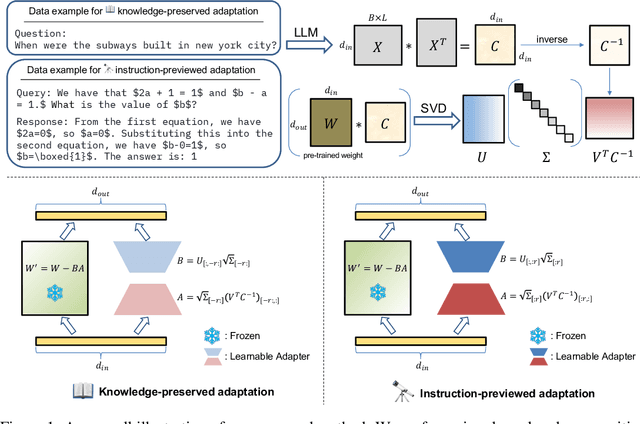
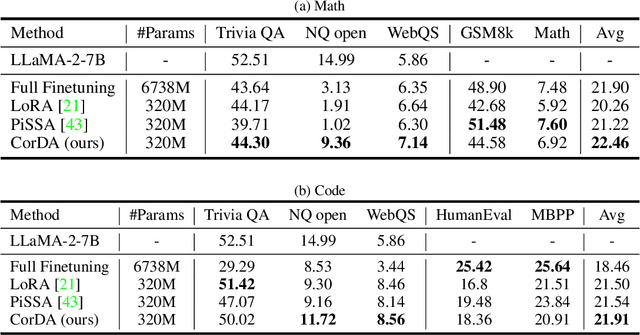
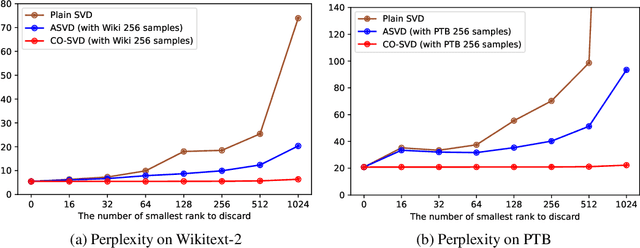
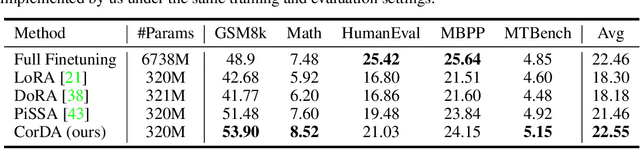
Current parameter-efficient fine-tuning (PEFT) methods build adapters without considering the context of downstream task to learn, or the context of important knowledge to maintain. As a result, there is often a performance gap compared to full-parameter finetuning, and meanwhile the finetuned model suffers from catastrophic forgetting of the pre-trained world knowledge. In this paper, we propose CorDA, a Context-oriented Decomposition Adaptation method that builds learnable adapters from weight decomposition oriented by the context of downstream task or world knowledge. Concretely, we collect a few data samples, and perform singular value decomposition for each linear layer of a pre-trained LLM multiplied by the covariance matrix of the input activation using these samples. By doing so, the context of the representative samples is captured through deciding the factorizing orientation. Our method enables two options, the knowledge-preserved adaptation and the instruction-previewed adaptation. For the former, we use question-answering samples to obtain the covariance matrices, and use the decomposed components with the smallest $r$ singular values to initialize a learnable adapter, with the others frozen such that the world knowledge is better preserved. For the latter, we use the instruction data from the finetuning task, such as math or coding, to orientate the decomposition and train the largest $r$ components that capture the main characteristics of the task to learn. We conduct extensive experiments on Math, Code, and Instruction Following tasks. Our knowledge-preserved adaptation not only achieves better performance than LoRA on finetuning tasks, but also mitigates the forgetting of world knowledge. Our instruction-previewed adaptation is able to further enhance the finetuning performance, surpassing full-parameter finetuning and the state-of-the-art PEFT methods.
FP6-LLM: Efficiently Serving Large Language Models Through FP6-Centric Algorithm-System Co-Design
Jan 25, 2024

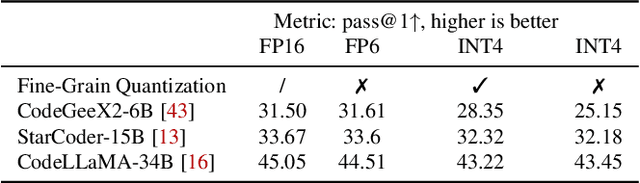

Six-bit quantization (FP6) can effectively reduce the size of large language models (LLMs) and preserve the model quality consistently across varied applications. However, existing systems do not provide Tensor Core support for FP6 quantization and struggle to achieve practical performance improvements during LLM inference. It is challenging to support FP6 quantization on GPUs due to (1) unfriendly memory access of model weights with irregular bit-width and (2) high runtime overhead of weight de-quantization. To address these problems, we propose TC-FPx, the first full-stack GPU kernel design scheme with unified Tensor Core support of float-point weights for various quantization bit-width. We integrate TC-FPx kernel into an existing inference system, providing new end-to-end support (called FP6-LLM) for quantized LLM inference, where better trade-offs between inference cost and model quality are achieved. Experiments show that FP6-LLM enables the inference of LLaMA-70b using only a single GPU, achieving 1.69x-2.65x higher normalized inference throughput than the FP16 baseline. The source code will be publicly available soon.
DeepSpeed4Science Initiative: Enabling Large-Scale Scientific Discovery through Sophisticated AI System Technologies
Oct 11, 2023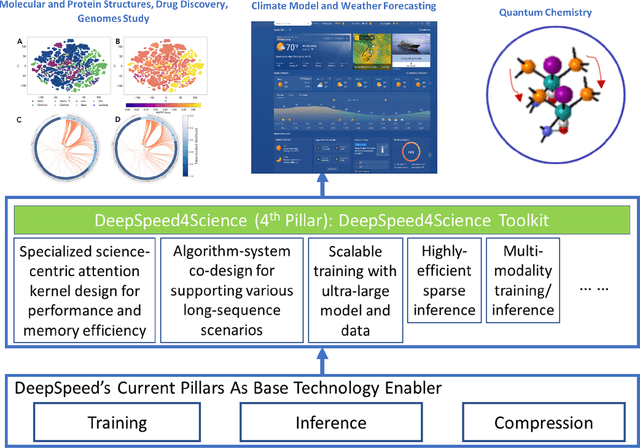
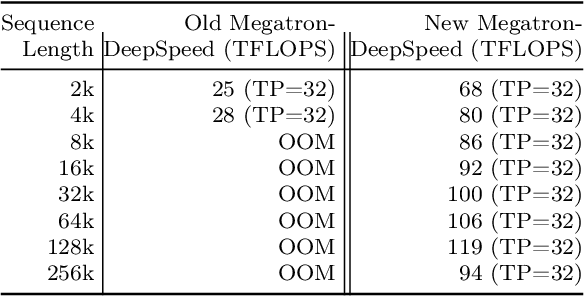
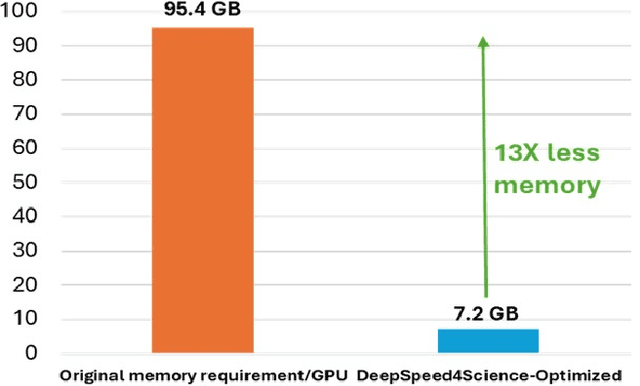
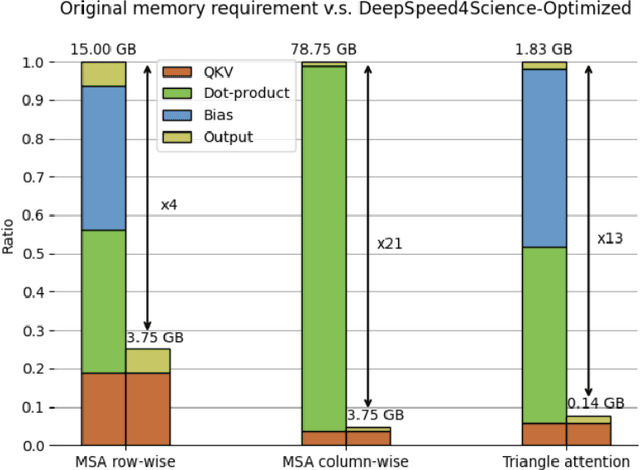
In the upcoming decade, deep learning may revolutionize the natural sciences, enhancing our capacity to model and predict natural occurrences. This could herald a new era of scientific exploration, bringing significant advancements across sectors from drug development to renewable energy. To answer this call, we present DeepSpeed4Science initiative (deepspeed4science.ai) which aims to build unique capabilities through AI system technology innovations to help domain experts to unlock today's biggest science mysteries. By leveraging DeepSpeed's current technology pillars (training, inference and compression) as base technology enablers, DeepSpeed4Science will create a new set of AI system technologies tailored for accelerating scientific discoveries by addressing their unique complexity beyond the common technical approaches used for accelerating generic large language models (LLMs). In this paper, we showcase the early progress we made with DeepSpeed4Science in addressing two of the critical system challenges in structural biology research.