 Add to Chrome
 Add to Firefox
 Add to Edge
Low Light Image Enhancement Challenge at NTIRE 2026
Apr 19, 2026
This paper presents a comprehensive review of the NTIRE 2026 Low Light Image Enhancement Challenge, highlighting the proposed solutions and final results. The objective of this challenge is to identify effective networks capable of producing clearer and visually compelling images in diverse and challenging conditions by learning representative visual cues with the purpose of restoring information loss due to low-contrast and noisy images. A total of 195 participants registered for the first track and 153 for the second track of the competition, and 22 teams ultimately submitted valid entries. This paper thoroughly evaluates the state-of-the-art advances in (joint denoising and) low-light image enhancement, showcasing the significant progress in the field, while leveraging samples of our novel dataset.

Rectified Schrödinger Bridge Matching for Few-Step Visual Navigation
Apr 07, 2026Visual navigation is a core challenge in Embodied AI, requiring autonomous agents to translate high-dimensional sensory observations into continuous, long-horizon action trajectories. While generative policies based on diffusion models and Schrödinger Bridges (SB) effectively capture multimodal action distributions, they require dozens of integration steps due to high-variance stochastic transport, posing a critical barrier for real-time robotic control. We propose Rectified Schrödinger Bridge Matching (RSBM), a framework that exploits a shared velocity-field structure between standard Schrödinger Bridges ($\varepsilon=1$, maximum-entropy transport) and deterministic Optimal Transport ($\varepsilon\to 0$, as in Conditional Flow Matching), controlled by a single entropic regularization parameter $\varepsilon$. We prove two key results: (1) the conditional velocity field's functional form is invariant across the entire $\varepsilon$-spectrum (Velocity Structure Invariance), enabling a single network to serve all regularization strengths; and (2) reducing $\varepsilon$ linearly decreases the conditional velocity variance, enabling more stable coarse-step ODE integration. Anchored to a learned conditional prior that shortens transport distance, RSBM operates at an intermediate $\varepsilon$ that balances multimodal coverage and path straightness. Empirically, while standard bridges require $\geq 10$ steps to converge, RSBM achieves over 94% cosine similarity and 92% success rate in merely 3 integration steps -- without distillation or multi-stage training -- substantially narrowing the gap between high-fidelity generative policies and the low-latency demands of Embodied AI.
SnapFlow: One-Step Action Generation for Flow-Matching VLAs via Progressive Self-Distillation
Apr 07, 2026Vision-Language-Action (VLA) models based on flow matching -- such as pi0, pi0.5, and SmolVLA -- achieve state-of-the-art generalist robotic manipulation, yet their iterative denoising, typically 10 ODE steps, introduces substantial latency: on a modern GPU, denoising alone accounts for 80% of end-to-end inference time. Naively reducing the step count is unreliable, degrading success on most tasks due to the velocity field being uncalibrated for single-step jumps. We present SnapFlow, a plug-and-play self-distillation method that compresses multi-step denoising into a single forward pass (1-NFE) for flow-matching VLAs. SnapFlow mixes standard flow-matching samples with consistency samples whose targets are two-step Euler shortcut velocities computed from the model's own marginal velocity predictions, avoiding the trajectory drift caused by conditional velocities, as we analyze theoretically. A zero-initialized target-time embedding lets the network switch between local velocity estimation and global one-step generation within a single architecture. SnapFlow requires no external teacher, no architecture changes, and trains in ~12h on a single GPU. We validate on two VLA architectures spanning a 6x parameter range, with identical hyperparameters: on pi0.5 (3B) across four LIBERO suites (40 tasks, 400 episodes), SnapFlow achieves 98.75% average success -- matching the 10-step teacher at 97.75% and slightly exceeding it -- with 9.6x denoising speedup and end-to-end latency reduced from 274ms to 83ms; on SmolVLA (500M), it reduces MSE by 8.3% with 3.56x end-to-end acceleration. An action-step sweep on long-horizon tasks reveals that SnapFlow maintains its advantage across execution horizons, achieving 93% at n_act=5 where the baseline reaches only 90%. SnapFlow is orthogonal to layer-distillation and token-pruning approaches, enabling compositional speedups.
Experience is the Best Teacher: Motivating Effective Exploration in Reinforcement Learning for LLMs
Mar 20, 2026Reinforcement Learning (RL) with rubric-based rewards has recently shown remarkable progress in enhancing general reasoning capabilities of Large Language Models (LLMs), yet still suffers from ineffective exploration confined to curent policy distribution. In fact, RL optimization can be viewed as steering the policy toward an ideal distribution that maximizes the rewards, while effective exploration should align efforts with desired target. Leveraging this insight, we propose HeRL, a Hindsight experience guided Reinforcement Learning framework to bootstrap effective exploration by explicitly telling LLMs the desired behaviors specified in rewards. Concretely, HeRL treats failed trajectories along with their unmet rubrics as hindsight experience, which serves as in-context guidance for the policy to explore desired responses beyond its current distribution. Additionally, we introduce a bonus reward to incentivize responses with greater potential for improvement under such guidance. HeRL facilitates effective learning from desired high quality samples without repeated trial-and-error from scratch, yielding a more accurate estimation of the expected gradient theoretically. Extensive experiments across various benchmarks demonstrate that HeRL achieves superior performance gains over baselines, and can further benefit from experience guided self-improvement at test time. Our code is available at https://github.com/sikelifei/HeRL.
Replay Failures as Successes: Sample-Efficient Reinforcement Learning for Instruction Following
Dec 29, 2025Reinforcement Learning (RL) has shown promise for aligning Large Language Models (LLMs) to follow instructions with various constraints. Despite the encouraging results, RL improvement inevitably relies on sampling successful, high-quality responses; however, the initial model often struggles to generate responses that satisfy all constraints due to its limited capabilities, yielding sparse or indistinguishable rewards that impede learning. In this work, we propose Hindsight instruction Replay (HiR), a novel sample-efficient RL framework for complex instruction following tasks, which employs a select-then-rewrite strategy to replay failed attempts as successes based on the constraints that have been satisfied in hindsight. We perform RL on these replayed samples as well as the original ones, theoretically framing the objective as dual-preference learning at both the instruction- and response-level to enable efficient optimization using only a binary reward signal. Extensive experiments demonstrate that the proposed HiR yields promising results across different instruction following tasks, while requiring less computational budget. Our code and dataset is available at https://github.com/sastpg/HIR.
WanJuanSiLu: A High-Quality Open-Source Webtext Dataset for Low-Resource Languages
Jan 24, 2025


This paper introduces the open-source dataset WanJuanSiLu, designed to provide high-quality training corpora for low-resource languages, thereby advancing the research and development of multilingual models. To achieve this, we have developed a systematic data processing framework tailored for low-resource languages. This framework encompasses key stages such as data extraction, corpus cleaning, content deduplication, security filtering, quality evaluation, and theme classification. Through the implementation of this framework, we have significantly improved both the quality and security of the dataset, while maintaining its linguistic diversity. As of now, data for all five languages have been fully open-sourced. The dataset can be accessed at https://opendatalab.com/applyMultilingualCorpus, and GitHub repository is available at https://github.com/opendatalab/WanJuan3.0
OmniCorpus: A Unified Multimodal Corpus of 10 Billion-Level Images Interleaved with Text
Jun 13, 2024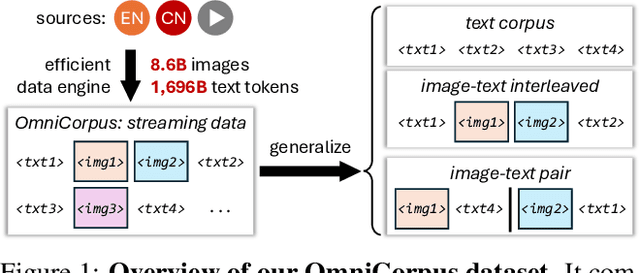


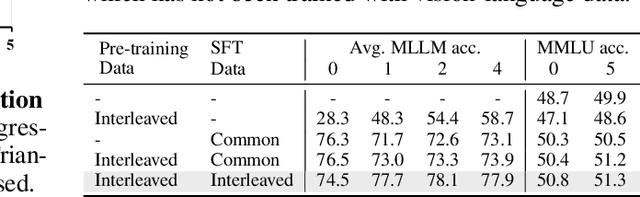
Image-text interleaved data, consisting of multiple images and texts arranged in a natural document format, aligns with the presentation paradigm of internet data and closely resembles human reading habits. Recent studies have shown that such data aids multimodal in-context learning and maintains the capabilities of large language models during multimodal fine-tuning. However, the limited scale and diversity of current image-text interleaved data restrict the development of multimodal large language models. In this paper, we introduce OmniCorpus, a 10 billion-scale image-text interleaved dataset. Using an efficient data engine, we filter and extract large-scale high-quality documents, which contain 8.6 billion images and 1,696 billion text tokens. Compared to counterparts (e.g., MMC4, OBELICS), our dataset 1) has 15 times larger scales while maintaining good data quality; 2) features more diverse sources, including both English and non-English websites as well as video-centric websites; 3) is more flexible, easily degradable from an image-text interleaved format to pure text corpus and image-text pairs. Through comprehensive analysis and experiments, we validate the quality, usability, and effectiveness of the proposed dataset. We hope this could provide a solid data foundation for future multimodal model research. Code and data are released at https://github.com/OpenGVLab/OmniCorpus.
OmniCorpus: An Unified Multimodal Corpus of 10 Billion-Level Images Interleaved with Text
Jun 12, 2024Image-text interleaved data, consisting of multiple images and texts arranged in a natural document format, aligns with the presentation paradigm of internet data and closely resembles human reading habits. Recent studies have shown that such data aids multimodal in-context learning and maintains the capabilities of large language models during multimodal fine-tuning. However, the limited scale and diversity of current image-text interleaved data restrict the development of multimodal large language models. In this paper, we introduce OmniCorpus, a 10 billion-scale image-text interleaved dataset. Using an efficient data engine, we filter and extract large-scale high-quality documents, which contain 8.6 billion images and 1,696 billion text tokens. Compared to counterparts (e.g., MMC4, OBELICS), our dataset 1) has 15 times larger scales while maintaining good data quality; 2) features more diverse sources, including both English and non-English websites as well as video-centric websites; 3) is more flexible, easily degradable from an image-text interleaved format to pure text corpus and image-text pairs. Through comprehensive analysis and experiments, we validate the quality, usability, and effectiveness of the proposed dataset. We hope this could provide a solid data foundation for future multimodal model research. Code and data are released at https://github.com/OpenGVLab/OmniCorpus.
How Far Are We to GPT-4V? Closing the Gap to Commercial Multimodal Models with Open-Source Suites
Apr 29, 2024
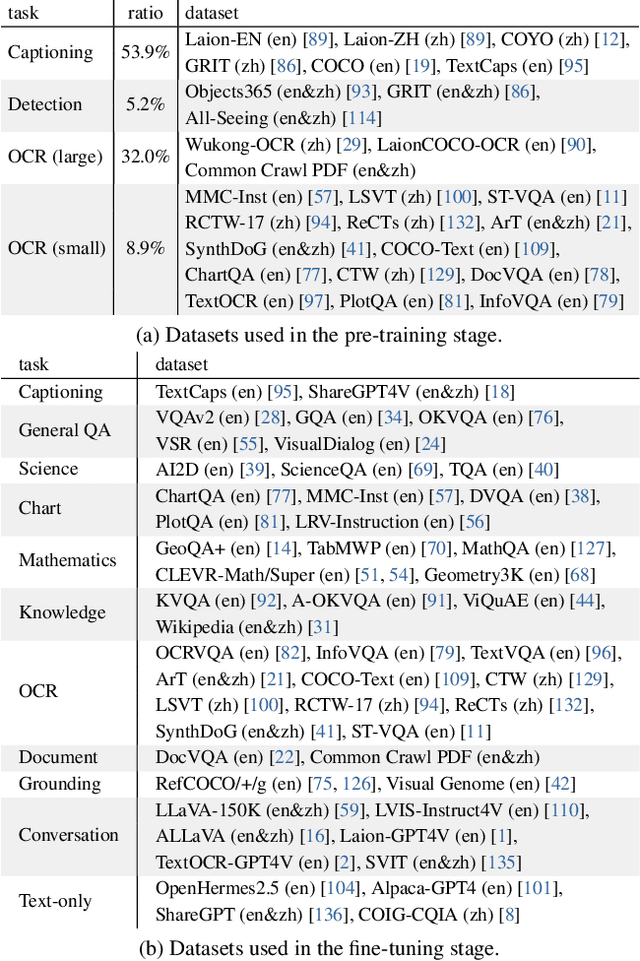
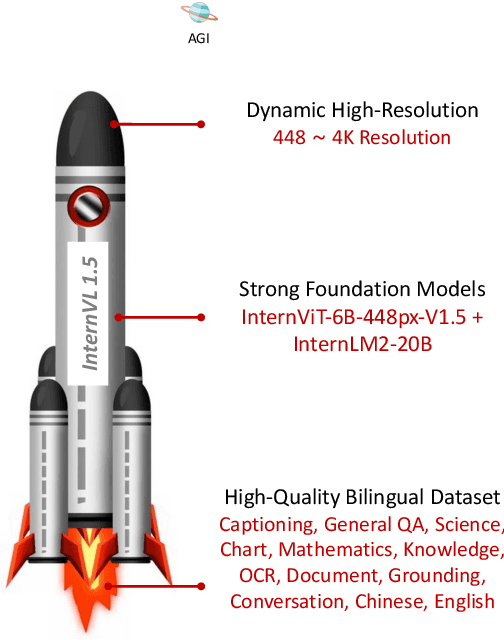
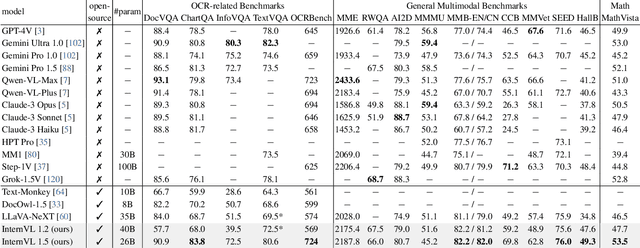
In this report, we introduce InternVL 1.5, an open-source multimodal large language model (MLLM) to bridge the capability gap between open-source and proprietary commercial models in multimodal understanding. We introduce three simple improvements: (1) Strong Vision Encoder: we explored a continuous learning strategy for the large-scale vision foundation model -- InternViT-6B, boosting its visual understanding capabilities, and making it can be transferred and reused in different LLMs. (2) Dynamic High-Resolution: we divide images into tiles ranging from 1 to 40 of 448$\times$448 pixels according to the aspect ratio and resolution of the input images, which supports up to 4K resolution input. (3) High-Quality Bilingual Dataset: we carefully collected a high-quality bilingual dataset that covers common scenes, document images, and annotated them with English and Chinese question-answer pairs, significantly enhancing performance in OCR- and Chinese-related tasks. We evaluate InternVL 1.5 through a series of benchmarks and comparative studies. Compared to both open-source and proprietary models, InternVL 1.5 shows competitive performance, achieving state-of-the-art results in 8 of 18 benchmarks. Code has been released at https://github.com/OpenGVLab/InternVL.
InternLM2 Technical Report
Mar 26, 2024


The evolution of Large Language Models (LLMs) like ChatGPT and GPT-4 has sparked discussions on the advent of Artificial General Intelligence (AGI). However, replicating such advancements in open-source models has been challenging. This paper introduces InternLM2, an open-source LLM that outperforms its predecessors in comprehensive evaluations across 6 dimensions and 30 benchmarks, long-context modeling, and open-ended subjective evaluations through innovative pre-training and optimization techniques. The pre-training process of InternLM2 is meticulously detailed, highlighting the preparation of diverse data types including text, code, and long-context data. InternLM2 efficiently captures long-term dependencies, initially trained on 4k tokens before advancing to 32k tokens in pre-training and fine-tuning stages, exhibiting remarkable performance on the 200k ``Needle-in-a-Haystack" test. InternLM2 is further aligned using Supervised Fine-Tuning (SFT) and a novel Conditional Online Reinforcement Learning from Human Feedback (COOL RLHF) strategy that addresses conflicting human preferences and reward hacking. By releasing InternLM2 models in different training stages and model sizes, we provide the community with insights into the model's evolution.