 Add to Chrome
 Add to Firefox
 Add to Edge
Do You See What You Draw? A Semantic Closed-Loop Framework for Holistic Evaluation of Unified Multimodal Models
Aug 12, 2026
As Large Vision-Language Models increasingly aim to integrate visual generation and understanding within a single parameter space, evaluating such structural unification in a cohesive manner remains a critical challenge. Current evaluation protocols predominantly treat generative and discriminative capabilities as separate tasks, leaving a gap in system-level evaluation for unified multimodal models (UMMs). In this work, we propose Self-Generative-Understanding (SGU), a novel, annotation-free evaluation framework that probes the integrated capabilities of unified models through a semantic closed-loop challenge. Without requiring new annotations, SGU leverages the dual understanding-and-generation abilities of UMMs by asking them to first perceive an image and produce a textual description, subsequently reconstruct a visual context based on that description, and finally perform reasoning over the self-generated output. This pipeline provides a zero-cost testbed that yields an integrated performance score specifically tailored for evaluating UMMs as unified systems. Extensive experiments show that even high-performing UMMs often struggle to reason over their own generated contexts, revealing limitations that are not captured by separate evaluations of understanding or generation alone. Our work provides a complementary holistic evaluation framework and offers a foundation for benchmarking the development of next-generation unified multimodal models.

Beyond Gene Reconstruction: Learning Cell Representations through Complementary Transcriptomic Views
Aug 02, 2026The rapid growth of single-cell transcriptomic data has enabled the development of foundation models pretrained primarily by reconstructing masked expression values. This objective encourages these models to learn gene dependencies but does not directly optimize whole-cell representations, which are essential for many downstream tasks. To bridge this gap, we propose a contrastive pretraining framework that learns cell representations through complementary transcriptomic views. Since standard contrastive learning is not readily applicable to single-cell pretraining, we introduce specific adaptations along three dimensions --- co-expression-guided gene partitioning, expression-aware contrast-set construction, and competence-gated contrastive onset. Specifically, we first construct two complementary views of each cell by partitioning its genes according to their co-expression structure. Then, to prevent the model from using gene-set identity as a shortcut, we construct hard negatives by permuting expression values while keeping gene identities unchanged. Finally, we introduce a competence-aware controller to determine how the contrastive objective is applied. Experiments on cell-type annotation and gene regulatory network inference demonstrate competitive transfer under the evaluated protocols. In the six-network GRN evaluation, our method records the highest mean AUROC and AUPRC point estimates among the compared variants, while the highest-scoring variant differs across individual networks. These results establish complementary-view contrastive learning as an effective direction for single-cell pretraining beyond gene reconstruction.
A Reconstruction-Based Framework for Caption Evaluation Beyond Reference Captions
Jul 25, 2026Image captioning is a primary task in vision--language research, yet assessing how faithfully a caption preserves image semantics without relying on reference captions remains unsettled. Prevailing evaluations rely on human-annotated references, whose content reflects annotator intent and captioning proficiency. In this paper, we study a reconstruction-based principle for caption evaluation: a caption is as good as its capacity to enable reconstruction of the original image. However, because captioning inherently compresses visual information, it is impossible to recover all details, and pixel-wise comparison between reconstructed and source images is neither feasible nor meaningful. Through our in-depth analysis of the nature of captions, whose fundamental purpose is to transmit the semantic content of an image, we propose a revised principle: a caption is as good as its capacity to enable a reconstruction that is semantically equivalent to the original. To assess semantic equivalence, we test whether the reconstruction matches the original image across a suite of downstream vision--language tasks, yielding a reference-free, task-conditioned caption score. We characterize component-dependent limitations and introduce the lower-cost Captioning Turing Test Dataset (CTTD) surrogate.
AgentMeter: Evaluating Model-CLI Matching for CLI-Based Local Task-Solving Agents
Jun 19, 2026LLM agents increasingly solve local tasks through command-line and CLI-based harness interfaces, including code editing, repository inspection, data analysis, and file workflows. Existing evaluations often emphasize task success, but deployed local agents are not models alone: the CLI mediates prompts, context replay, tool outputs, file access, terminal observations, and stopping behavior. As a result, the same model can produce different success, token, and cost profiles under different CLIs. We introduce AGENTMETER, a benchmark for evaluating model-CLI matching in CLI-mediated local task-solving agents, together with AgentMeter Score (AMS), a success-anchored, cost-aware metric over calibrated task-effort tiers. AgentMeter uses Benchmark90 as the full validation set and Core30 as a lower-cost subset for expanded comparison across 24 complete model-CLI configurations. On Core30, common deployment criteria select different configurations: highest Pass/30 selects GLM-5.1 with qwen-coder, lowest Tok./Pass selects GPT-5.3-Codex with kimi-cli, lowest billable USD/Pass selects Qwen3.6+ with Codex, while highest AMS selects Qwen3.6+ with kimi-cli. Benchmark90 validation preserves the Top-1 configuration and Top-3 set, with Spearman correlation 0.765, Kendall correlation 0.567, and AMS MAE 0.0383. These results show that model choice and CLI choice should not be decoupled, and that model-CLI configurations should be evaluated as the deployed unit.
Long-CODE: Isolating Pure Long-Context as an Orthogonal Dimension in Video Evaluation
Apr 19, 2026As video generation models achieve unprecedented capabilities, the demand for robust video evaluation metrics becomes increasingly critical. Traditional metrics are intrinsically tailored for short-video evaluation, predominantly assessing frame-level visual quality and localized temporal smoothness. However, as state-of-the-art video generation models scale to generate longer videos, these metrics fail to capture essential long-range characteristics, such as narrative richness and global causal consistency. Recognizing that short-term visual perception and long-context attributes are fundamentally orthogonal dimensions, we argue that long-video metrics should be disentangled from short-video assessments. In this paper, we focus on the rigorous justification and design of a dedicated framework for long-video evaluation. We first introduce a suite of long-video attribute corruption tests, exposing the critical limitations of existing hort-video metrics from their insensitivity to structural inconsistencies, such as shot-level perturbations and narrative shuffling. To bridge this gap, we design a novel long-video metric based on shot dynamics, which is highly sensitive to the long-range testing framework. Furthermore, we introduce Long-CODE (Long-Context as an Orthogonal Dimension for video Evaluation), a specialized dataset designed to benchmark long-video evaluation, with human annotations isolated specifically to genuine long-range characteristics. Extensive experiments show that our proposed metrics achieve state-of-the-art correlation with human judgments. Ultimately, our metric and benchmark seamlessly complement existing short-video standards, establishing a holistic and unbiased evaluation paradigm for video generation models.
Experience is the Best Teacher: Motivating Effective Exploration in Reinforcement Learning for LLMs
Mar 20, 2026Reinforcement Learning (RL) with rubric-based rewards has recently shown remarkable progress in enhancing general reasoning capabilities of Large Language Models (LLMs), yet still suffers from ineffective exploration confined to curent policy distribution. In fact, RL optimization can be viewed as steering the policy toward an ideal distribution that maximizes the rewards, while effective exploration should align efforts with desired target. Leveraging this insight, we propose HeRL, a Hindsight experience guided Reinforcement Learning framework to bootstrap effective exploration by explicitly telling LLMs the desired behaviors specified in rewards. Concretely, HeRL treats failed trajectories along with their unmet rubrics as hindsight experience, which serves as in-context guidance for the policy to explore desired responses beyond its current distribution. Additionally, we introduce a bonus reward to incentivize responses with greater potential for improvement under such guidance. HeRL facilitates effective learning from desired high quality samples without repeated trial-and-error from scratch, yielding a more accurate estimation of the expected gradient theoretically. Extensive experiments across various benchmarks demonstrate that HeRL achieves superior performance gains over baselines, and can further benefit from experience guided self-improvement at test time. Our code is available at https://github.com/sikelifei/HeRL.
Spatial Transcriptomics as Images for Large-Scale Pretraining
Mar 18, 2026Spatial Transcriptomics (ST) profiles thousands of gene expression values at discrete spots with precise coordinates on tissue sections, preserving spatial context essential for clinical and pathological studies. With rising sequencing throughput and advancing platforms, the expanding data volumes motivate large-scale ST pretraining. However, the fundamental unit for pretraining, i.e., what constitutes a single training sample, remains ill-posed. Existing choices fall into two camps: (1) treating each spot as an independent sample, which discards spatial dependencies and collapses ST into single-cell transcriptomics; and (2) treating an entire slide as a single sample, which produces prohibitively large inputs and drastically fewer training examples, undermining effective pretraining. To address this gap, we propose treating spatial transcriptomics as croppable images. Specifically, we define a multi-channel image representation with fixed spatial size by cropping patches from raw slides, thereby preserving spatial context while substantially increasing the number of training samples. Along the channel dimension, we define gene subset selection rules to control input dimensionality and improve pretraining stability. Extensive experiments show that the proposed image-like dataset construction for ST pretraining consistently improves downstream performance, outperforming conventional pretraining schemes. Ablation studies verify that both spatial patching and channel design are necessary, establishing a unified, practical paradigm for organizing ST data and enabling large-scale pretraining.
Scaling Test-Time Robustness of Vision-Language Models via Self-Critical Inference Framework
Mar 08, 2026The emergence of Large Language Models (LLMs) has driven rapid progress in multi-modal learning, particularly in the development of Large Vision-Language Models (LVLMs). However, existing LVLM training paradigms place excessive reliance on the LLM component, giving rise to two critical robustness challenges: language bias and language sensitivity. To address both issues simultaneously, we propose a novel Self-Critical Inference (SCI) framework that extends Visual Contrastive Decoding by conducting multi-round counterfactual reasoning through both textual and visual perturbations. This process further introduces a new strategy for improving robustness by scaling the number of counterfactual rounds. Moreover, we also observe that failure cases of LVLMs differ significantly across models, indicating that fixed robustness benchmarks may not be able to capture the true reliability of LVLMs. To this end, we propose the Dynamic Robustness Benchmark (DRBench), a model-specific evaluation framework targeting both language bias and sensitivity issues. Extensive experiments show that SCI consistently outperforms baseline methods on DRBench, and that increasing the number of inference rounds further boosts robustness beyond existing single-step counterfactual reasoning methods.
CCCaption: Dual-Reward Reinforcement Learning for Complete and Correct Image Captioning
Feb 25, 2026Image captioning remains a fundamental task for vision language understanding, yet ground-truth supervision still relies predominantly on human-annotated references. Because human annotations reflect subjective preferences and expertise, ground-truth captions are often incomplete or even incorrect, which in turn limits caption models. We argue that caption quality should be assessed by two objective aspects: completeness (does the caption cover all salient visual facts?) and correctness (are the descriptions true with respect to the image?). To this end, we introduce CCCaption: a dual-reward reinforcement learning framework with a dedicated fine-tuning corpus that explicitly optimizes these properties to generate \textbf{C}omplete and \textbf{C}orrect \textbf{Captions}. For completeness, we use diverse LVLMs to disentangle the image into a set of visual queries, and reward captions that answer more of these queries, with a dynamic query sampling strategy to improve training efficiency. For correctness, we penalize captions that contain hallucinations by validating the authenticity of sub-caption queries, which are derived from the caption decomposition. Our symmetric dual-reward optimization jointly maximizes completeness and correctness, guiding models toward captions that better satisfy these objective criteria. Extensive experiments across standard captioning benchmarks show consistent improvements, offering a principled path to training caption models beyond human-annotation imitation.
Gene Incremental Learning for Single-Cell Transcriptomics
Nov 14, 2025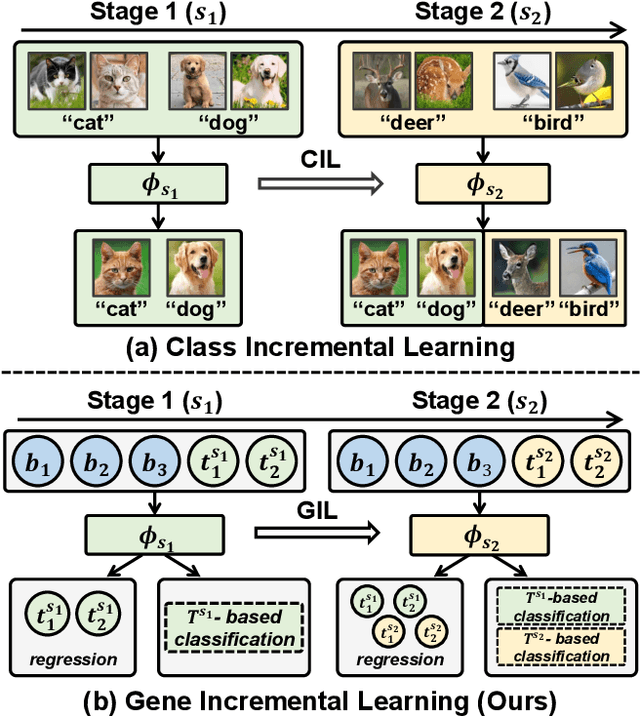
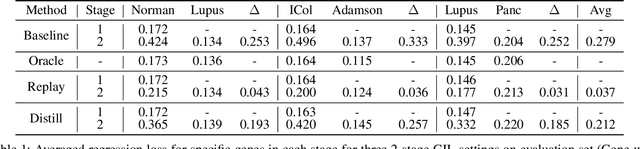
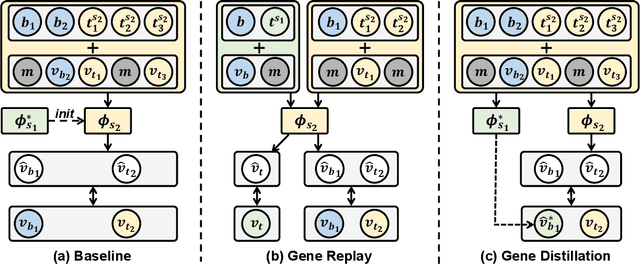
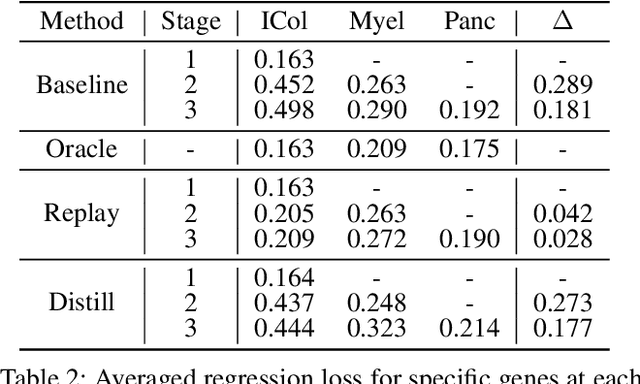
Classes, as fundamental elements of Computer Vision, have been extensively studied within incremental learning frameworks. In contrast, tokens, which play essential roles in many research fields, exhibit similar characteristics of growth, yet investigations into their incremental learning remain significantly scarce. This research gap primarily stems from the holistic nature of tokens in language, which imposes significant challenges on the design of incremental learning frameworks for them. To overcome this obstacle, in this work, we turn to a type of token, gene, for a large-scale biological dataset--single-cell transcriptomics--to formulate a pipeline for gene incremental learning and establish corresponding evaluations. We found that the forgetting problem also exists in gene incremental learning, thus we adapted existing class incremental learning methods to mitigate the forgetting of genes. Through extensive experiments, we demonstrated the soundness of our framework design and evaluations, as well as the effectiveness of our method adaptations. Finally, we provide a complete benchmark for gene incremental learning in single-cell transcriptomics.