 Add to Chrome
 Add to Firefox
 Add to Edge
Low Light Image Enhancement Challenge at NTIRE 2026
Apr 19, 2026
This paper presents a comprehensive review of the NTIRE 2026 Low Light Image Enhancement Challenge, highlighting the proposed solutions and final results. The objective of this challenge is to identify effective networks capable of producing clearer and visually compelling images in diverse and challenging conditions by learning representative visual cues with the purpose of restoring information loss due to low-contrast and noisy images. A total of 195 participants registered for the first track and 153 for the second track of the competition, and 22 teams ultimately submitted valid entries. This paper thoroughly evaluates the state-of-the-art advances in (joint denoising and) low-light image enhancement, showcasing the significant progress in the field, while leveraging samples of our novel dataset.

Decoder-Free Distillation for Quantized Image Restoration
Mar 10, 2026Quantization-Aware Training (QAT), combined with Knowledge Distillation (KD), holds immense promise for compressing models for edge deployment. However, joint optimization for precision-sensitive image restoration (IR) to recover visual quality from degraded images remains largely underexplored. Directly adapting QAT-KD to low-level vision reveals three critical bottlenecks: teacher-student capacity mismatch, spatial error amplification during decoder distillation, and an optimization "tug-of-war" between reconstruction and distillation losses caused by quantization noise. To tackle these, we introduce Quantization-aware Distilled Restoration (QDR), a framework for edge-deployed IR. QDR eliminates capacity mismatch via FP32 self-distillation and prevents error amplification through Decoder-Free Distillation (DFD), which corrects quantization errors strictly at the network bottleneck. To stabilize the optimization tug-of-war, we propose a Learnable Magnitude Reweighting (LMR) that dynamically balances competing gradients. Finally, we design an Edge-Friendly Model (EFM) featuring a lightweight Learnable Degradation Gating (LDG) to dynamically modulate spatial degradation localization. Extensive experiments across four IR tasks demonstrate that our Int8 model recovers 96.5% of FP32 performance, achieves 442 frames per second (FPS) on an NVIDIA Jetson Orin, and boosts downstream object detection by 16.3 mAP
The Tenth NTIRE 2025 Image Denoising Challenge Report
Apr 16, 2025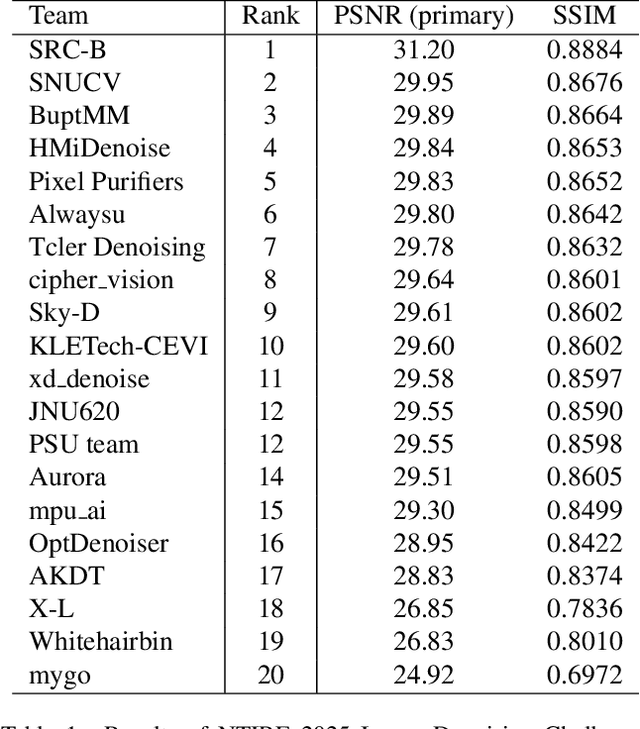
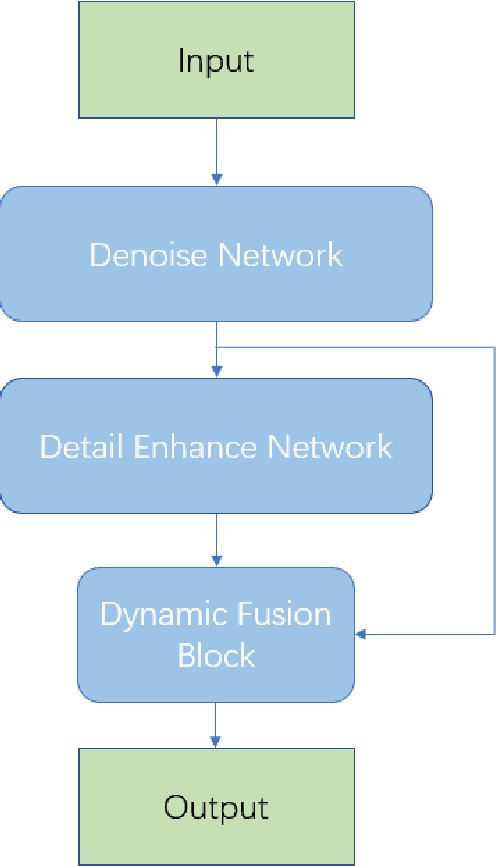
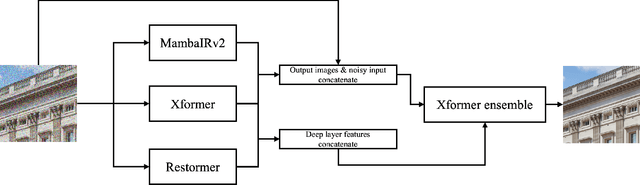
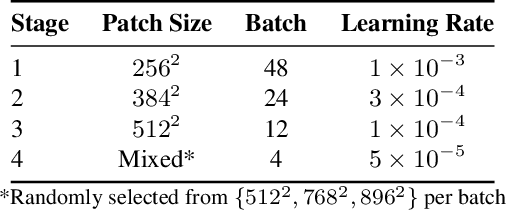
This paper presents an overview of the NTIRE 2025 Image Denoising Challenge ({\sigma} = 50), highlighting the proposed methodologies and corresponding results. The primary objective is to develop a network architecture capable of achieving high-quality denoising performance, quantitatively evaluated using PSNR, without constraints on computational complexity or model size. The task assumes independent additive white Gaussian noise (AWGN) with a fixed noise level of 50. A total of 290 participants registered for the challenge, with 20 teams successfully submitting valid results, providing insights into the current state-of-the-art in image denoising.
Illuminating Darkness: Enhancing Real-world Low-light Scenes with Smartphone Images
Mar 10, 2025Digital cameras often struggle to produce plausible images in low-light conditions. Improving these single-shot images remains challenging due to a lack of diverse real-world pair data samples. To address this limitation, we propose a large-scale high-resolution (i.e., beyond 4k) pair Single-Shot Low-Light Enhancement (SLLIE) dataset. Our dataset comprises 6,425 unique focus-aligned image pairs captured with smartphone sensors in dynamic settings under challenging lighting conditions (0.1--200 lux), covering various indoor and outdoor scenes with varying noise and intensity. We extracted and refined around 180,000 non-overlapping patches from 6,025 collected scenes for training while reserving 400 pairs for benchmarking. In addition to that, we collected 2,117 low-light scenes from different sources for extensive real-world aesthetic evaluation. To our knowledge, this is the largest real-world dataset available for SLLIE research. We also propose learning luminance-chrominance (LC) attributes separately through a tuning fork-shaped transformer model to enhance real-world low-light images, addressing challenges like denoising and over-enhancement in complex scenes. We also propose an LC cross-attention block for feature fusion, an LC refinement block for enhanced reconstruction, and LC-guided supervision to ensure perceptually coherent enhancements. We demonstrated our method's effectiveness across various hardware and scenarios, proving its practicality in real-world applications. Code and dataset available at https://github.com/sharif-apu/LSD-TFFormer.
A Secure Healthcare 5.0 System Based on Blockchain Technology Entangled with Federated Learning Technique
Sep 16, 2022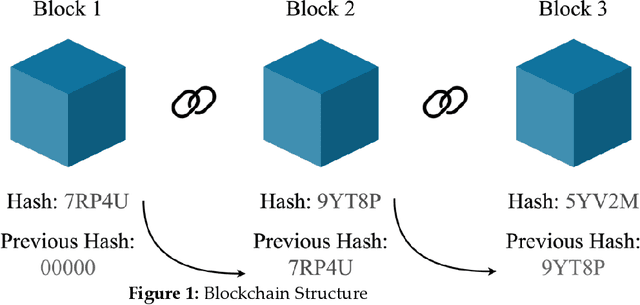
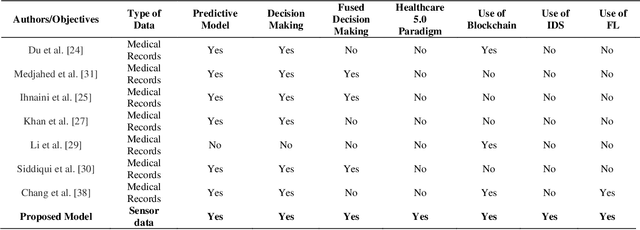
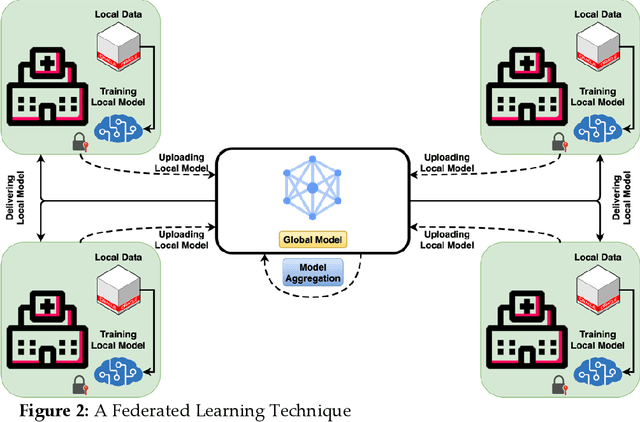
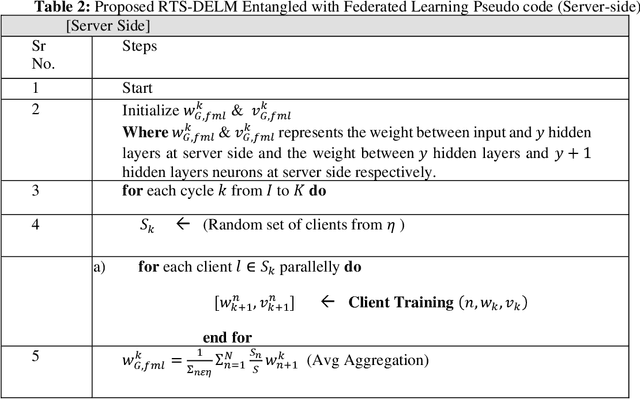
In recent years, the global Internet of Medical Things (IoMT) industry has evolved at a tremendous speed. Security and privacy are key concerns on the IoMT, owing to the huge scale and deployment of IoMT networks. Machine learning (ML) and blockchain (BC) technologies have significantly enhanced the capabilities and facilities of healthcare 5.0, spawning a new area known as "Smart Healthcare." By identifying concerns early, a smart healthcare system can help avoid long-term damage. This will enhance the quality of life for patients while reducing their stress and healthcare costs. The IoMT enables a range of functionalities in the field of information technology, one of which is smart and interactive health care. However, combining medical data into a single storage location to train a powerful machine learning model raises concerns about privacy, ownership, and compliance with greater concentration. Federated learning (FL) overcomes the preceding difficulties by utilizing a centralized aggregate server to disseminate a global learning model. Simultaneously, the local participant keeps control of patient information, assuring data confidentiality and security. This article conducts a comprehensive analysis of the findings on blockchain technology entangled with federated learning in healthcare. 5.0. The purpose of this study is to construct a secure health monitoring system in healthcare 5.0 by utilizing a blockchain technology and Intrusion Detection System (IDS) to detect any malicious activity in a healthcare network and enables physicians to monitor patients through medical sensors and take necessary measures periodically by predicting diseases.